

Sony has filed a patent for a game controller that ditches the fixed layout used on every mainstream PlayStation pad. The design centers on magnetic modules that slot onto a grid, a small touchscreen where the DualSense touchpad normally sits, and a rotating dial for moving through menus. The filing was published on July 16, 2026 under the number US-20260199776-A1.
Quick answer: The patent covers a modular controller built on a four-by-seven magnetic grid. Thumbsticks, directional controls, and a touchscreen module can each be detached and repositioned on that grid, while a rotating dial handles menu navigation and notifications. Sony has not confirmed it for the PS6 or any product.
Magnetic modules and the four-by-seven grid
The core idea is a controller body that acts as a base for interchangeable input modules. A four-by-seven magnetic grid holds each piece in place and lets you move it. Analog sticks, the directional pad, face buttons, and the display itself can all be pulled off and set down in a different spot.
Sony frames this around personal preference. Players want different components in different positions, so the layout can be rebuilt to fit a specific grip or a specific game. Someone who never uses two sticks in a certain title could swap in extra buttons instead. The familiar gamepad shape stays intact, which keeps it closer to a standard controller than fully open-ended modular pads.
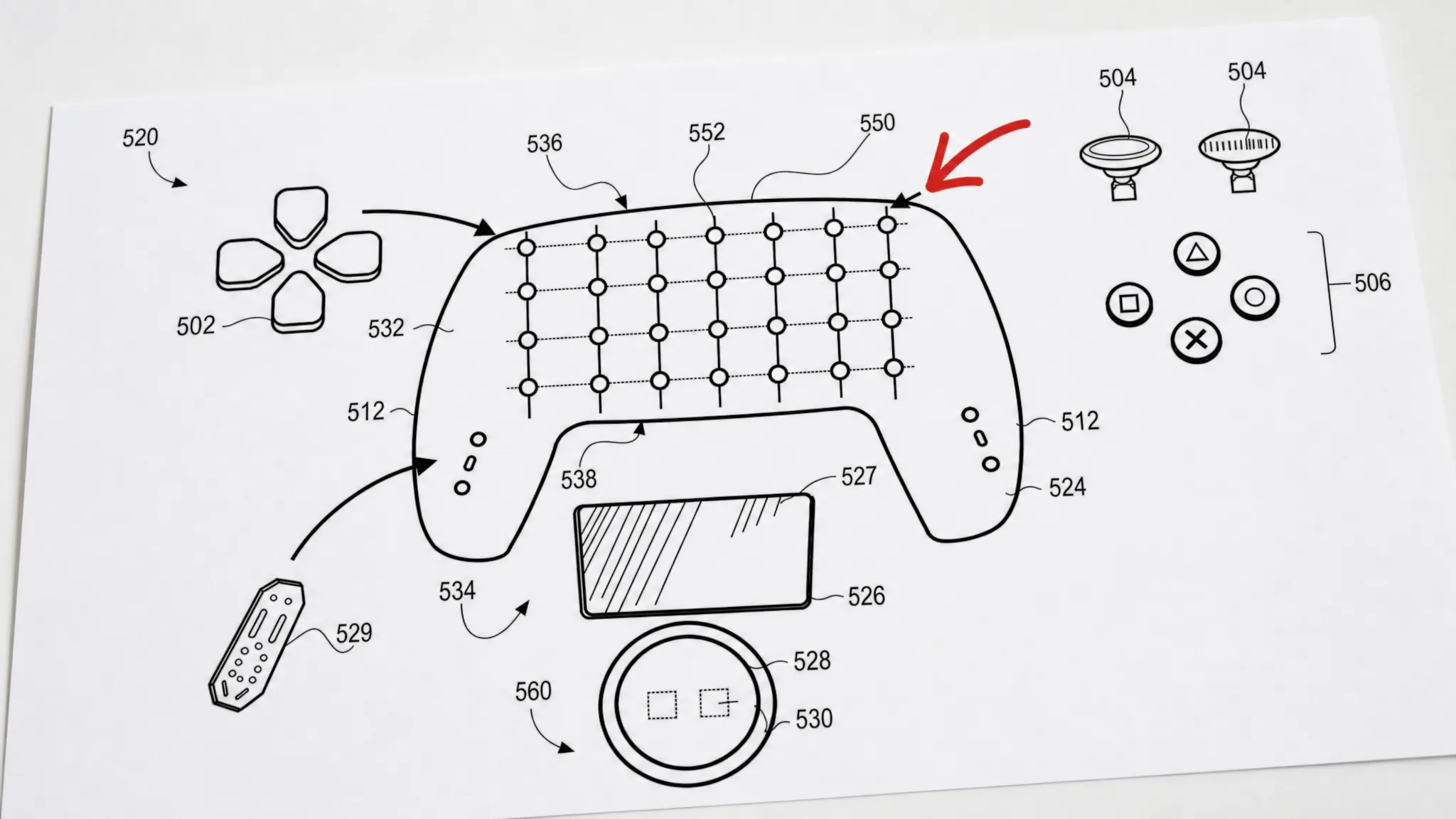
The stated benefit is accessibility as much as customization. By letting people rearrange inputs, the design can adapt to the physical needs of the hand using it, extending the thinking behind the PS5 Access controller into a more conventional pad. The main practical hurdle is keeping the magnetic modules firmly attached during intense gameplay.
The touchscreen module and rotating dial
In place of the DualSense touchpad, the patent puts a full-color touchscreen. It presents selectable icons for controlling and navigating the console interface, and it responds to both standard touch gestures and a physical press, similar to tapping and clicking a phone screen.
On the opposite side of the screen sits a dedicated rotating dial. Turning it scrolls through menus without interrupting play, and pressing it confirms a selection. That covers the console interface, audio settings, and incoming messages. The dial gives you a way to reach these features without lifting your thumbs off the sticks.
| Element | Function described |
|---|---|
| Magnetic grid | Four-by-seven base that holds and repositions modules |
| Input modules | Thumbsticks, directional controls, buttons that detach and move |
| Touchscreen | Menus, settings, messages, and notifications via touch or click |
| Rotating dial | Scrolls menus by turning, confirms by pressing |
Phone pairing and in-game notifications
The display is also meant to surface notifications directly on the controller. It can show PSN app messages, settings, and system alerts in one place. The patent goes further and mentions phone pairing, with incoming calls and text messages potentially appearing on the controller screen.
Interacting with one of these alerts is designed to pause the running game automatically. In a single-player title, answering a call through the touchscreen would freeze the action until you return. That behavior would have little value in online games like Fortnite or a live shooter, where a match cannot simply be paused. Exactly how pairing and call handling would work in practice is not spelled out.
Is this the PS6 controller?
Nothing here is confirmed hardware. The concept currently exists only as patent documentation and schematic drawings, and Sony has made no announcement about a release date or mass production. Companies file patents constantly, and many never turn into products.
Because the design references use across multiple devices, it could end up tied to the PS6, a later console, a handheld system, or a specialized accessibility pad. The PS6 itself remains unfinished on the business side, with its release date and price not yet locked in. Treat the touchscreen and modular grid as ideas Sony is protecting, not as settled features of the next controller.