

Unity 7 is the next major version of the Unity Editor and runtime, built for a faster, more open development workflow. It carries forward everything from Unity 6 while adding real-time global illumination, a modern CoreCLR core, external collaboration tools, and new monetization features. The engine was revealed at Unite Seoul, with a public roadmap covering beta and launch timing.
Quick answer: Unity 7 enters beta in December 2026 and reaches full release in Q1 2027 (by the end of March). Projects built in Unity 6 move to Unity 7 with no rebuilding required.
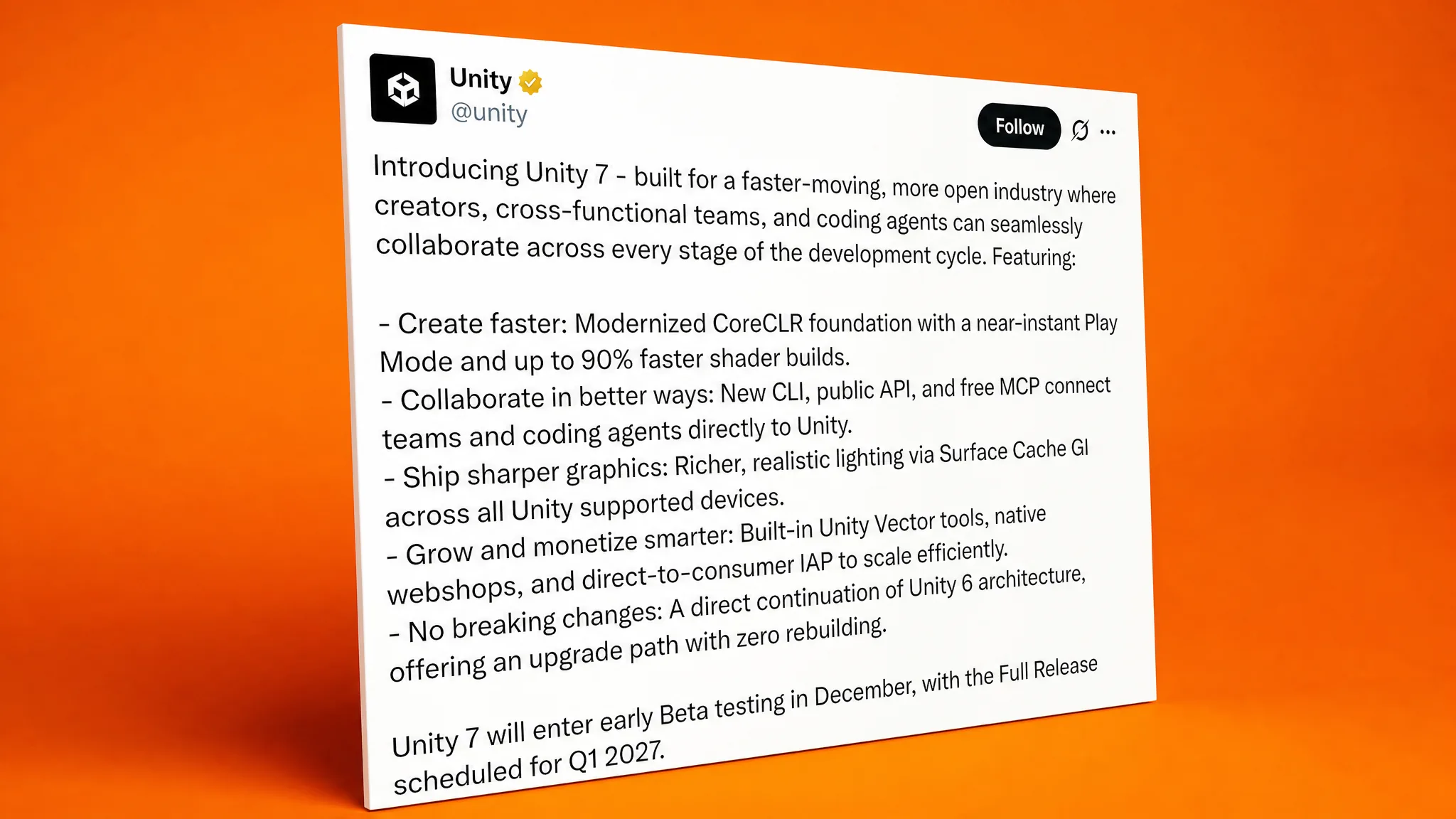
Unity 7 release timeline
Unity has laid out a staged rollout. Select features begin early beta testing in the months ahead, followed by a wider preview, then the full release. No exact day-and-time launch has been confirmed beyond these windows.
| Milestone | Timing |
|---|---|
| Early beta / preview | December 2026 |
| Full release | Q1 2027 (by end of March) |
You can track the schedule and feature status on the official Unity 7 roadmap.
Upgrading from Unity 6 without rebuilding
Unity 7 is described as a direct continuation of the Unity 6 architecture rather than a clean break. Because the underlying architecture does not change at the version boundary, existing projects, skills, and code carry forward into Unity 7.
The foundational pieces of Unity 7, including CoreCLR and Surface Cache GI, are being shipped and production-verified inside Unity 6.x releases before landing in Unity 7. That means the workflows teams already depend on remain supported after the switch, and the upgrade path requires zero rebuilding.
Faster creation with CoreCLR
Unity 7 runs on a modernized core built on CoreCLR, which speeds up the day-to-day development loop. The goal is to keep developers working without long waits between edits.
- Near-instant Play Mode.
- Domain reloads that touch only the code that actually changed.
- Shader builds that are up to 90% faster.
Sharper graphics with Surface Cache GI
The headline visual feature is real-time global illumination through Surface Cache GI. It brings indirect lighting that adapts when lights change, producing richer and more realistic lighting across scenes.
These visuals are designed to run from a single renderer and scale from high-end PCs down to mobile devices, helped by AI-assisted graphics optimization and neural upscaling. In practice, that lets teams target high-end visual detail on a wide range of hardware without maintaining separate rendering paths.
Open ecosystem and team collaboration
Unity 7 opens production beyond the Editor. A new CLI and public API let artists, producers, and developers validate assets, push builds, and collaborate from the tools they already use, with no full Editor access needed for those roles.
The workflow is built around external tools rather than direct submission pipelines. For example, an artist in Blender can receive a deep link that carries the full project, scene, asset, and revision context for a requested fix. They open Unity’s web dashboard in a browser, make the change, and check it against full in-game lighting and animation using the Scene Preview feature. The result is checked into source control, and an engineer can then validate the asset and push an updated build through the CLI.
A free-to-use MCP also connects AI coding agents directly to Unity, so an agent can plug in and validate a build alongside human reviewers.
AI tools are optional
AI features are a core part of Unity 7, but Unity has stated they are not required. Studios that keep AI out of their creative work are still fully supported by the release.
Unity 7 is built for a future where humans and coding agents can work together. But the choice is always the team’s, not the platform’s.
Monetization and Unity Vector
Unity 7 adds commerce and growth tools built into the engine. Native direct-to-consumer in-app purchases, no-code webshops, and unified catalogs give developers more ways to sell directly to players.
Purchase data from these channels feeds back into Unity Vector, the AI engine behind Unity Ads. Vector uses real gameplay data to match players to games, and the added purchase signals are meant to help developers find audiences and monetize more flexibly.
How to prepare now
The fastest way to get ready is to upgrade to the latest Unity 6 release. Many of Unity 7’s foundational features are already shipping there, so moving to current Unity 6 now lets you try CoreCLR-based improvements and Surface Cache GI ahead of the full launch, and it keeps the eventual jump to Unity 7 smooth. With beta testing set for December 2026 and the full release in Q1 2027, teams have a clear window to validate their pipelines before switching over.