
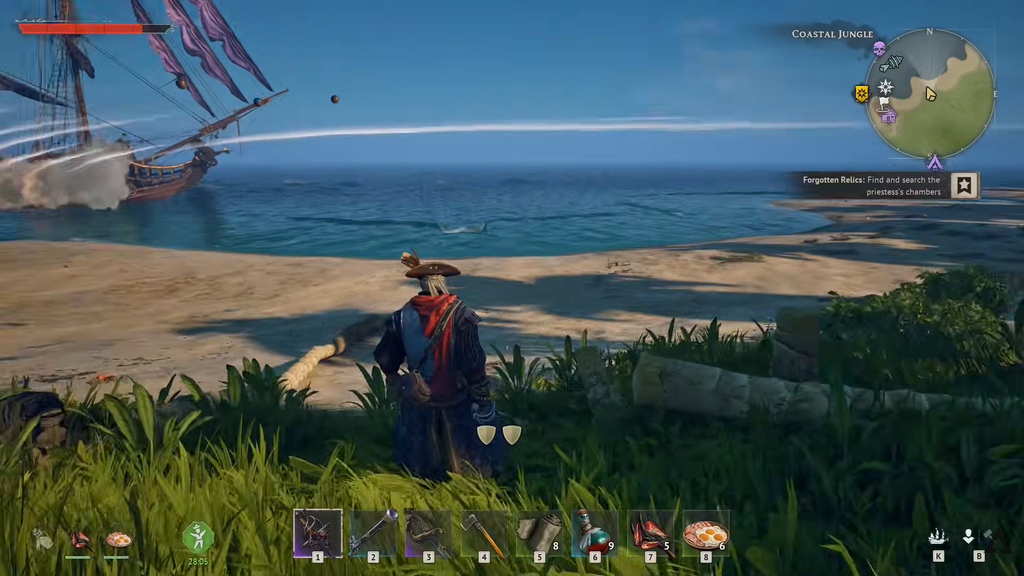
Posture points are Windrose’s poise system, shown as a row of small shield icons sitting under your health bar. They track how many incoming attacks your character can absorb, either through blocking or by getting hit, before the guard collapses and you stagger.
What posture points actually represent
The shield icons under your health bar are a visual layer for an underlying posture pool. Individual shields do not map one-to-one with single hits. Instead, the row represents a total amount of “posture” that drains as you take pressure, with shields breaking off in chunks as the pool depletes.
Light hits chip the meter slowly. Heavy attacks bite off much larger portions, which is why some enemies seem to crack your guard in just two or three swings. Posture is independent of health, so a full health bar will not save you from a clean stagger window.
How posture is spent
Three things drain posture: getting struck without blocking, blocking an attack normally, and absorbing repeated pressure without a reset. The system is symmetrical, so the same rules apply to enemies you are fighting.
A perfect block is the exception. Time the block input just before an attack lands and the hit costs you no posture, while the attacker eats the posture damage instead. That is the parry interaction, and it flips the exchange from defensive to offensive.
What happens when posture breaks
Once the final shield disappears, the character is staggered in place for roughly four seconds. During that window you cannot block, dodge, or attack, and incoming damage is amplified. Most early deaths come from this state rather than from raw damage spikes, since enemies are free to combo through the stun.
The same condition applies in reverse. Pressuring an enemy until their shields break opens a clean punish window where they cannot defend or retaliate.
Posture vs. stamina
Posture and stamina are two separate resources that govern different defensive choices. Mixing them is what keeps fights stable instead of spiraling into a stagger.
| Resource | Drained by | Penalty when empty |
|---|---|---|
| Posture points | Blocking and taking hits | 4-second stagger, increased damage taken |
| Stamina | Dodging and attacking | Cannot dodge or swing effectively |
Holding block indefinitely will always end in a stagger because posture cannot soak unlimited pressure. Rotating between a block, a dodge, and the occasional parry spreads the load across both meters.
How to recover and increase posture
Posture regenerates on its own when you are not actively being hit. You do not have to fully disengage from a fight; a short opening between enemy combos is usually enough for the meter to start refilling.
The total cap is not tied to a character stat and cannot be raised by leveling up. The only way to gain more posture points is through gear with posture modifiers. Two confirmed examples are below.
| Item | Type | Rarity | Effect |
|---|---|---|---|
| Stalwart Greatsword | Weapon | Epic | Increases posture points |
| Knight’s Ring | Accessory | Rare | +1 posture |
Better armor and certain consumables can also contribute to posture totals, so swapping into defensive gear before a tough fight is a practical way to extend your guard.
Parrying and posture damage
Parrying is the most efficient way to pressure an enemy’s posture without spending much of your own. A clean parry skips the posture cost on your side, dumps the damage onto the enemy’s posture pool, and can stagger them outright if they were already close to breaking.
Agility weapons such as the Saber tend to feel especially strong in this loop because their fast recovery lets you punish the opening immediately after the parry lands.
When posture matters most
Tougher enemies carry larger posture pools, which makes them harder to stagger with melee alone. Mixing in ranged weapons during longer fights is often the fastest way to break a stalemate, since chip pressure from firearms or bows can soften a guard while you reposition.
If you favor offense-heavy weapons that bypass blocking patterns, posture management becomes less critical. For any defensive playstyle built around blocking and parrying, it is the single mechanic that decides whether a fight stays under control or collapses in one bad exchange.