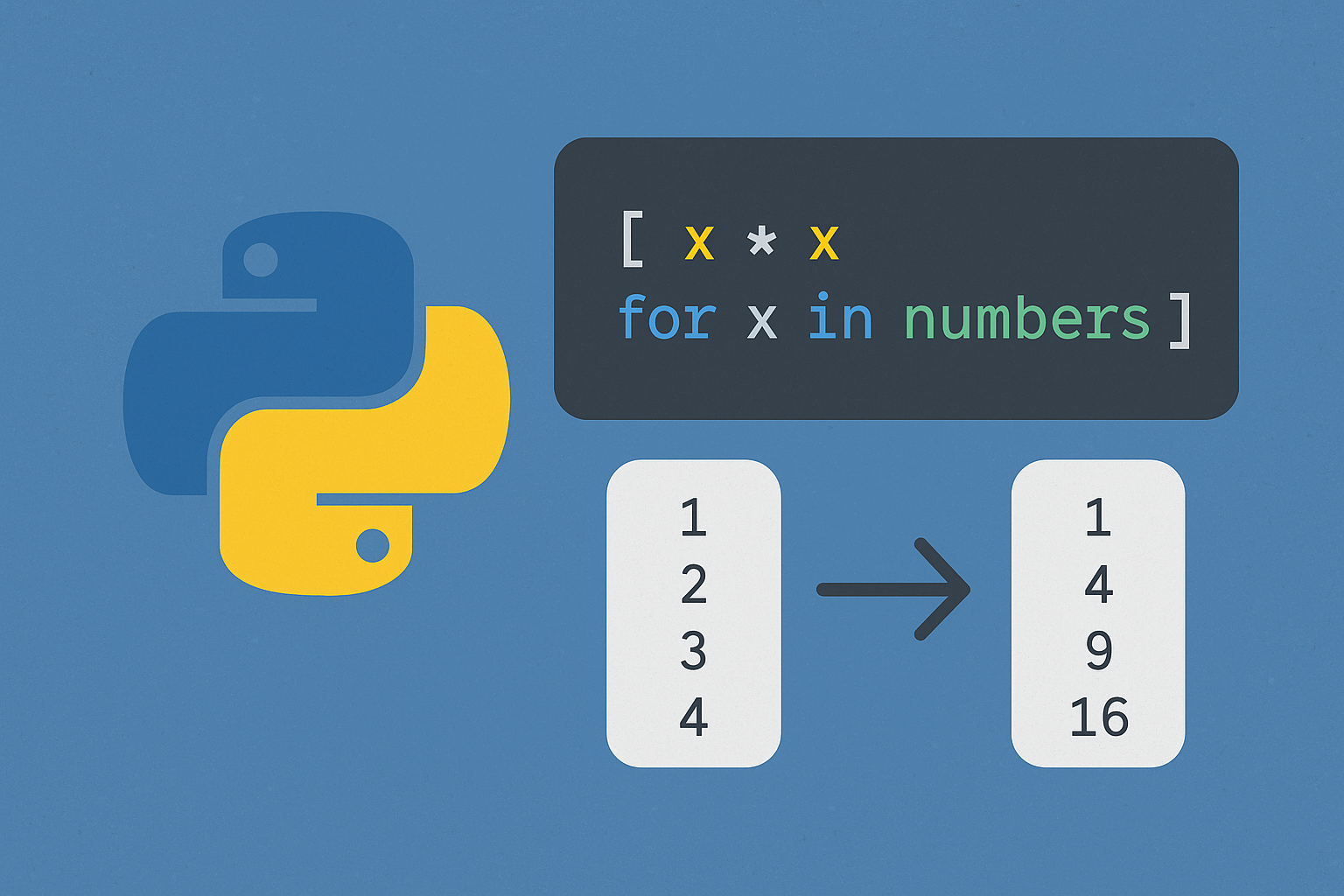
Use a list comprehension to build a new list from any iterable in one readable expression. Python’s syntax is documented in the official documentation, and the feature originated in PEP 202.
Method 1: Create a list with a basic comprehension
nums = [2, 3, 4, 5]squares = [n * n for n in nums]
print(squares) # [4, 9, 16, 25]print(nums) # [2, 3, 4, 5]Method 2: Filter items with an if clause
nums = range(10)
evens = [n for n in nums if n % 2 == 0]
print(evens) # [0, 2, 4, 6, 8]letters = ("a", "b", "c", "aa", "bb")
filtered = [s for s in letters if len(s) == 1]
print(filtered) # ['a', 'b', 'c']Method 3: Transform conditionally with an inline if-else
temps = [12, -3, 18, -1]
non_negative = [t if t >= 0 else 0 for t in temps]
print(non_negative) # [12, 0, 18, 0]# Filter positives, then transform.
positives_squared = [t * t for t in temps if t > 0]
print(positives_squared) # [144, 324]Method 4: Combine multiple loops and flatten nested data
xs = [1, 2]
ys = ["a", "b", "c"]
pairs = [(x, y) for x in xs for y in ys]
print(pairs) # [(1, 'a'), (1, 'b'), (1, 'c'), (2, 'a'), (2, 'b'), (2, 'c')]grid = [[1, 2], [3, 4], [5, 6]]
flat = [v for row in grid for v in row]
print(flat) # [1, 2, 3, 4, 5, 6]Method 5: Stream large results with a generator expression
gen = (n * n for n in range(1_000_000)) # generator expression
total = sum(n for n in range(1_000_000))
print(total)
Why it matters: generator expressions are evaluated lazily, which keeps memory usage low on huge datasets. See the original design note in PEP 289.
Method 6: Prefer built-ins over complex comprehensions
matrix = [
    [1, 2, 3],
    [4, 5, 6],
]
transposed = list(zip(*matrix))
print(transposed) # [(1, 4), (2, 5), (3, 6)]items = [" apple", "banana ", " pear "]
cleaned = []
for s in items:
t = s.strip()
cleaned.append(t)
print(cleaned) # ['apple', 'banana', 'pear']Method 7: Compare to the equivalent for loop
nums = [1, 2, 3, 4]
doubled = []for n in nums:
doubled.append(n * 2)
print(doubled) # [2, 4, 6, 8]doubled_fast = [n * 2 for n in nums]
print(doubled_fast) # [2, 4, 6, 8]Quick patterns you’ll reuse
- Map values:
[f(x) for x in data]. - Filter values:
[x for x in data if keep(x)]. - Conditional outputs:
[a(x) if test(x) else b(x) for x in data]. - Flatten nested lists:
[y for row in rows for y in row].
Reference the syntax and nuances in the official documentation as you practice.
That’s it—use comprehensions for compact, readable transformations, switch to generator expressions for very large outputs, and fall back to clear loops when logic gets busy.