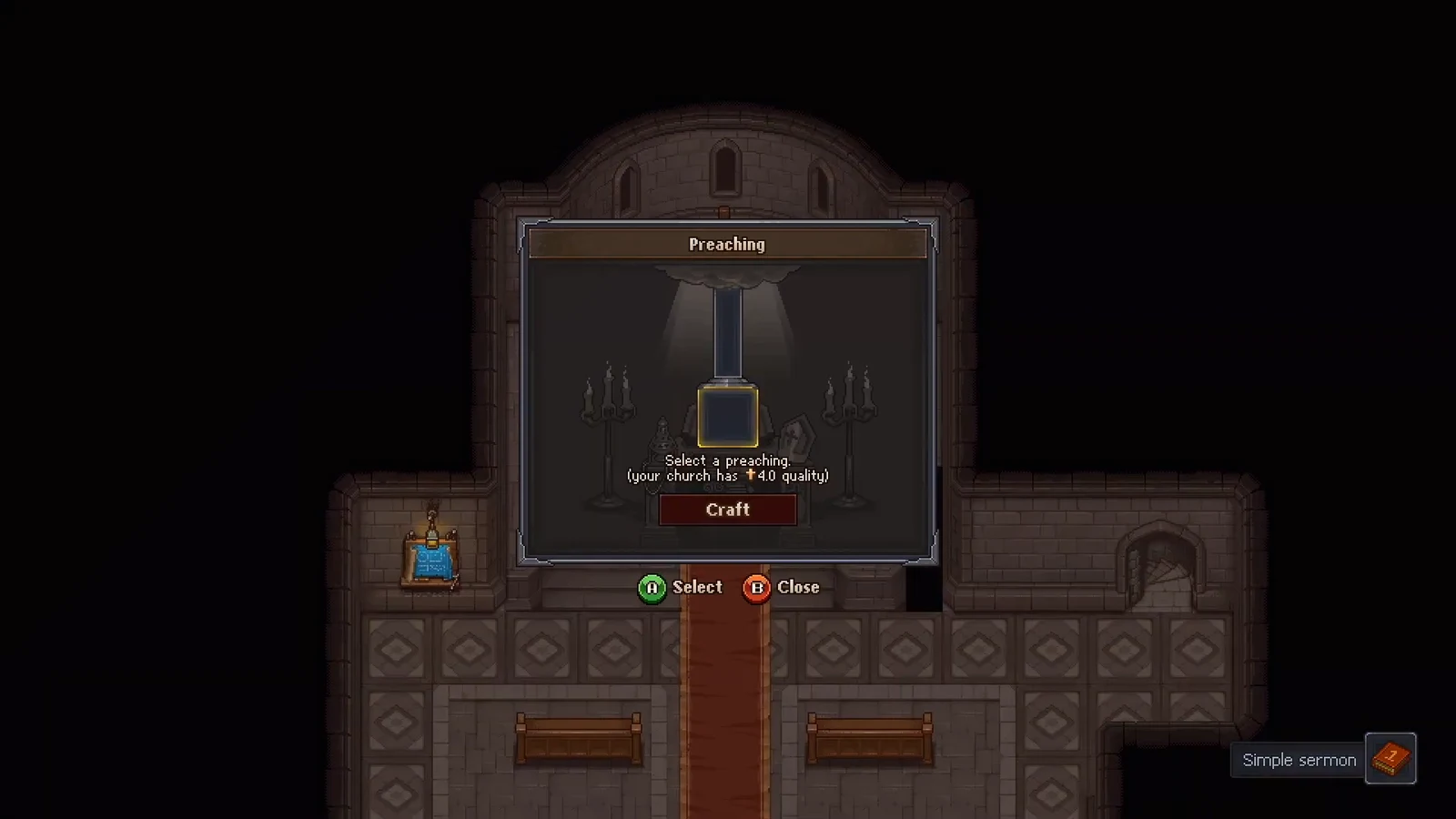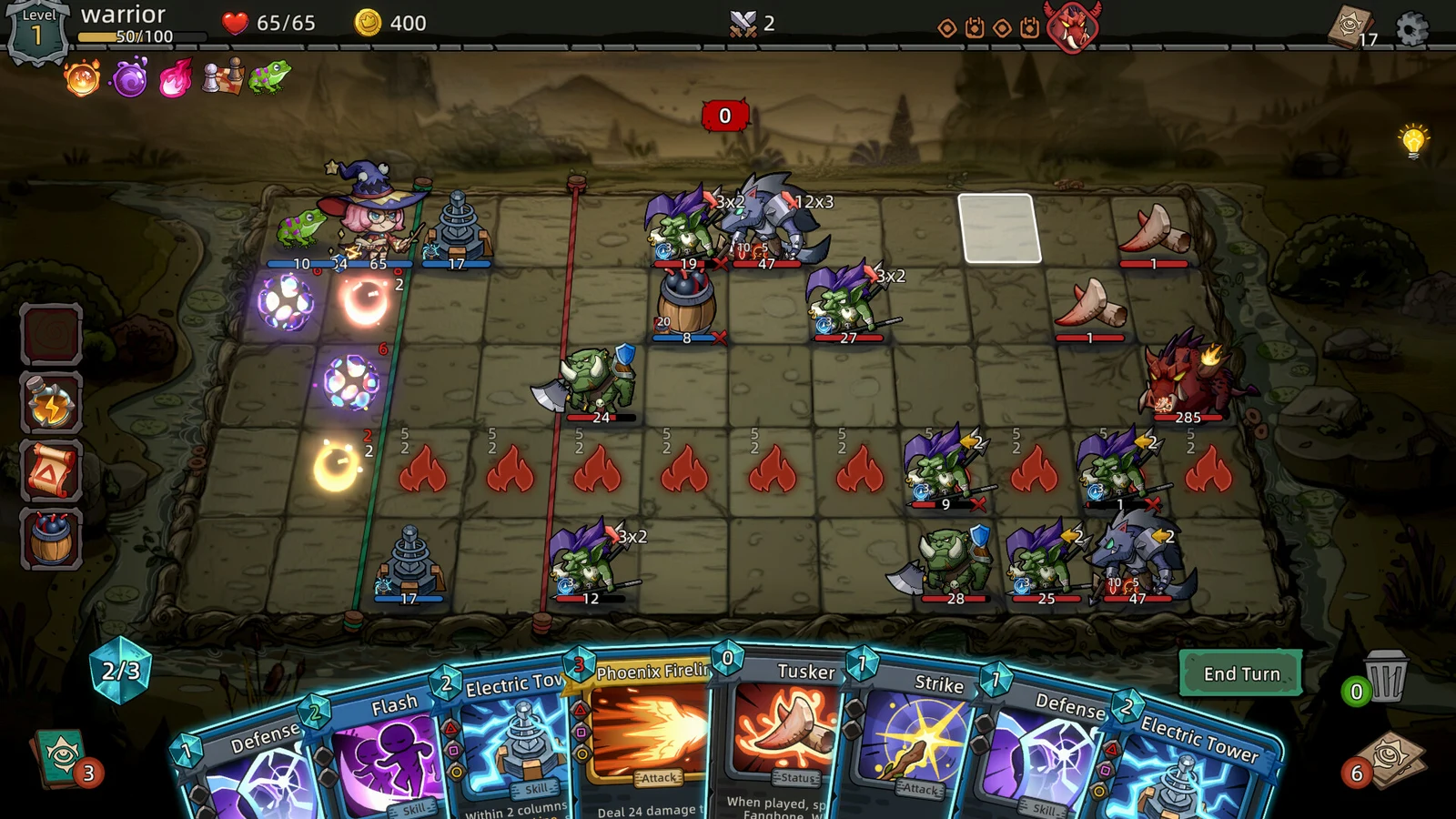
Silent Mainland is a roguelike deckbuilder from Winwill Studio that puts a tactical board underneath the usual card draw. Instead of standing in one spot and trading blows, your mercenary occupies a tile on a 5×12 battlefield, and almost every card cares about where that tile is. Monsters pour in as timed waves rather than a single fixed encounter, so the deck you build has to answer both damage and distance.
Quick answer: Fights happen on a 5×12 grid where your column changes what cards do. Cross the green Safety Line to cut energy costs and gain Strength, and clear five monster waves to win.
The 5×12 grid: columns, Border Line, and Safety Line
The board is five rows deep and twelve columns wide. You start on the left, monsters walk in from the right, and the columns between you double as a range readout. Enemies show which distance column they occupy, and if you are outside their reach, they spend their turn advancing instead of attacking. Retreating is a real defensive option, not a wasted energy point.
Two coloured lines do most of the work. Red and blue markers tell you where attacks can and cannot land, while the green line changes the economy of your hand.
| Marker | What it does |
|---|---|
| Border Line (red) | Caps how far forward you are allowed to move |
| Safety Line (green) | Crossing it forward lowers card energy costs and grants Strength |
| Distance columns | Show each monster’s range and whether it will step closer |
| Red tiles | Valid targets or destinations for the card you are dragging |
The Safety Line is not fixed for the whole fight. It creeps forward at Night, which quietly changes which tiles count as cheap.
Core cards: Strike, Defense, Move, March, and Pincer Tactics
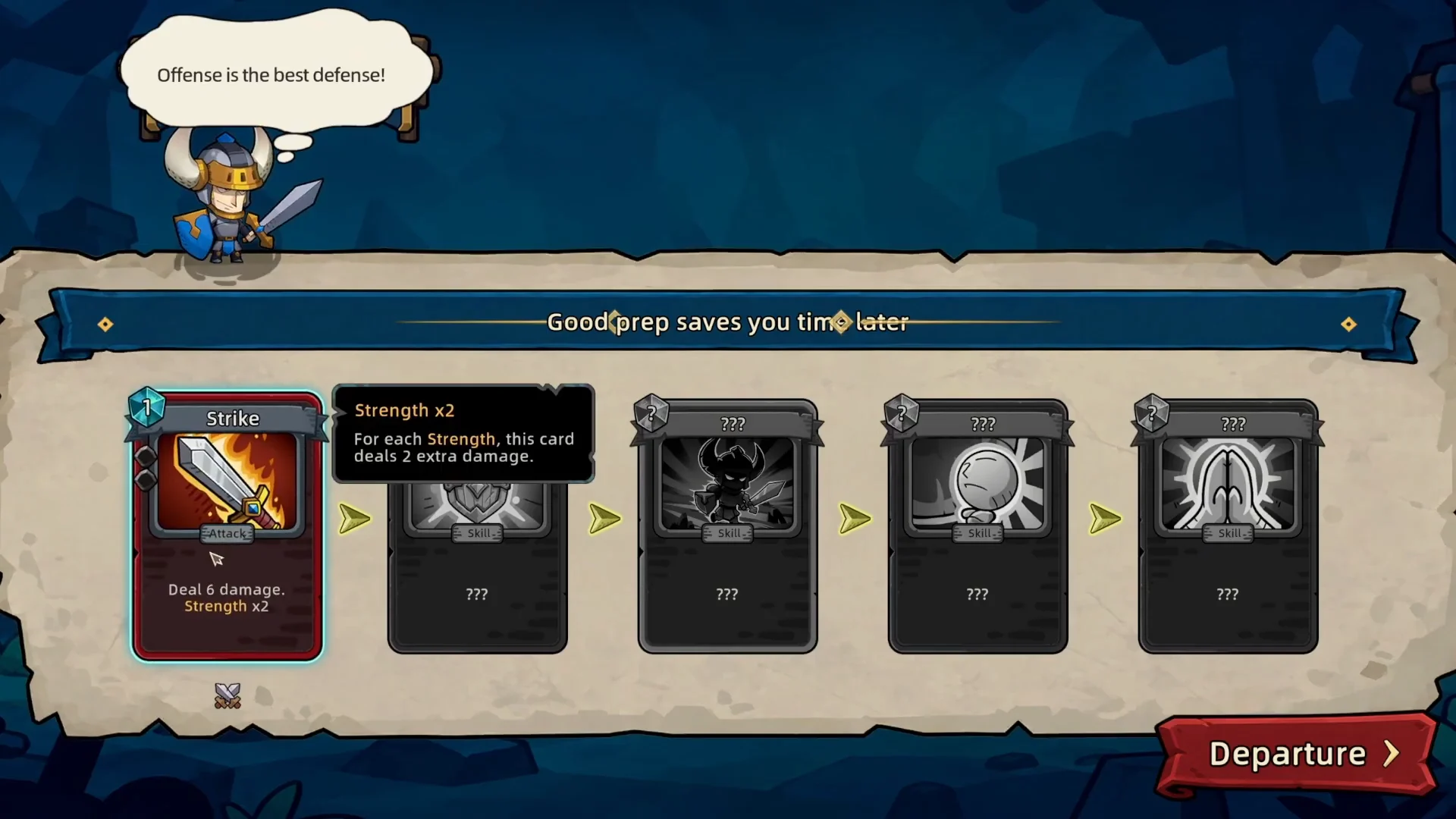
The tutorial hands out five cards in sequence, and each one teaches a different half of the system. You play them by dragging onto highlighted tiles, so targeting and positioning use the same gesture.
| Card | Effect |
|---|---|
| Strike | Deal 6 damage, Strength x2 |
| Defense | Grants 6 Armor, which absorbs damage before HP |
| Move | Reposition to a highlighted tile, limited by the Border Line |
| March | Forward 1 grid plus temporary Strength, cheaper past the Safety Line |
| Pincer Tactics | Gain 5 Armor, then move 3 enemy columns 1 grid toward the centre |
Pincer Tactics is the clearest example of why the grid matters. Herding three columns of monsters into one line turns scattered enemies into a single stack you can hit with column-wide effects, but doing it badly drags everything into melee range at once. The tutorial stage can be lost outright by running out of energy mid-reposition.
Day and Night rules for your hand and armor
Turns cycle through Daytime and Night, and the two phases follow different rules. The practical effect is that you can bank resources during one phase and must spend them in the other, which sets the tempo for when you push forward and when you dig in.
| Phase | Rules |
|---|---|
| Daytime | You keep your hand and your armor |
| Night | Your hand is discarded and the Safety Line advances |
Holding cards through the day lets you set up a large turn. Holding them into Night wastes them, so unspent energy is better converted into Armor or forward movement before the phase flips.
Five monster waves, enemy intents, and boss arrival
Each battle is built from five monster waves. A countdown in a red frame tells you how long until the next group arrives, and every enemy on the board displays an intent icon for what it plans to do next turn. That combination is the planning information you get: current threats on the left of the screen, incoming pressure on the timer.
Waves escalate rather than repeat. Early rows bring simple attackers like Vultures and Pangolins, elites arrive with special rules, and a “Boss Approaching” alert precedes the final wave. Elite behaviour is worth learning individually, since a single ability can invalidate a turn you already planned.
| Enemy | Notable ability |
|---|---|
| Scarecrow (elite) | Inspire |
| Monkey (elite) | Split Intention, dividing into two units with half HP |
| Phantom Horse (boss) | Phantom Step and Shenma |
| Tauren Chieftain (boss) | Mad Cow, Rampage, Gale |
| Hellhound (boss) | Summon Intention on a 4-turn countdown |
| Forgotten Mage (boss) | Floods your hand with unplayable Miasma cards |
Objects also appear on the field. An Explosive Barrel sitting in a column becomes a positioning problem, and Undead enemies in the ruins stage push curse cards into your deck, which is what makes the Forgotten Mage dangerous rather than its raw damage.
Board control cards, terrain, and summoned illusions
Beyond damage and Armor, the deck contains cards that rearrange the board itself. Outburst destroys an entire enemy column. Blood Arrow creates Arrow Terrain based on Bleed stacks, shaping zones that punish anything that walks into them. Barricades give you something to hide behind while stacking defence.
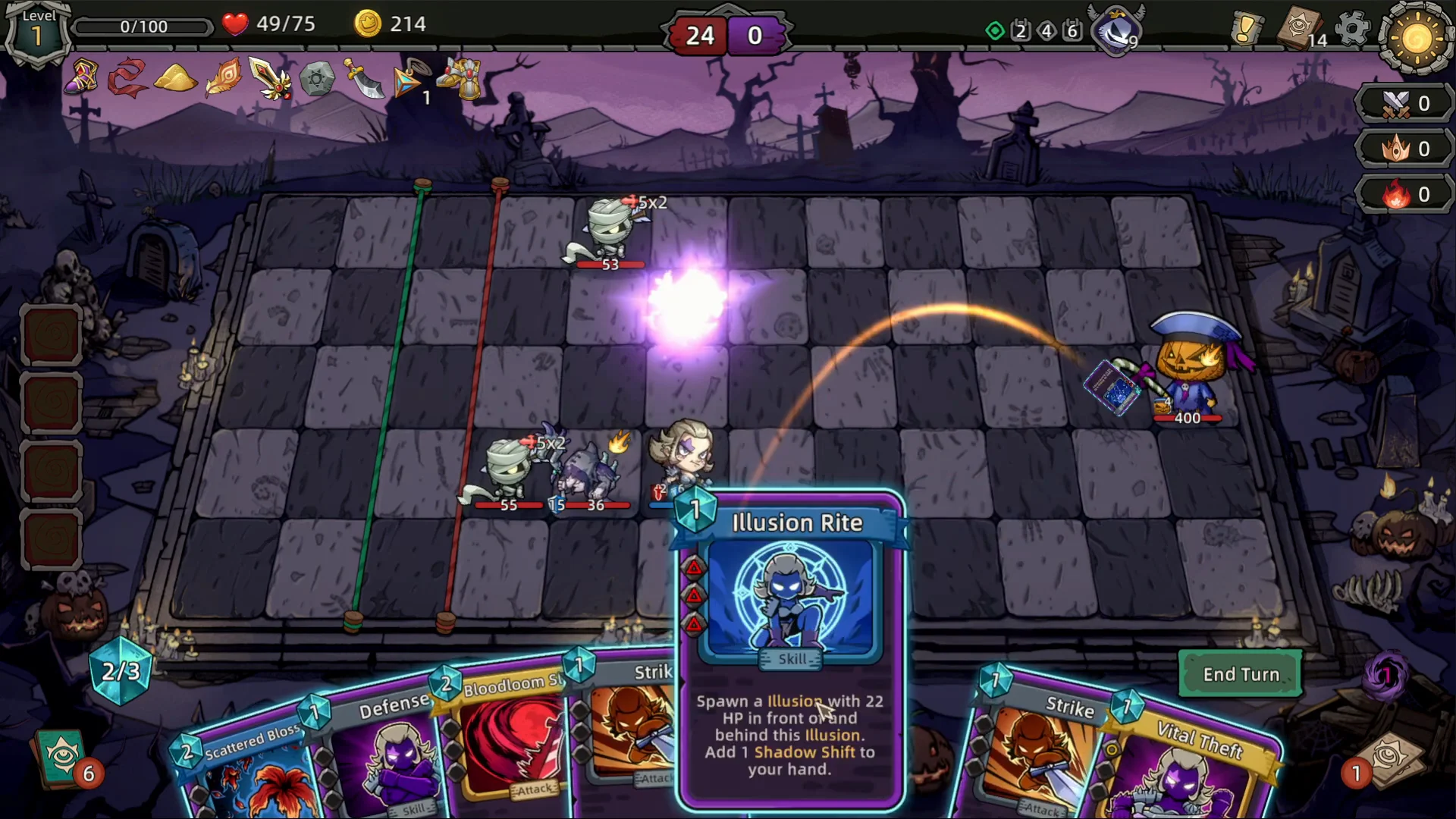
Summons work on the same column logic. Shadow Call places an illusion with 22 HP in your own column, giving enemies a target that is not you.
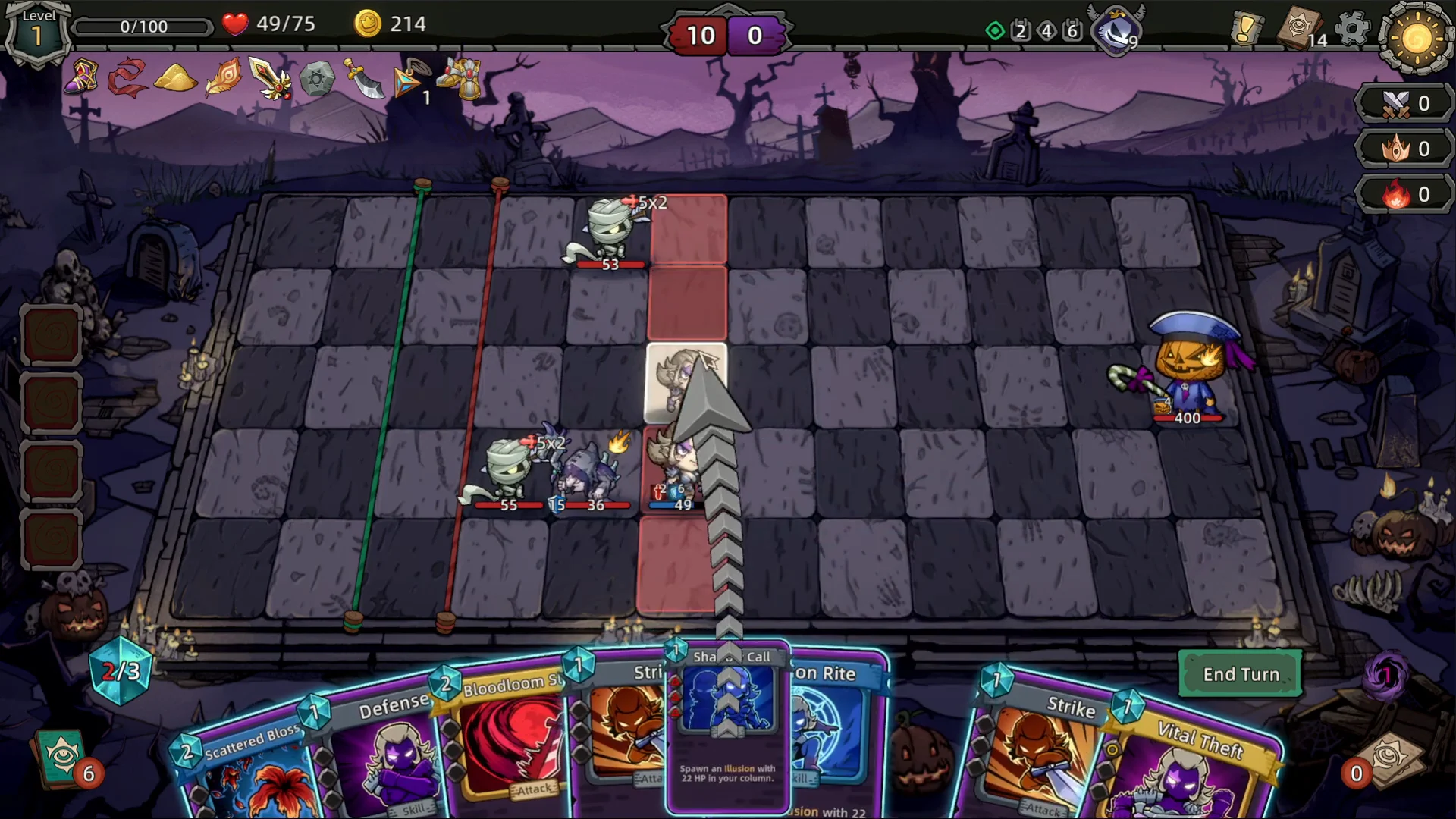
Illusion Rite follows up by spawning another illusion and adding Shadow Shift to your hand, chaining bodies into movement options. Enemies will happily spend their attacks on those illusions, though they can still apply Vulnerable and Frail to your frontline through the crowd.
Upgrading cards mid-battle with Enhance and Empower Stones
Card upgrades are not restricted to the map. Enhance Stone and Empower Stone objects spawn on the battlefield, and you break them by targeting them with your own cards. Destroying one opens an upgrade window immediately, which is how Trapped becomes Trapped+, Sharp Blade gains +3 Strength, or Blood Arrow drops to zero energy cost.
Levelling up during a fight offers a choice of three cards, so your deck grows while the waves are still arriving. Upgrades follow three paths.
- Augmentation, for raising a card’s raw numbers
- Generalization, which broadens how a card can be used
- Empowerment, for stronger or cheaper versions of an effect
Skipping a reward is a legitimate play. You can pass on a card draft for a small gold cost to keep a deck focused, which matters in a game with 350+ cards where consistency beats variety.
Relics, events, and merchants between waves
Progression runs across a campaign map rather than a single branching path, taking in territories such as Brave Village, Greedy Caverns, Remainsand Barrens, Thornveil Wastes, and Death Graves. Relics are the permanent layer on top of your deck, and several of them interact directly with positioning.
| Relic | Effect |
|---|---|
| Spike Armor | 4 Retaliation damage to attackers |
| Heartbroken Lotus | Applies Vulnerable to monsters on arrival |
| Holy Helm | +12 Armor at the start of your turn |
| Invincible Necklace | Awarded for helping herbivores in Territorial Disputes |
Events sit between battles and are usually a trade rather than a gift. Fairy Spring Water offers +8 Max HP or +30 Exp. Broken Sword Cliff lets you take the Infinite Blade or 120 Gold. The Abyssal Shell doubles gold from future battles if you hand over everything you are carrying. The Chosen One trades 15 Max HP for an epic relic. Card Whispers asks for 10 damage to empower a card.
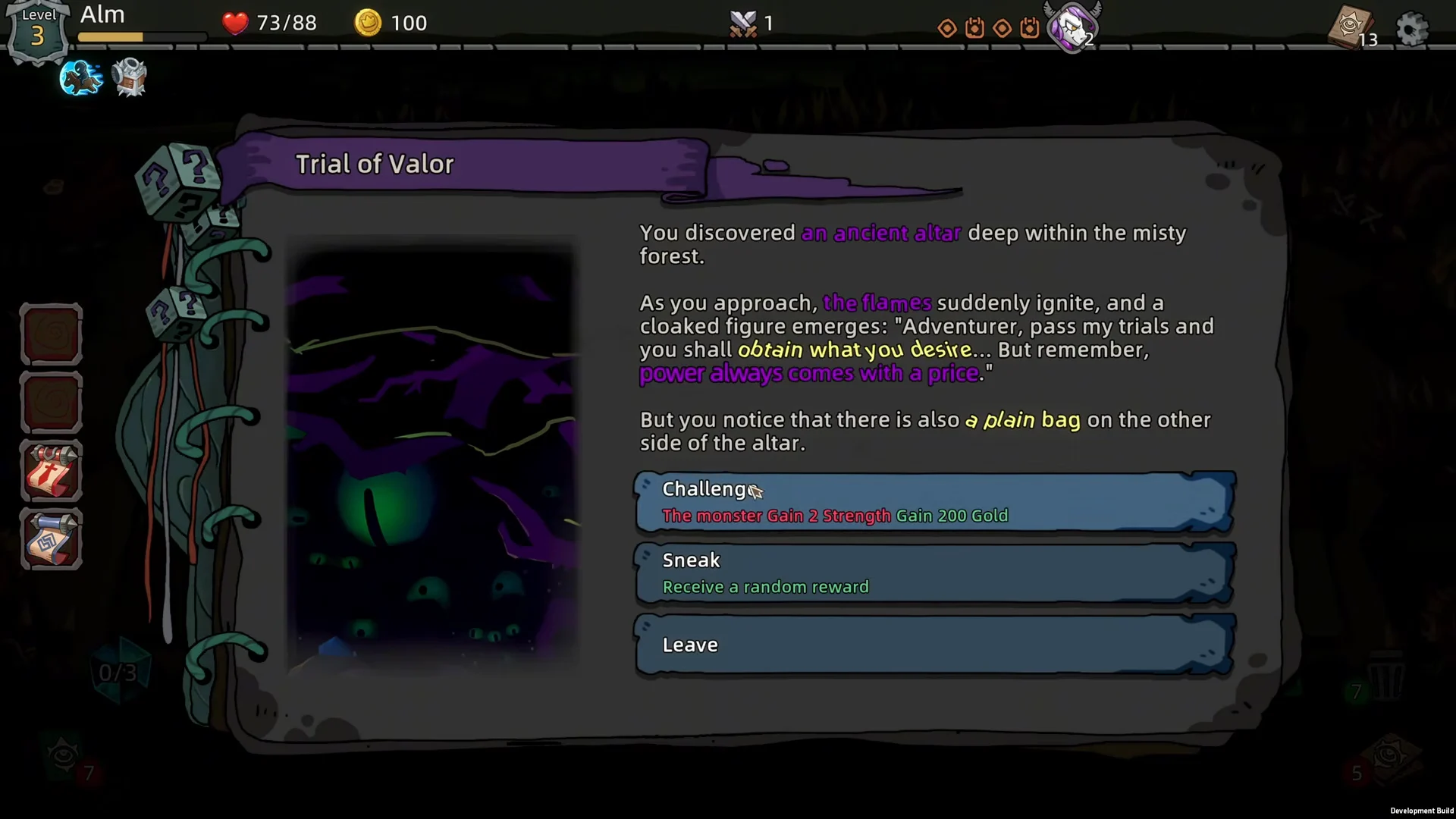
Post-battle choices work the same way. One menu offers 100 Gold, a Stone for empowering a card, or a Challenge that adds a new wave in exchange for 200 Gold. Merchants then sell cards, relics, items and services, including healing, card removal and enhancement, and clearing basic Strike cards out of a deck is one of the more reliable purchases.
Characters, content, and how to play the demo
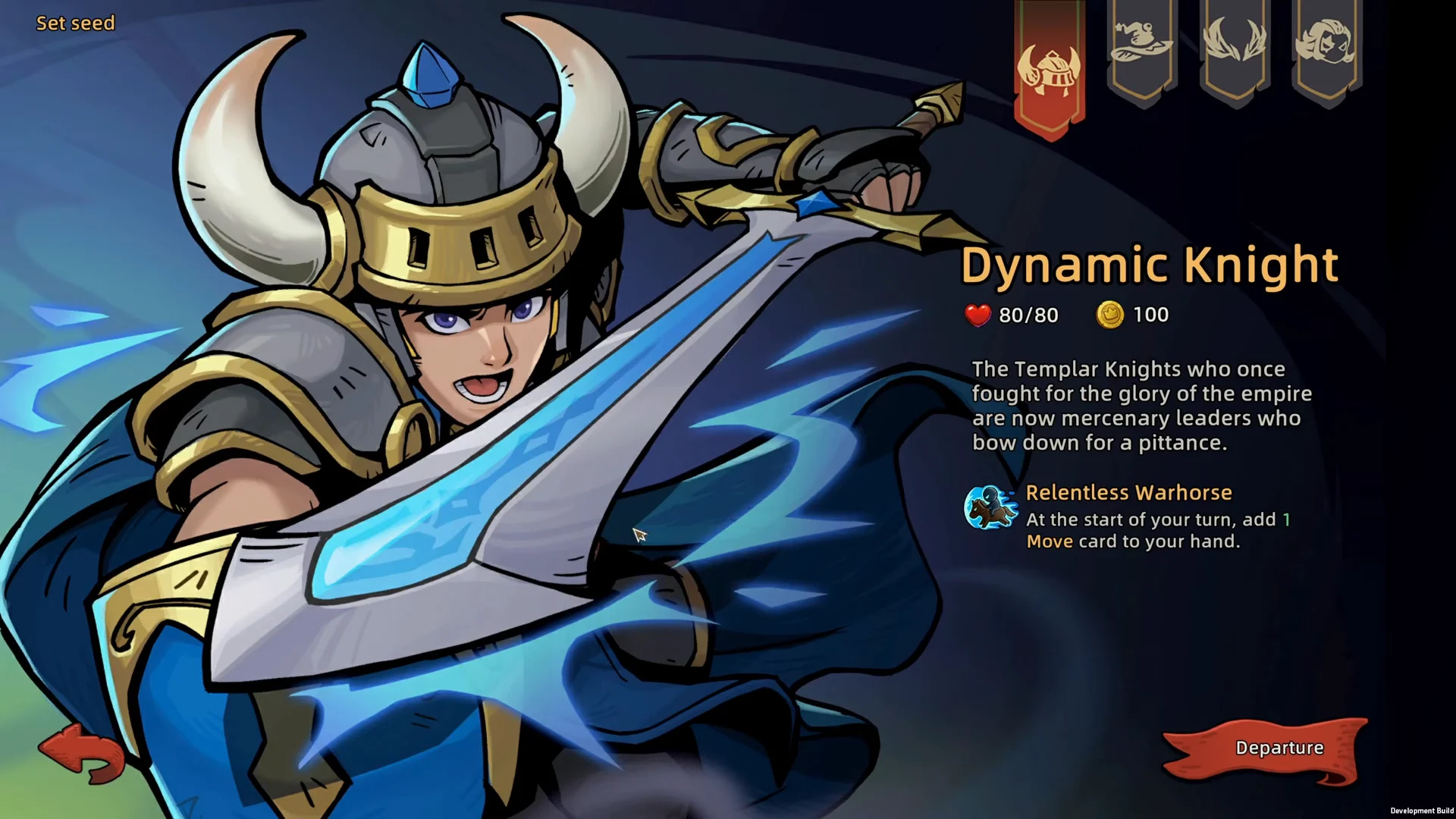
The full roster covers four mercenaries with distinct traits. Dynamic Knight starts at 80/80 HP with 100 gold and the Relentless Warhorse skill, and is the positioning specialist built around movement, terrain and Arrow Arrays.
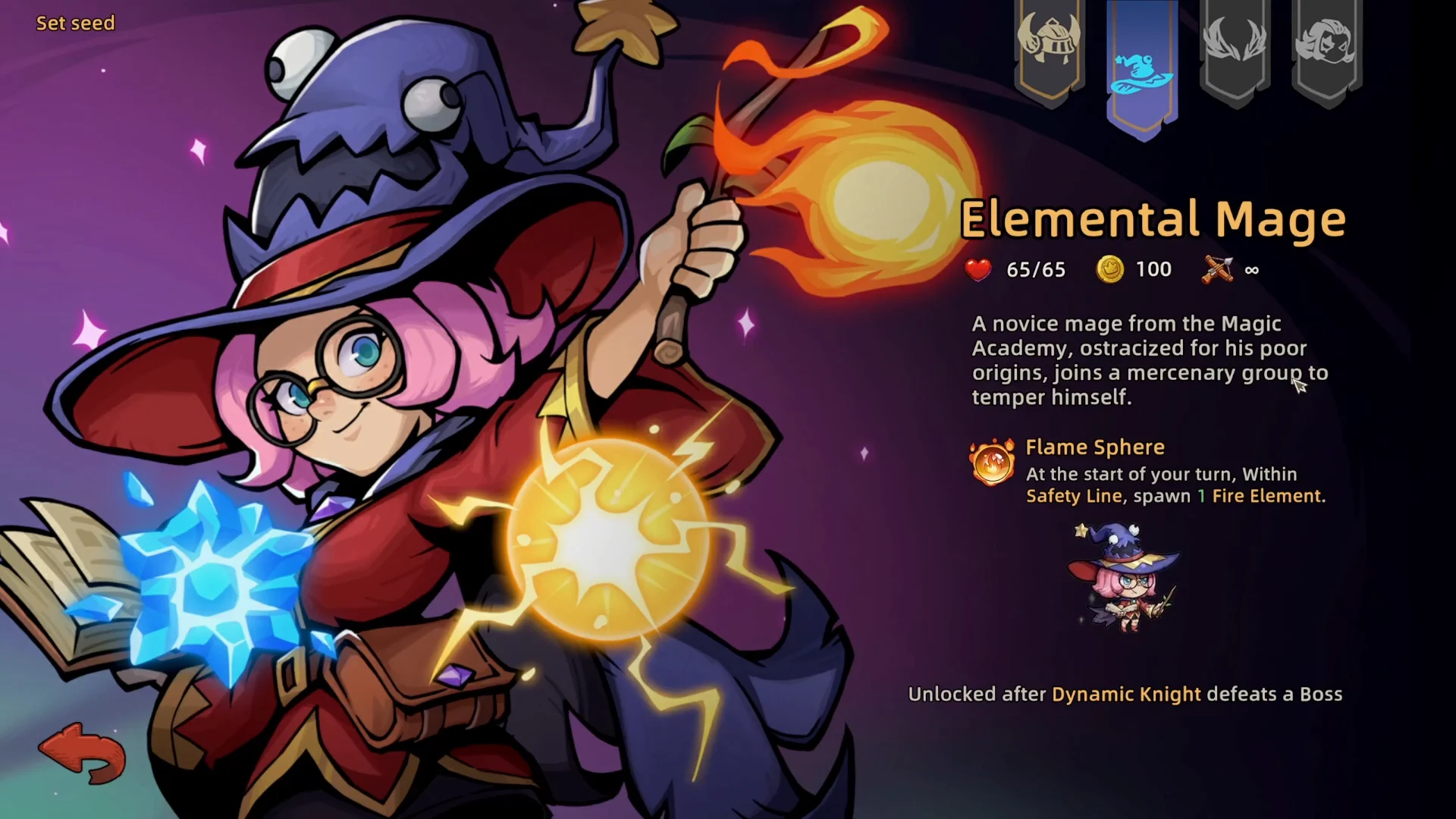
Elemental Mage brings Flame Sphere, and Howling Druid and Sorrow Assassin round out the four. Across a run you can draw on 350+ cards, 130+ relics, 50+ items and 30+ events.
A playable demo is available now, ahead of the game’s planned Q1 2027 release. The Steam version is downloadable from the store page.
A browser-playable build and a Windows download are also hosted on the developer’s itch.io page, in English and Simplified Chinese. If you are starting from scratch, the five tutorial lessons are worth clearing first, and confirmation that you are done is a pop-up congratulating you on completing the tutorial stage before you are sent back to the main menu to pick a mercenary.