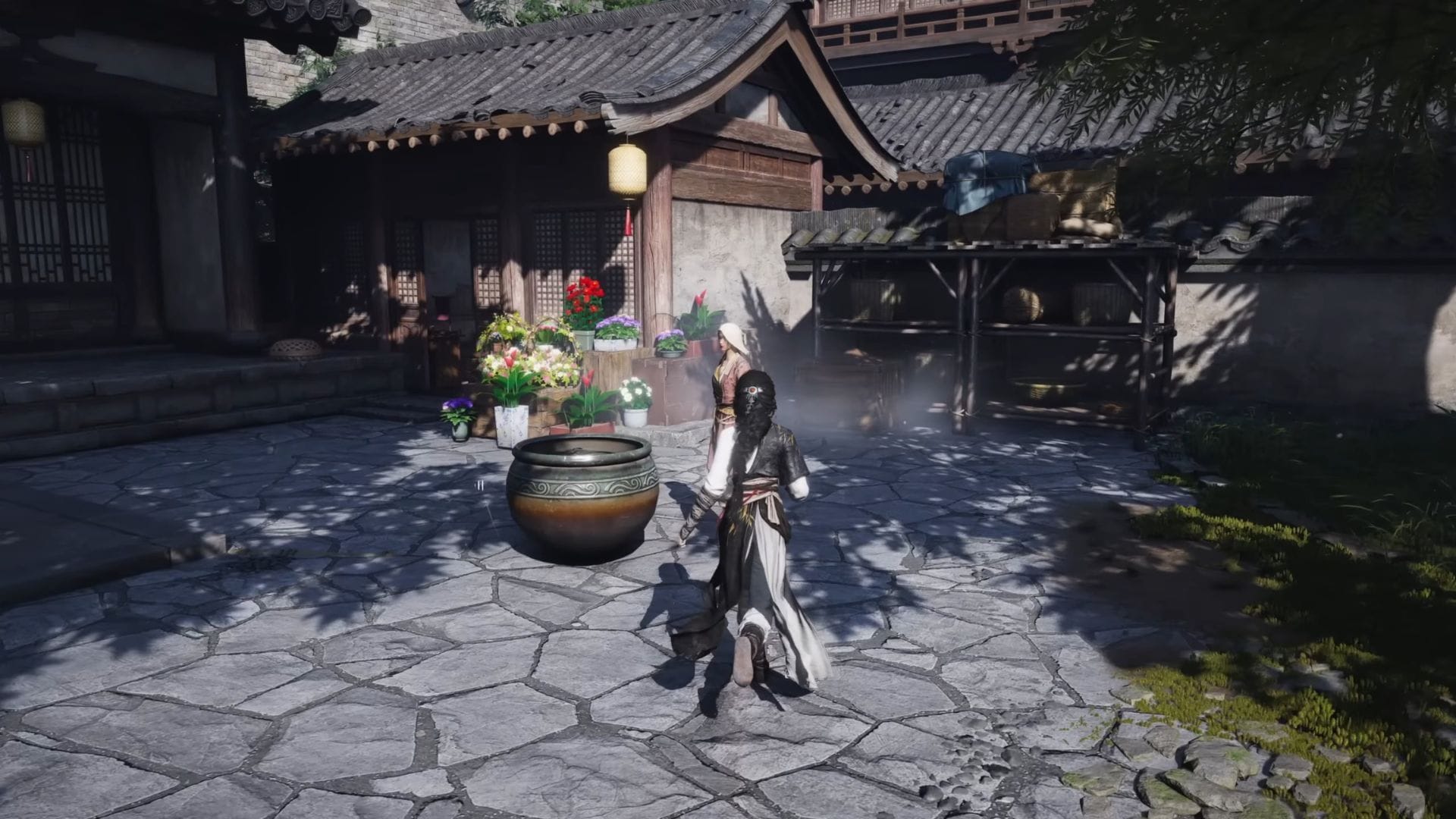
Where Winds Meet does something unusual with NPCs: many of them use an AI chat system instead of fixed dialogue. You can type anything into a chat box, the NPC responds, and your relationship level changes based on how that conversation plays out. Befriending these characters unlocks weekly gifts and one-time rewards, but the system can feel opaque, especially with stubborn NPCs like Qin Caiwei who keep talking in circles.
Players have pushed on this system hard enough that some consistent patterns have emerged. The AI is flexible, but the game still checks for a few simple conditions before it will bump your affinity or mark the NPC as a proper “Old Friend”. Understanding those rules is the key to getting past characters that seem to stall out.
How AI Chat NPCs work in Where Winds Meet
AI Chat NPCs are a special subset of characters scattered across Qinghe and beyond. When you stand in front of one and press the interaction button, you see an extra option that opens a chat window instead of the usual short dialogue.
Several things matter during these conversations:
- Affinity tiers: NPCs start at Stranger and can move through stages up to Revered. Big jumps often happen when the game thinks you “resolved” their situation.
- System hints: A short line above or near the chat box describes their problem or goal. That line is effectively the win condition for the conversation.
- Soft story gates: Some NPCs mainly want you to listen; others want you to take a stance or describe a solution. Until you hit that beat, affinity barely moves.
There’s no single script to follow. The game looks for whether your replies roughly satisfy the NPC’s prompt and then decides whether to end the conversation and issue an affinity change or reward.
Why NPCs like Qin Caiwei feel “stuck”
Many players report that certain NPCs happily accept all kinds of shortcuts, while others, like Qin Caiwei, keep looping. One comment sums it up: she “wants to tell me one story after another,” and shortcuts that work elsewhere simply don’t move her past Stranger.
That behavior usually means two things:
- Her win condition is “story completion,” not a single trick. She is designed around you listening through her perspective. If you keep trying to jump to the end, she steers you back into recounting events or emotions.
- She is less tolerant of blunt commands. With some NPCs you can skip to the outcome (“we are friends now”) and get an instant affection spike. Qin Caiwei tends to respond that “we are not at this point yet” and insists on working through the issue.
The result is that she feels unusually stubborn compared to, say, a lumberjack who can be coaxed into selling his firewood in a couple of lines. The underlying system is the same, but her logic leans much more on whether you’ve acknowledged and processed her story.
General methods players use to befriend AI Chat NPCs
Even with variations between characters, several broad strategies work across most AI Chat NPCs.
Method 1: Roleplay the resolution in parentheses
Many NPCs describe their own “stage directions” in brackets, such as (waves hand) or (looks surprised). The chat accepts similar bracketed actions from you, and the game often treats these as narrative facts.
(Convinced him to sell firewood to me) or (helped her face the past and find peace).(we become friends and trust each other) or a verbal send-off such as “farewell, friend.”Players have reported that, for many NPCs, this can instantly push affinity to Friend or even Revered. With tougher characters, it might take several variants of the same idea (“I show proof of my good intentions”, “I convince him to change his path”, “we are friends now”).
Method 2: Give them exactly what they’re asking for
Another approach is to keep things extremely literal and polite. Some NPCs only need to be heard; others respond to simple agreement and encouragement.
This method is slower than bracketed commands but tends to feel more like a real dialogue, which some players prefer. It also avoids confusing NPCs that react poorly to heavy-handed narration.
Method 3: Let them finish talking, then exit gracefully
For some AI Chat NPCs the only requirement is that you stay engaged long enough and then leave politely. Their internal trigger seems to be “conversation concluded peacefully,” not any specific clause.
If the system accepts this as a clean wrap-up, you usually see an affinity change once the chat window closes. If not, resetting and trying a different approach is faster than arguing.
Specific patterns that do not work well with Qin Caiwei
Reports around Qin Caiwei point to a few pitfalls:
- One-line mind control: Dropping a single line like
(you are convinced we are best friends)often works elsewhere, but she frequently rejects this and reiterates that she still has unresolved business. - Skipping her story: Treating her like a box to tick, rather than someone who wants to recount a series of memories, keeps you stuck in a loop of introductions and half-finished anecdotes.
- Vague outcomes: General lines like “everything will be fine” or “you can do it” are less effective on characters whose hint text clearly points to a more specific resolution.
With someone like Qin Caiwei, it is more effective to combine listening and narration. Let her talk through the beats she insists on, then summarize what she has shared and describe a concrete emotional endpoint in brackets.
Practical strategy for stubborn AI NPCs like Qin Caiwei
When an NPC keeps looping or refusing to move past Stranger, a structured approach helps.
(helps her confront her regrets and accept what cannot be changed) and then (she feels understood and we become close friends).(we part ways as trusted friends). If the system is satisfied, the chat ends and your affinity jumps.Tip: If a particular phrasing fails, stay close to the same idea but vary the wording slightly across resets. The system is pattern-driven, not tied to one magic sentence.
What you gain for befriending AI Chat NPCs
Raising friendship with AI Chat NPCs is mostly about flavor and small bonuses, not game-breaking power. Once you’ve pushed a character to the right tier, they can:
- Send weekly gifts, usually currency or common materials.
- Offer one-time items or small narrative payoffs tied to their personal story.
- Populate your “Old Friends” list, which also contributes to exploration and completion goals in certain regions.
The exact rewards differ by NPC and are still being mapped out in detail, but broadly they sit in the “nice to have” category rather than mandatory progression. That makes characters like Qin Caiwei good candidates for players who enjoy roleplay and long-form conversation, while others may prefer to prioritize easier, more transactional NPCs first.
When an NPC refuses to budge, it’s usually not because the system is broken; it’s because their hidden condition hasn’t been clearly satisfied. For most characters in Where Winds Meet, that condition boils down to one of three things: listen to their story, describe a believable resolution, and leave on amicable terms. Qin Caiwei leans harder on the first two, which makes her feel more demanding than most. Approach her with patience, mix straightforward replies with explicit bracketed actions, and reset when a line of conversation goes nowhere—eventually, the game does acknowledge that the two of you have become friends.