Every serious Palworld fight comes down to one question: do you win by hitting harder, or by hitting the right weakness? The game gives you two very different levers. One is raw attack power, pushed up by damage passives on a single Pal. The other is elemental math, where type advantage and partner-skill buffs multiply what you already have. Understanding how those two systems combine is what turns a slow grind into a fast kill.
Quick answer: Element wins in most fights. A super-effective hit doubles damage (2x), and stacking a status like burn or soak plus a Pal that amplifies that status routinely beats a higher flat attack number. Reserve pure attack-passive stacks for enemies with no exploitable weakness.

How elemental multipliers change damage
Element type only affects combat damage, not base work at your camp. There are nine elements, and each attack is checked against the defender’s type before the number lands. Hitting a weakness doubles the damage, while attacking something that resists you cuts it in half.
| Situation | Damage result |
|---|---|
| Single element, strong vs enemy | Double (2x) |
| Single element, weak vs enemy | Half (0.5x) |
| Dual element, both strong | Quadruple (4x) |
| Dual element, both weak | Quarter (0.25x) |
| Dual element, one strong + one weak | Normal |
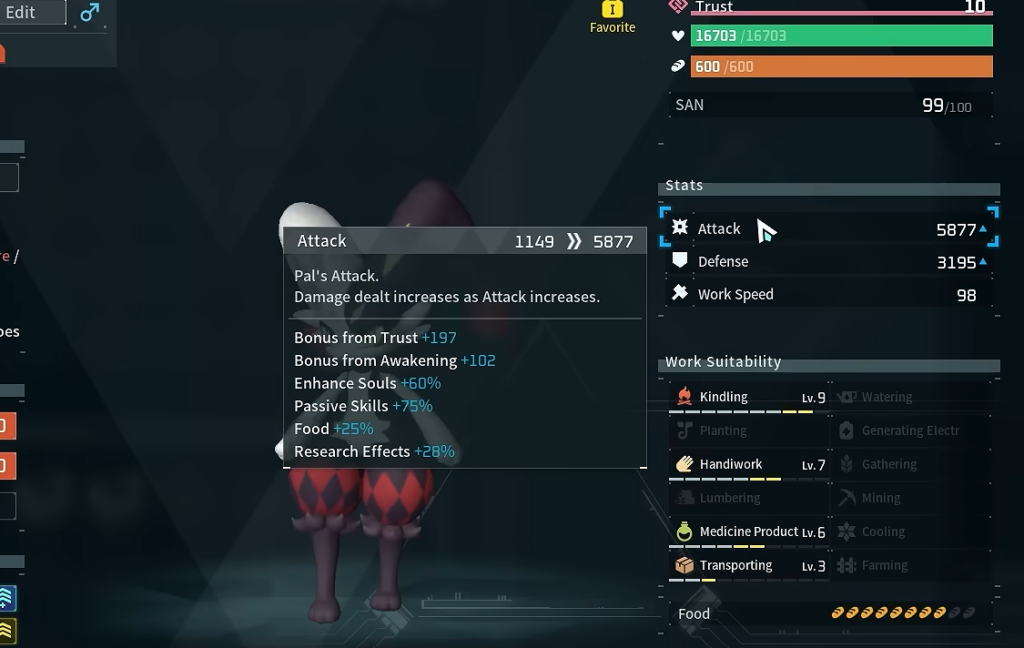
That 4x ceiling is the reason type matters more than a big attack stat in most encounters. A Pal with a mediocre attack number and a matching weakness will out-damage a stronger Pal that is hitting into resistance.
Full Palworld type chart
Use this to pick your attacker before a boss or alpha. Neutral is the outlier, since it has no offensive advantage and mostly earns its place on your base team instead.
| Element | Strong against | Weak to |
|---|---|---|
| Neutral | None | Dark |
| Fire | Grass, Ice | Water |
| Water | Fire | Grass, Electric |
| Grass | Water, Ground | Fire, Ice |
| Electric | Water | Ground, Dragon |
| Ice | Grass, Dragon | Fire |
| Ground | Electric | Grass, Ice |
| Dark | Neutral | Dragon |
| Dragon | Dark | Ice, Dragon |
Dual-element Pals inherit both weaknesses. A Fire/Dark Pal, for example, takes extra damage from both Water and Dragon attacks, so its offense can be strong while its defense is fragile against the right counter.
Elemental partner-skill buffs (the “whistle” effect)
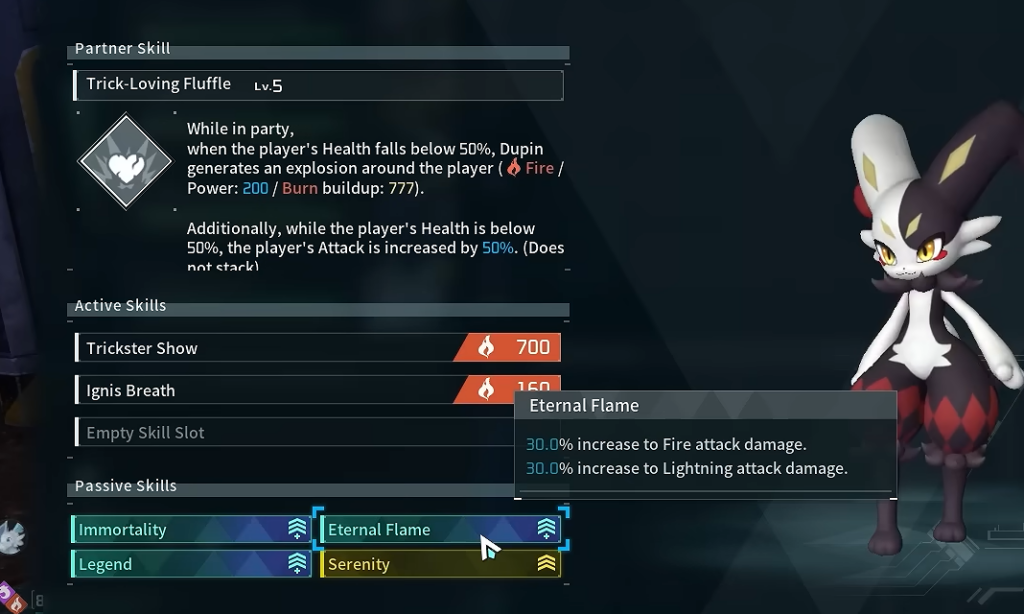
Some Pals passively raise the damage of a specific element for the rest of your party just by being on your team. You do not have to send them out. Recruit one that matches the element you plan to spam, and every Pal throwing that element hits harder.
| Pal | Element buffed | Where to find |
|---|---|---|
| Sparkit | Electric | Small Settlement |
| Dinossom Lux | Electric | PIDF Tower Entrance |
| Rooby | Fire | Natural Bridge |
| Pyrin | Fire | Ruined Fortress City |
| Wixen | Fire | Foot of the Volcano |
| Warsect | Fire | No.2 Wildlife Sanctuary |
| Kelpsea Ignis | Fire | From Raw Kelpsea |
| Hoocrates | Dark | Plateau of Beginnings |
| Pyrin Nox | Dark | Ruined Fortress City |
| Bristla | Grass | Gobfin’s Turf |
| Dinossom | Grass | Grassy Behemoth Hills |
| Verdash | Grass | No.2 Wildlife Sanctuary |
| Dumud | Ground | Northeast of Sealed Realm of Winged Tyrant |
| Foxcicle | Ice | Free Pal Alliance Tower Entrance |
| Kelpsea | Water | Azurobe Hill |
| Cremis | Neutral | Desolate Church |
| Ribunny | Neutral | Ascetic Falls |
Pals that convert your own attacks to an element
A second group adds their element to the player’s weapon damage, so the gun in your hands starts scoring type advantage. Most of these are mounts and only apply the bonus while you are riding them.
| Pal | Element added to player | Condition |
|---|---|---|
| Nox | Dark | On team |
| Anubis | Ground | On team |
| Chillet | Dragon | Mounted |
| Maraith | Dark | Mounted |
| Helzephyr | Dark | Mounted |
| Shadowbeak | Dark | Mounted |
| Frostallion Noct | Dark | Mounted |
| Univolt | Electric | Mounted |
| Beakon | Electric | Mounted |
| Ragnahawk | Fire | Mounted |
| Blazamut | Fire | Mounted |
| Jormuntide Ignis | Fire | Mounted |
| Suzaku | Fire | Mounted |
| Suzaku Aqua | Water | Mounted |
| Azurobe | Water | Mounted |
| Quivern | Dragon | Mounted |
| Frostallion | Ice | Mounted |

Attack power: the raw-damage passive stack
The other route is pure attack. The strongest offensive passive loadout is Demon God, Muscle Head, Ferocious and Serenity on a single carry Pal. That combination pushes flat damage as high as it goes without touching any elemental system.
The trade-off is survivability. If you swap one of those four for Vampiric, you gain life steal and staying power at the cost of some raw output. To judge any Pal fairly at its ceiling, build it with max IVs, fully condensed, and its partner skill at level 5. In the 1.0 update, that ceiling is much easier to reach because the Pal Essence Condenser needs only 48 copies for max rank instead of 116, with Pals and players topping out at level 80.
Why status synergy beats a bigger attack number
The decisive shift in 1.0 is status stacking. You apply a status such as burn, poison, blind, soak or electrify, then bring a Pal that amplifies damage against that exact status. The multiplier from that pairing regularly outperforms a higher raw attack stat, which is why several Pals with modest numbers top their type.
- Burn: Renjishi applies burn, and Jormuntide Ignis raises attack power by 65% against burning targets, a boost that also applies to your Pals.
- Soak: Ophydia inflicts Soak 6, Jormuntide adds +65% damage to soaked targets, and soaked enemies also take double electric damage.
- Electrify: Snot applies Electrify 6 for double water damage plus paralysis, and Slow Wot adds a 60% explosion on top.
- Poison: Dandelord makes your attacks apply poison, and Prixter adds a +65% overall damage increase against poisoned targets.
- Blind: Frostallion Noct applies Blind 6 while mounted, and Rouger adds +65% damage to blinded targets.
Poison has no element of its own, so it layers on top of burn and other status effects without interference. That makes status-plus-amplifier teams the strongest damage engines for a raid army, not the single highest-attack Pal in isolation.
Building your party around the right lever
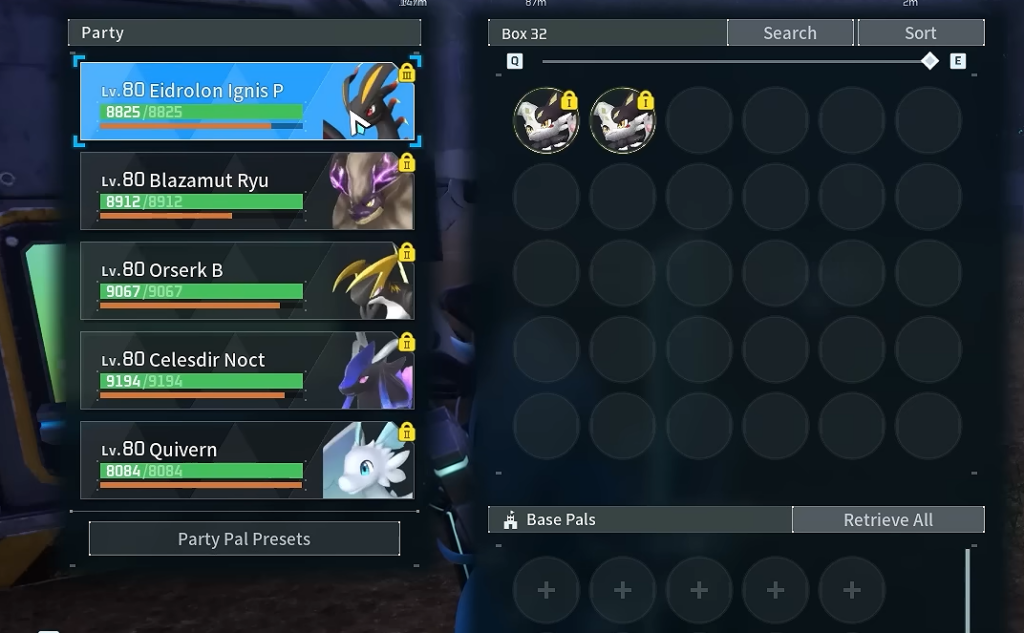
Match your build to the fight. When you are exploring or clearing dungeon bosses that respawn as random types, a diverse team with several elements gives you coverage no matter what appears. Pals that carry two or three elements, like Jormuntide with Dragon, Water and Electric attacks, stretch that coverage even further.
Syndicate Tower bosses are the opposite. They never change, so you can scout their element first and return with a full party built to exploit it. Against Zoe and Grizzbolt, who fight with Electric, load up on Ground Pals and add a Ground partner-skill buffer such as Dumud to raise the whole party’s Ground damage.
So the honest verdict on element versus attack power is that they are not rivals — they are layers. Attack passives set your floor. Type advantage doubles or quadruples it. Partner-skill buffs and status amplifiers push it higher still. Stack all three in the same direction against a known boss, and you will clear fights far faster than any single big-attack Pal ever could.