

Coins are the bottleneck in Dragon Adventures. They pay for auction dragons, potions, themes, seeds, and event items, and the costs climb faster than casual play can cover. The good news is that coin income in this game is mostly arithmetic, not luck. Every crop has a fixed growth time and sell value, every mob drops a fixed amount of meat, and every potion has a rough market price in the Undercity.
Quick answer: Keep a fully fertilized crop field harvesting on a timer, spend your active playtime killing mobs in Prehistoric for meat and bacon, and sell every mutation potion you pull from chests in the Undercity. Those three habits together are what move a day’s income from a few thousand coins into six figures.
Coin sources and what each one pays
Before committing hours to any single method, it helps to see the payouts side by side. Passive income is small per hour but never stops. Active grinding pays far more, but only while you are at the keyboard.
| Source | Where | Typical payout |
|---|---|---|
| Crop harvests | Farm in Origin world | 3,600 coins per hour from a fully fertilized pumpkin field |
| Meat and bacon | Wasteland, Prehistoric | Around 150,000 coins per 90–120 minute grind |
| Chest loot | Every world | Roughly 100,000 in raw coins over a few days, plus potions |
| Mutation potions | Sold in the Undercity | 80,000–95,000 coins each |
| Color and material potions | Sold in the Undercity | Around 5,000 coins each |
| Missions | Anywhere | 1,000 coins for a boss kill, plus season pass rewards |
| Spare dragons | Undercity auction | Around 6,500 for a normal Wasteland Venid |
Notice how skewed that list is. A single mutation potion is worth more than a full day of pumpkin harvests. Farming is not what makes you rich on its own; it is the floor under everything else.

Build the farm first: crops, fertilizer, and plot size
The farm sits in the Origin world, between the World Teleporter and the base portals. It is the only income stream that keeps running while you are offline, so it should be the first thing you set up and the last thing you neglect.

Best crops by coins per minute
Coins per minute is just the harvest value divided by the growth time, and it is the only number that matters when comparing seeds. Pumpkins and bananas top the chart, but both demand frequent check-ins.
| Crop (region) | Growth time | Seed cost | Harvest × sell value | Coins/min |
|---|---|---|---|---|
| Apple Tree (Origins) | 5m 30s | 50c | 1pc × 1c | 0.18 |
| Carrot Plant (Grassland) | 10m 30s | 100c | 2pc × 1c | 0.19 |
| Peach Tree (Jungle) | 30m | 150c | 3pc × 2c | 0.2 |
| Banana Tree (Volcano) | 50m | 200c | 5pc × 3c | 0.3 |
| Onion Plant (Tundra) | 1hr | 250c | 5pc × 3c | 0.25 |
| Watermelon Plant (Ocean) | 1hr 30m | 300c | 3pc × 8c | 0.27 |
| Pumpkin Plant (Desert) | 2hrs | 350c | 3pc × 12c | 0.3 |
| Pineapple Plant (Fantasy) | 2hr 30m | 400c | 3pc × 14c | 0.28 |
| Dragonfruit Plant (Wasteland) | 3hr 30m | 450c | 2pc × 20c | 0.19 |
| Coconut Tree (Prehistoric) | 6hrs | 500c | 4pc × 18c | 0.24 |
A full 100-plot pumpkin field produces 300 pumpkins per cycle. Fully fertilized, that works out to about 3,600 coins per hour, or 18,000 coins across five hours, assuming you return every hour to collect.
Coconuts are the choice if you cannot check in hourly. Their six-hour cooldown fits neatly around sleep and school, and with 225 tiles a harvest returns 900 coconuts. Stockpiled coconuts are also the single biggest merchant payday available, which brings us to the food of the day.
Sell to the merchant on the right day
The merchant rotates a food of the day that pays a premium over the General Store rate. Check it every time you log in, and hold your harvests rather than dumping them the moment the inventory fills. Around 24,000 banked coconuts sold on a coconut day comes to roughly a million coins, which no amount of daily selling matches.
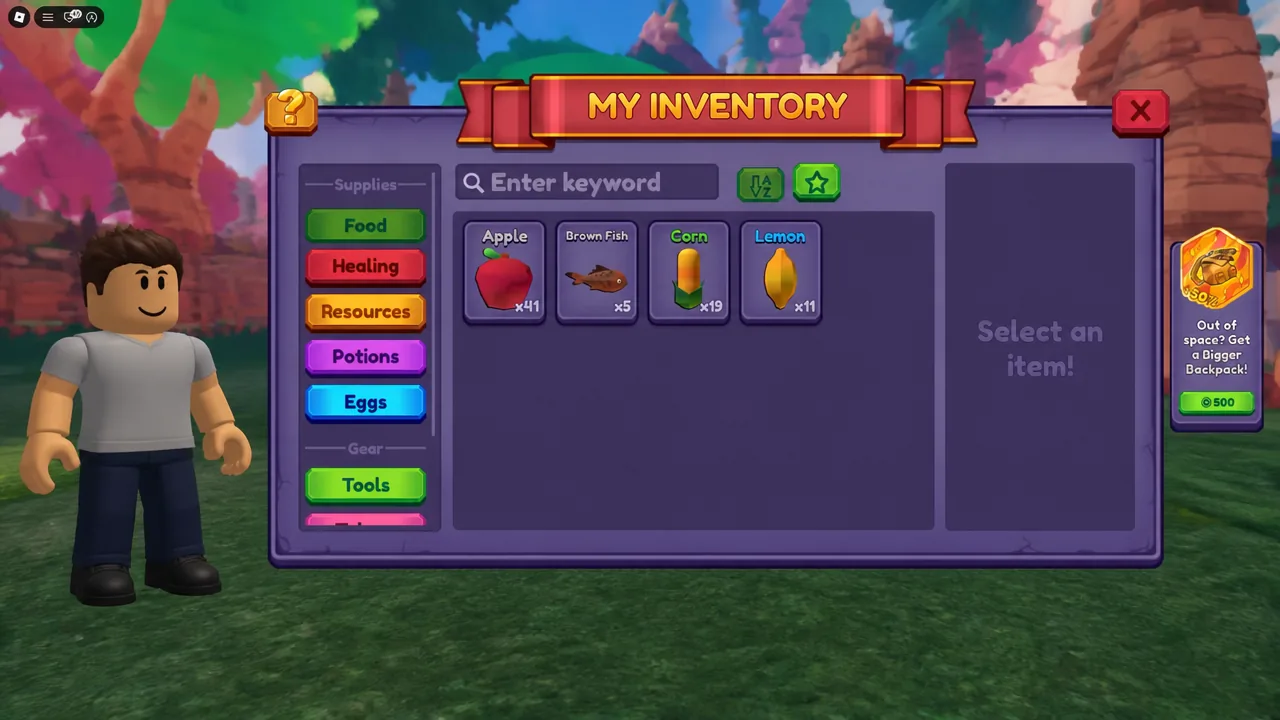
Note: coconut days come around infrequently. If you want steadier turnover, plant a mix of world crops instead of a single-crop field so something you own matches the rotation more often.
Grind meat and bacon in Wasteland and Prehistoric
This is the highest-paying activity available to an ordinary account, and it needs nothing but a strong dragon. Take your highest attack and defense dragon into the best world you have unlocked and kill mobs. Prehistoric mobs are the most generous, dropping 14 meat and 10 bacon each.
Meat sells for 8 coins and bacon for 10 at the General Store, with ashes at a token 1 coin. Grinding to roughly 10,000 meat and 7,100 bacon takes around 90 minutes to two hours and sells for about 150,000 coins. Double the session and you are near 300,000 in a day, which is the difference between a three-week grind landing at 3.1 million or 6.3 million.
You can also convert drops into elixir at the Alchemist rather than selling raw. The conversion rates are fixed.
| Input | Elixir produced | Needed for a Mutation Potion (250 elixir) |
|---|---|---|
| Meat | 1 per 50 | 12,500 meat |
| Bacon | 1 per 25 | 6,250 bacon |
| Ashes | 1 per 250 | 62,500 ashes |
Do the math before you commit. A Mutation Potion sells for roughly 80,000 to 100,000 coins, while 12,500 meat sold raw is 100,000 coins on its own. Crafting is worth it when you need the potion for a dragon or a trade, not as a pure coin play. Since mobs drop both meat and bacon, most players end up brewing from a mix of the two.
Chest runs and potion sales
Chests are scattered across every world, and the raw coins inside are the least interesting part. The real prize is potions. Blue and red chests can drop mutation potions, and a steady chest route across all worlds tends to produce several of them over a week.
Fold the route into travel you were doing anyway. Every time you move between maps for missions or a farm check, sweep the chests on the way rather than making a dedicated trip.

Color and material potions you do not plan to use go straight to the Undercity for around 5,000 coins each. Mutation potions belong in the 80,000 to 95,000 range. Fishing is a parallel source of the same loot: fish in the highest world you have unlocked if you want the fish to be worth selling, or fish in Origins and release the catch if you only care about the potions.
Missions, season pass, and Heroes League quests
Dailies and weeklies are small individually but they cost almost nothing to complete alongside everything else. Prioritize the ones that overlap with what you were already doing, such as “Farm 10 Plants” and “Earn 500 coins”. Defeating a boss pays 1,000 coins, and running the Origins boss is the fastest way to bank that.
Keep a couple of Origins or Grasslands eggs in your inventory permanently so hatching missions can be cleared on demand instead of sending you back to a shop. Clearing enough dailies and weeklies also unlocks the season dragon, which you can keep, trade, or sell in the Undercity.

Heroes League quests are worth the detour because they pay out in eggs rather than coins. Bane, Delver, and Boon eggs all carry real value on the market, and selling them uncut is often better than hatching and hoping for a good roll. Keep dragon flights running too, especially from the higher worlds, where the coin return per flight is meaningfully better.
Selling dragons and event items in the Undercity
Once you have a stable of dragons you do not use, the Undercity is where they turn into coins. Pricing is the whole game here. A normal Venid from Wasteland sits around 6,500 coins, and a Coralina with the Rainbow element around 8,600. List above the going rate and the dragon will simply sit there, because buyers are patient and picky.
Breeding becomes worthwhile in the mid to late game. Pair dragons for high mutations or in-demand themes and auction the offspring rather than selling whatever hatches. Themed and traited worlds sell well too, and an unusual theme can pull a strong price simply because few people are supplying it.
Event timing is the one place where patience beats grinding. Hatch aggressively on the first day of an event, when hype is highest and overpays are common. Then hold anything you did not sell. Once the event closes and supply dries up, event dragons and event potions fetch noticeably more than they did while everyone had them.
A daily routine that stacks every source
None of these methods conflict with each other, which is the point. A single session can advance four income streams at once if you sequence it properly.
| When | What to do |
|---|---|
| On login | Harvest and replant the field, check the merchant’s food of the day, start a dragon flight |
| First 10 minutes | Read the daily and weekly missions so you know which ones the session will clear |
| Main session | Grind mobs in Prehistoric or Wasteland for meat and bacon |
| While travelling | Sweep chests between worlds, collect potions and coins |
| Before logging off | Sell meat, bacon and surplus crops, list spare potions and dragons in the Undercity |
You know a sale landed when the coin counter at the top of the screen updates immediately after the transaction, and Undercity listings only convert once a buyer accepts, so treat those as pending rather than banked. The most common reasons a day ends flat are simple: crops left unharvested past their cycle, an unfertilized field, and potions sitting in the inventory instead of on the market.
Take the grind seriously but not literally around the clock. Long mob-farming sessions are physically tiring, and the players who sustain seven-figure coin totals are the ones who log in consistently, not the ones who burn out over a weekend.