
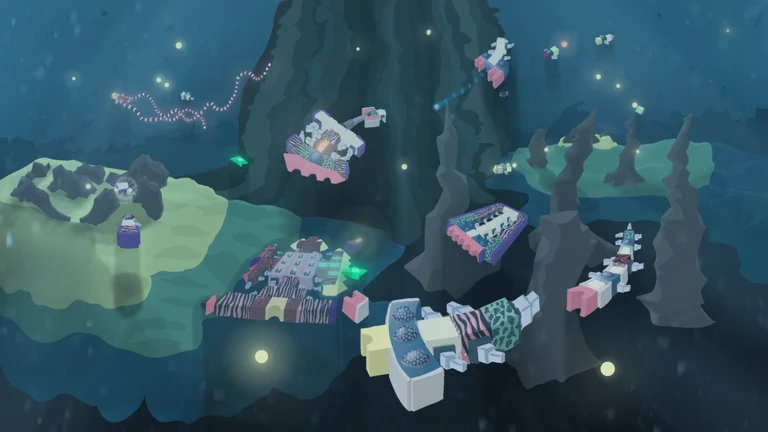
Evolve a Cell starts you as a speck in a pond full of things that want to eat you. You grow by eating food that matches your diet, spend DNA on body parts, and pick stat cards as you level. Mutations open in the middle stages, and Rebirth at Stage 4 resets you into a bigger cell with more points to spend. Your choices at each step decide how long you last.
Quick answer: Eat only your diet’s color and grow under the 3-minute newbie shield. Spend early DNA on health and movement, like thick membrane, fins, and cilia. Then add jaws or leech, roll mutations from Stage 3, and rebirth at Stage 4.
Plants or meat: the first choice in Evolve a Cell
The opening prompt reads “what do you eat?” and offers two choices. Plants grants a filter mouth for feeding on green matter. Meat gives you jaws, letting you eat red orbs and smaller cells you can bite. Carnivores also gain meat chunks from cells they kill, giving them another source of growth and DNA alongside red orbs.
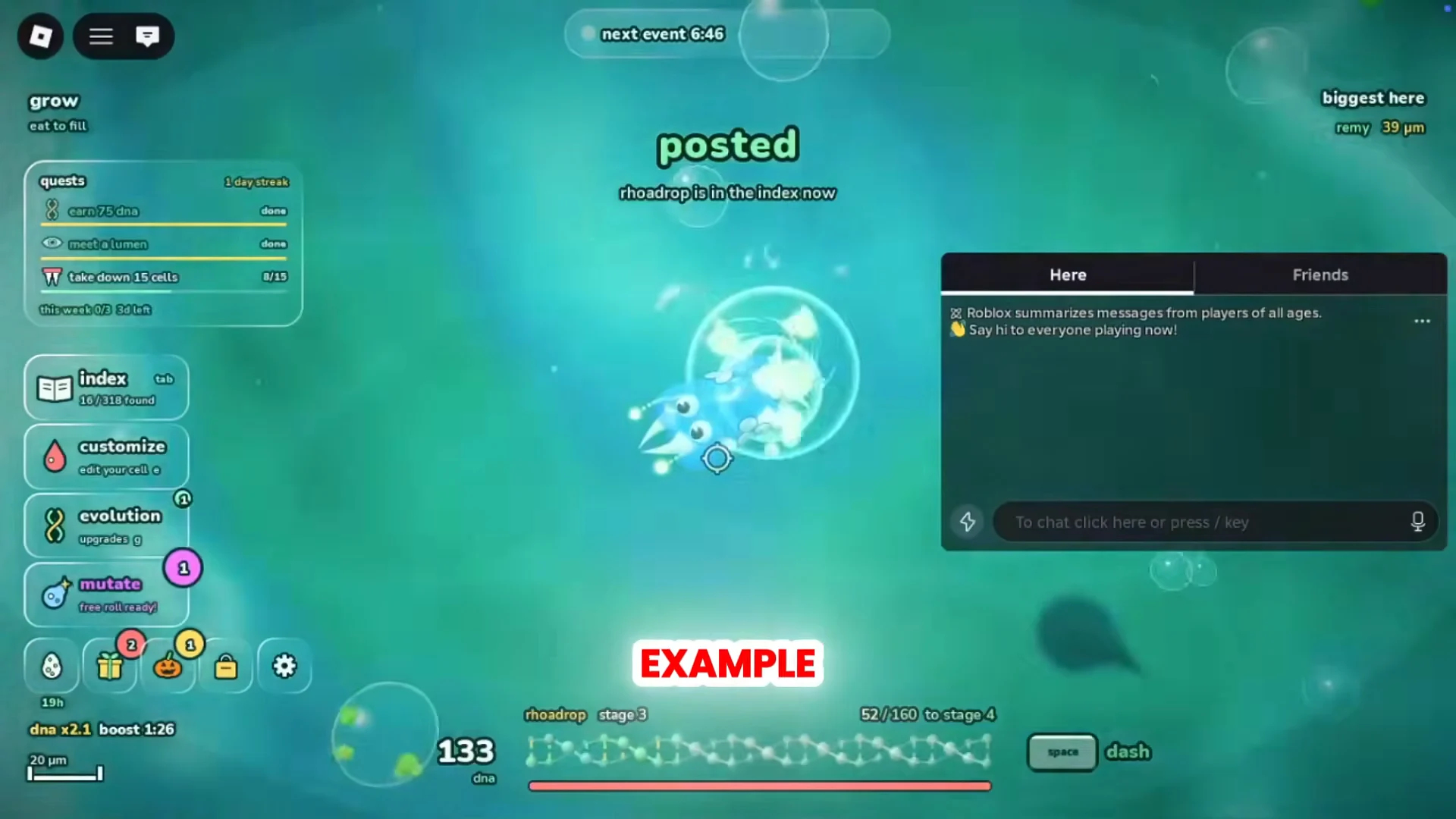
Eating your own color gives the best growth. Switching between colors slows you down. Food and kills fill the bar at the bottom of the screen, and filling it gives you XP, levels, and new stages.
After you hatch from the egg, a newbie shield appears with the message “Nothing can eat you for 3 minutes, grow fast!” Use that time to clear the nearby food and finish early quests. Stay close to where you spawned instead of exploring the edges of the pond.
Spacedashes or pushes you forward.Eopens the evolve and customize screen.- The dotted ring around another organism shows its detection and strike range.
- A “biggest here” tag marks the largest cell nearby.
Once the shield ends, assume every moving cell is dangerous until you know how big it is. Don’t fight a bigger cell right after you spawn.
Where DNA comes from and how to multiply it
DNA pays for everything in the build screen, so the rate you earn it sets the pace of a run. Food and kills give a steady base income. Quests, pond events, and boosts add to it on top.
| Source | What it gives |
|---|---|
| Diet-matched food | Steady DNA and growth |
| Killing cells (meat) | DNA plus meat chunks |
| Golden cell event | Jackpot plus a free roll |
| Sunbeam event | 1.5x DNA while it lasts |
| Weekly rare cell | Bonus reward when caught |
| Free 2x DNA pop-ups | Temporary double DNA |
| Feast (evolution tree) | +25% DNA from meat per level |
| General DNA node | +8% DNA from all sources |
The multipliers stack. Feast increases what every meat bite is worth. More DNA buys parts sooner, those parts help you kill faster, and faster kills bring in more DNA. Your current multiplier shows on the HUD during play, next to the evolution upgrades button. A paid 2x DNA boost and a “Grow now” option are also sold for Robux, but neither is required.
Free DNA from Gifts and the Pond Pass
The Gifts menu rewards you for logging in and playing. Its daily track starts over each week:
| Day | Reward |
|---|---|
| Day 1 | +80 DNA |
| Day 2 | +1 point |
| Day 3 | 2 free rerolls |
| Day 4 | 10 min 2x DNA |
| Day 5 | +2 points |
| Day 6 | Rare card, +120 DNA |
| Day 7 | +4 points, 15 min 2x DNA |
The Pond Pass is currently on Season 1: Haunted Pond. Its free track starts at +100 DNA on Tier 1 and later adds rolls, points, card rerolls, a lucky roll, and seasonal colors like ghoul and pumpkin. The premium tiers cost Robux, but the free tiers can be claimed as you reach them without paying.
Best early upgrades: health and movement before damage
When you level up, three upgrade cards appear along the bottom of the screen. Each card gives a passive stat boost. Collecting mutagens during a run also feeds into this progression. These are the cards you’ll see most often:
| Card | Effect |
|---|---|
| thick membrane | +15% more health |
| mending | Heal 50% faster out of fights |
| cilia | Turn faster |
| flagellum | Whip tail, swim faster |
| jaws | Bite 20% harder |
| leech | Bites heal you, plants give less |
| camo skin | Hunters can’t see you while you swim slowly |
| eye level 2 | Better vision and awareness |
| quick twitch | Dash recharges 12% faster |
Pick up thick membrane, mending, cilia, and flagellum first. They help you survive mistakes and escape fights, and that keeps you growing. Add jaws or leech once you start hunting other cells. Leech makes plants give you less, so it’s a bad pick for herbivores. At Stage 4, the cards offered include thick membrane, leech mouth (a sucker mouth that drains health from targets), and mending.
Body parts in the Evolution menu
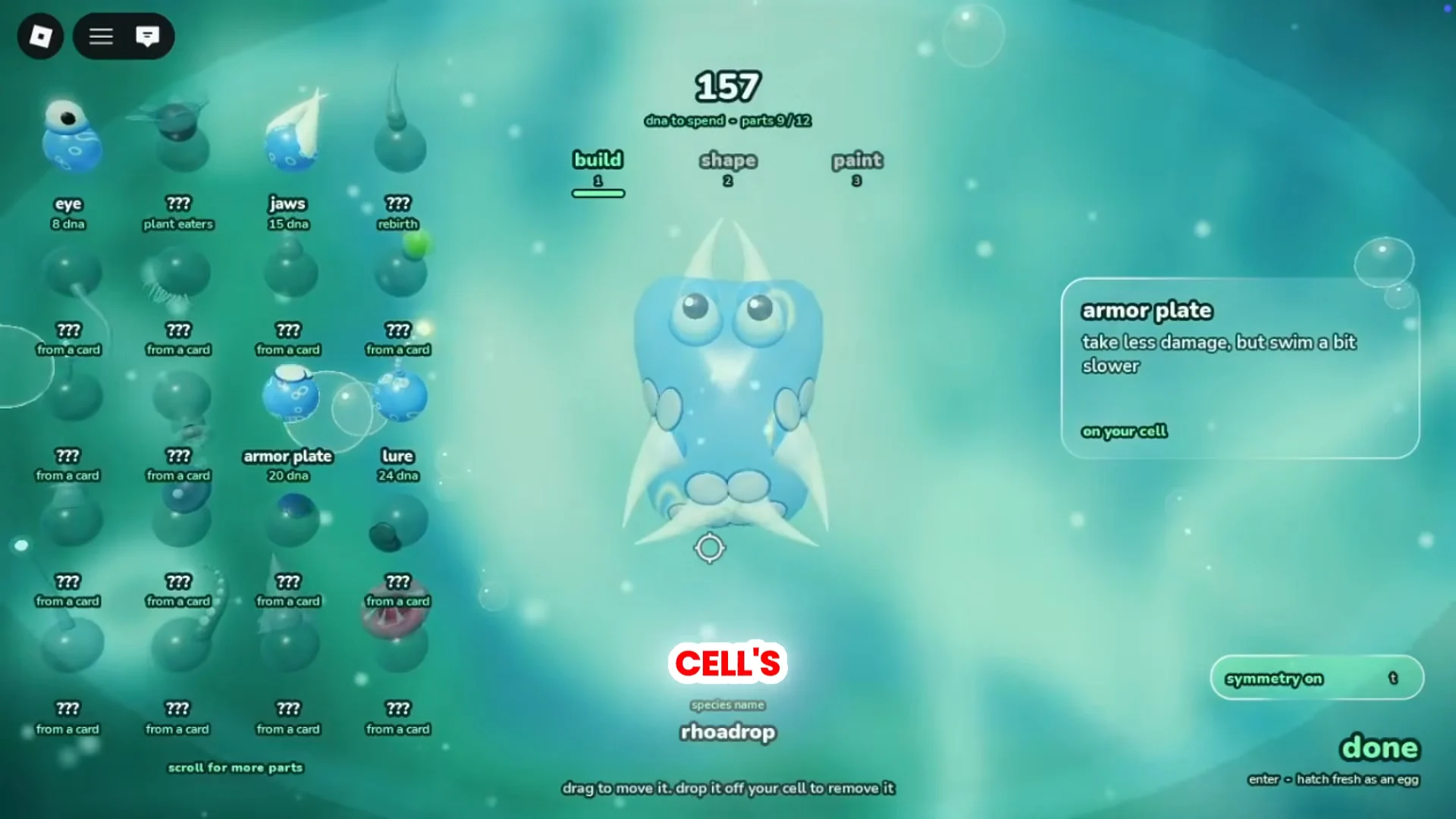
Press E to open the Evolution screen, which has three tabs. In Build, drag unlocked parts onto your cell. Shape controls symmetry, width, stretch, and the cell’s outline. In Paint, choose the body color, pattern color, skin texture, and glowing auras. Index milestones grant more colors and auras.
| Part | What it does | Cost |
|---|---|---|
| fins / tail | Faster straight-line swimming | — |
| jaws | Biting attacks | — |
| tentacles | Whip nearby targets | — |
| horn | Damage when you dash into cells | — |
| drill | Damage while you push into a cell | — |
| poison sac | Leaves poison clouds when you dash fast | — |
| armor plate | Less damage taken, slightly slower swimming | 20 DNA |
| lure | Glowing bulb that pulls food toward you | 24 DNA |
| stinger | Stings and slows anything chasing from behind | 28 DNA |
Where you place a part changes how useful it is. Armor plates and stingers belong on the back of the cell. When you run away, that’s the side your chaser hits. Horns and drills work best on the front, so they point into whatever you charge. The lure is a good fit for herbivores and cautious players, because it pulls food to you and you don’t have to chase it. You can also move the eyes, and turning on symmetry places matching parts on both sides at once.
In the customize menu, right-click a part to take it off. You can then redesign a cluttered cell without beginning again.
Evolution tree branches and the best nodes
The evolution tree has four branches: growth, speed, size, and hunt. You spend evolution points on its nodes, and you hold down on a node to grow it. You earn points by reaching stages (Stage 3 gives +1), from Gifts and the Pond Pass, and in larger amounts from Rebirth.
- feast: +25% DNA from meat per level. Speeds up any carnivore run.
- mending: Faster healing after fights per level. Useful in nearly every build.
- sharp edges: +15% damage per level. Worth it once you commit to hunting.
- mutant genes: Found in the growth branch. Required to open the mutation screen.
Choose one role and spend your points on it. A cell with points spread across melee damage, speed, and size ends up weak in all three. Speed and hunt suit a predator. Growth and mending suit a cell that wants to avoid fights and farm.
How mutations work in Evolve a Cell
Mutations are random passive traits that change how your cell plays. The mutate screen opens from Stage 3, once mutant genes is grown in the growth tree. Each roll shows a new trait with its rarity. You then keep either the new trait or the one you already had, so a bad roll never costs you a good mutation.
| Mutation | Rarity | Effect |
|---|---|---|
| tide rider | Common | Whirlpools throw you out instead of pulling you in |
| slick membrane | Rare | Drills and tentacle whips deal 50% less damage to you |
| hard shell | — | 10% less damage taken |
| sugar nose, vent-born, deep-born | — | Situational passives |
The roll screen keeps a pity counter. In the most recent version it reads “lucky roll: in 10 | legendary: in 100,” which means a lucky roll is guaranteed within 10 rolls and a legendary within 100. Extra rolls cost Robux. The current prices are R$ 27 for five rolls, R$ 225 for fifty, and R$ 72 for a lucky roll, and prices have changed between versions. You also get free rolls from the daily gift, the Pond Pass, and catching the golden cell, so you can keep rolling without paying.
Keep mutations that cover your build’s weak spot. Damage reduction like hard shell or slick membrane pairs well with thick membrane on a defensive cell. A mutation that doesn’t fit how you play is worth rerolling.
Stage 4 and Rebirth
When you reach Stage 4, a “stage 4: you grew, time to evolve” prompt appears, followed by “Rebirth unlocked.” Rebirth resets your current cell. In return, the next one starts bigger and you get more evolution points for the tree. The mutation screen stays available after you rebirth, so you can roll for perks on the new cell as well.
Every Rebirth makes the next run start stronger. That means slow, safe growth to Stage 4 is worth more than a single risky kill along the way.
Quests, pond events, and threats
Your quests appear in the upper-left of the HUD. Examples include “earn 75 dna,” “meet a lumen,” “take down 15 cells,” and a 7-day streak. Completing them gives you rewards without having to fight high-tier creatures, which makes them the safest way to progress.
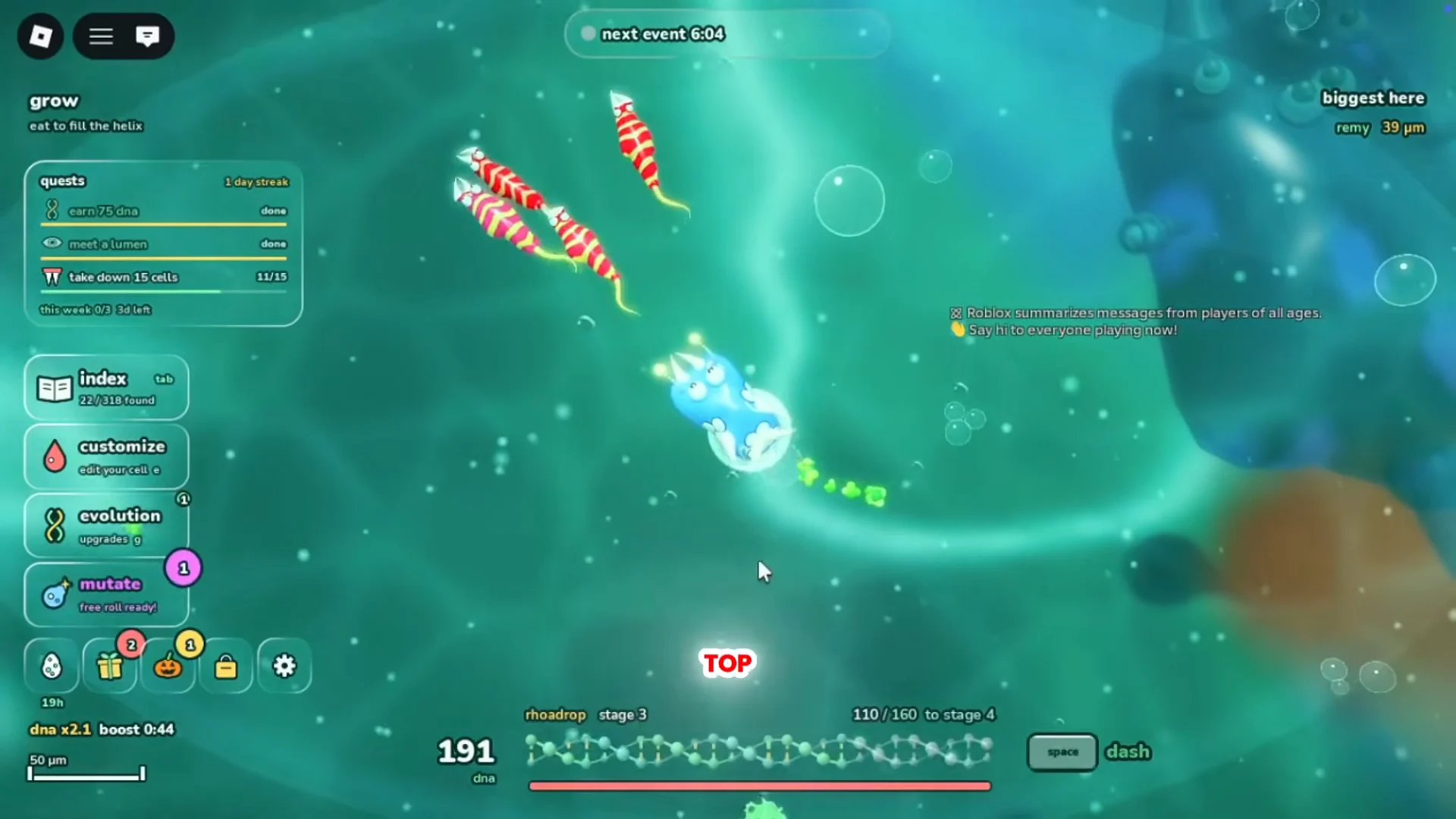
Random events alter the pond during a run. Their banners show up at the screen’s top and center.
| Event | What to do |
|---|---|
| meteor shower | Dodge the impacts |
| red tide | Leave the toxic water |
| the leviathan rises | Avoid the giant organism |
| hunters noticed you | Big cells now chase you, so dash away |
| carcass | Feed on the large food deposit |
| feeding frenzy | Eat fast during the window |
| golden cell | Follow the yellow arrow and catch it |
| sunbeam | Farm during the 1.5x DNA window |
| night falls | Expect visibility to change |
Other events include golden sugar, migration, kelp forest, nest events, and a weekly rare cell. Some plants fight back too: defensive plants and some wandering hazards release green clouds that hit hard. Keep an eye on your health bar and dash away as soon as a “danger” marker appears near a large creature.
What happens when your cell dies
When something kills you, the death screen shows who did it and gives you three options:
| Option | Result |
|---|---|
| descendant | Continue into generation 2 with some of your design preserved |
| start over | Back to stage 0 as a new cell |
| second chance | R$ 49 to revive on the spot and keep everything |
If you choose start over, you can pick a diet again, or hatch as any creature you’ve already logged in the Index, like the drifter or the abyssal. Paying to revive after an early death is rarely worth it. Rebuilding is cheap in the first stages, and dying teaches you the pond’s pace.
The basic loop doesn’t change: eat your color, grow, spend DNA on the part that fixes your current weakness, and fight only cells you can beat. When a fight starts going badly, dash away and go back to eating. Your next Rebirth makes up for the kill you missed.