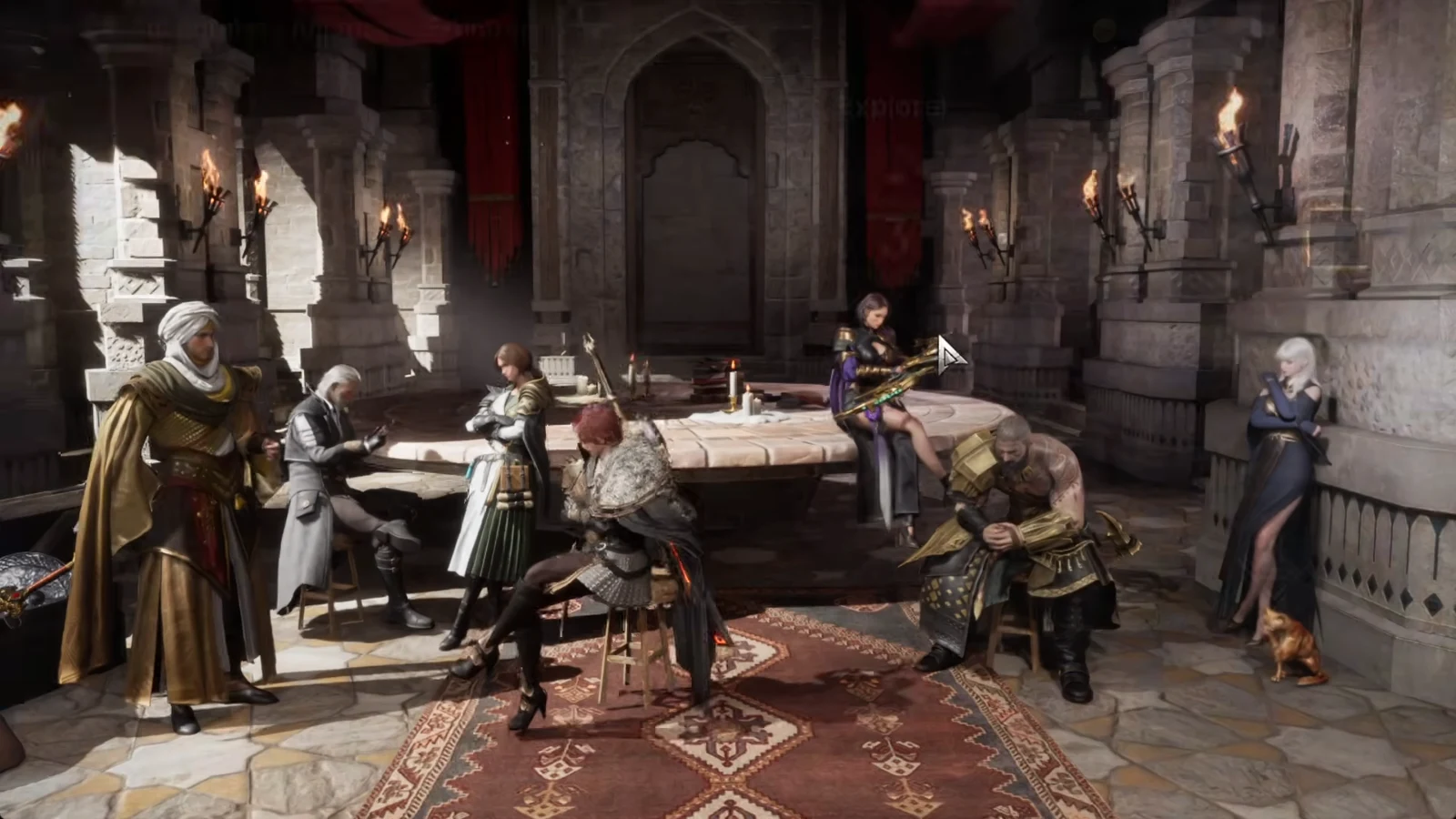
The Adventurers Alliance is the quiet power spike in Night Crows. It looks like a vendor hub, but every guild inside it is really an affinity track that gates permanent stat research, blueprints, costume materials, gliding mounts, and the constellation cards that shape your build. Ignore it for a few weeks and you end up paying for that in attack power later.
Quick answer: Open the Adventurers Alliance menu, donate every medal you hold to raise affinity, clear each guild’s task list, and spend your affinity currency on the Blacksmith Guild first for attack power cards and weapon research.
How guild affinity works in Night Crows
Access to the alliance comes from main story and side quests, and the individual guilds open up as you progress rather than all at once. The Artisan Guild, for example, comes online around level 36, at the same point Giant’s Tower becomes available.
Affinity is the only real currency of the system. Each guild tracks its own level, and rewards continue climbing well beyond the early tiers, with the Merchant track running up to affinity level 25. Higher affinity unlocks better shop stock and the higher-rarity constellation cards, up to 5-star.
There are two ways to push a guild’s affinity up. The first is donating medals, either generic ones such as the Forsaken Land’s Medal or guild-specific medals like the Merchant Guild’s Medal, Artisan Guild’s Medal, and Blacksmith Guild’s Medal. The second is completing that guild’s own task list.
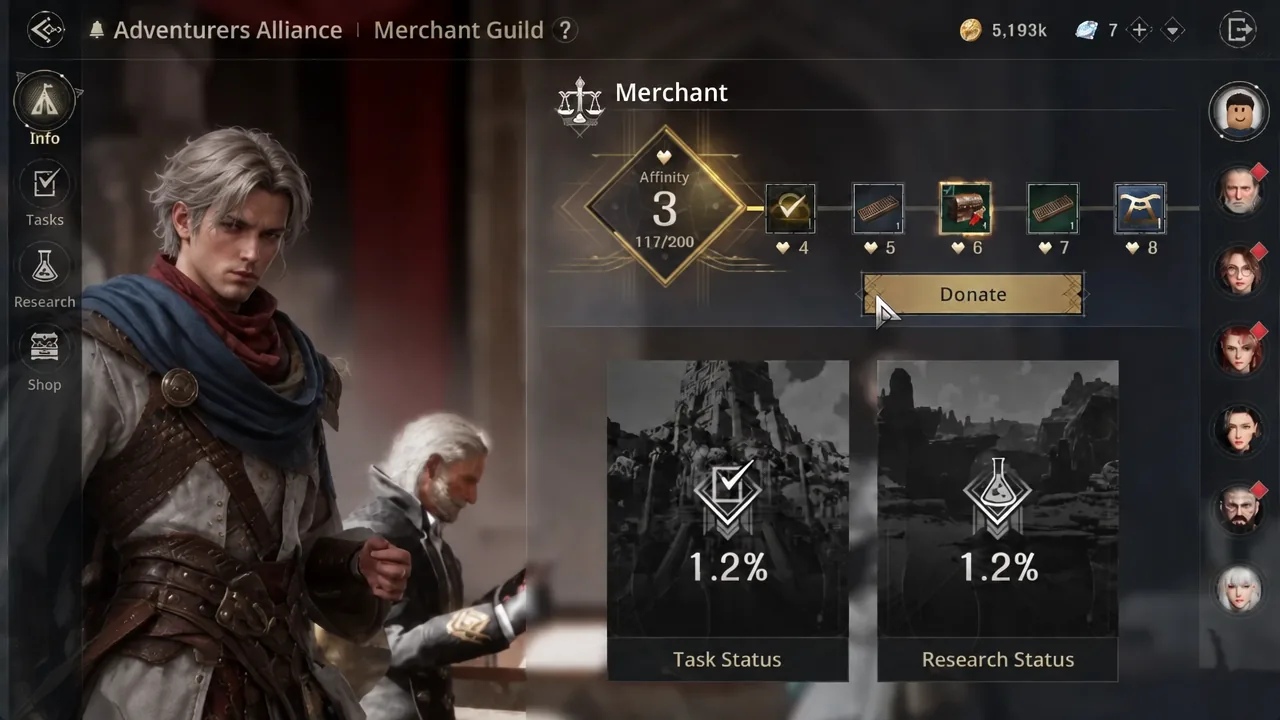
Tip: guilds with something waiting for you are flagged on the Adventurers Alliance list with a red notification marker, so you can sweep pending tasks and rewards without opening all seven panels one by one.
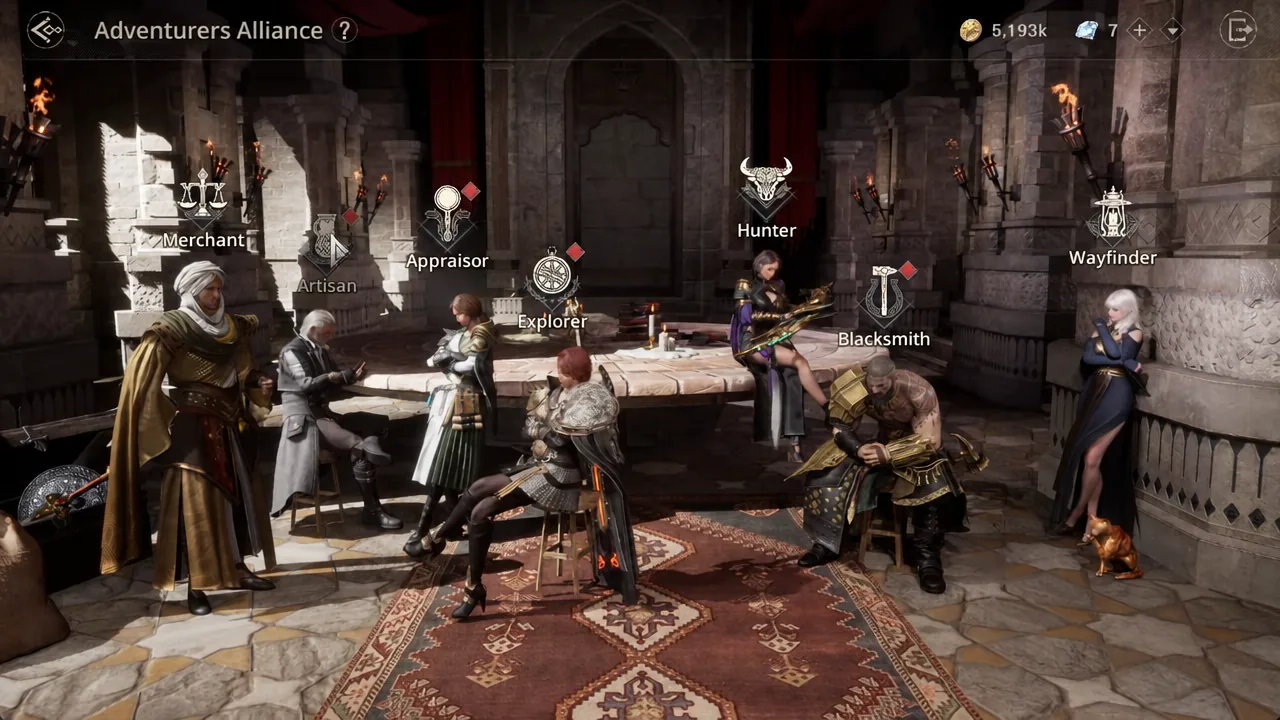
Which guild to prioritize first
Blacksmith is the priority. It holds the attack power constellation cards, gear research, and the weapon and armor blueprint fragments, which means it moves your combat numbers more directly than anything else in the alliance.
Merchant is the second stop, mainly because of its weekly relic chests. A Lesser Relic of Subjugation Chest runs 100,000 gold and can produce relics such as Relic of Subjugation IV, which carry meaningful stat boosts. After that, it is a question of what you personally need: costumes, a glider, or card packs.
| Guild | What it is for |
|---|---|
| Blacksmith | Attack power cards, gear research, weapon and armor blueprint fragments, Etherium Ore |
| Merchant | Weekly relic chests, donation-heavy affinity track, Master Merchant’s Abacus |
| Artisan | Accessory crafting blueprints, accessory research, damaged accessory materials |
| Appraiser | Constellation cards, costume and phantom weapon summon chests, Costume Seals, Powerstone Refining Stones |
| Explorer | Gliding mount crafting materials and potential abilities |
| Hunter | Monster card codex research, commission contracts, elixirs |
| Wayfinder | Exploration research and card packs, including Stardust |
Hunter deserves a mention for its daily value rather than raw power. The extra commission contract it sells stretches how much you can earn in a day, and the elixirs it stocks are cheap consumables you will burn through anyway.
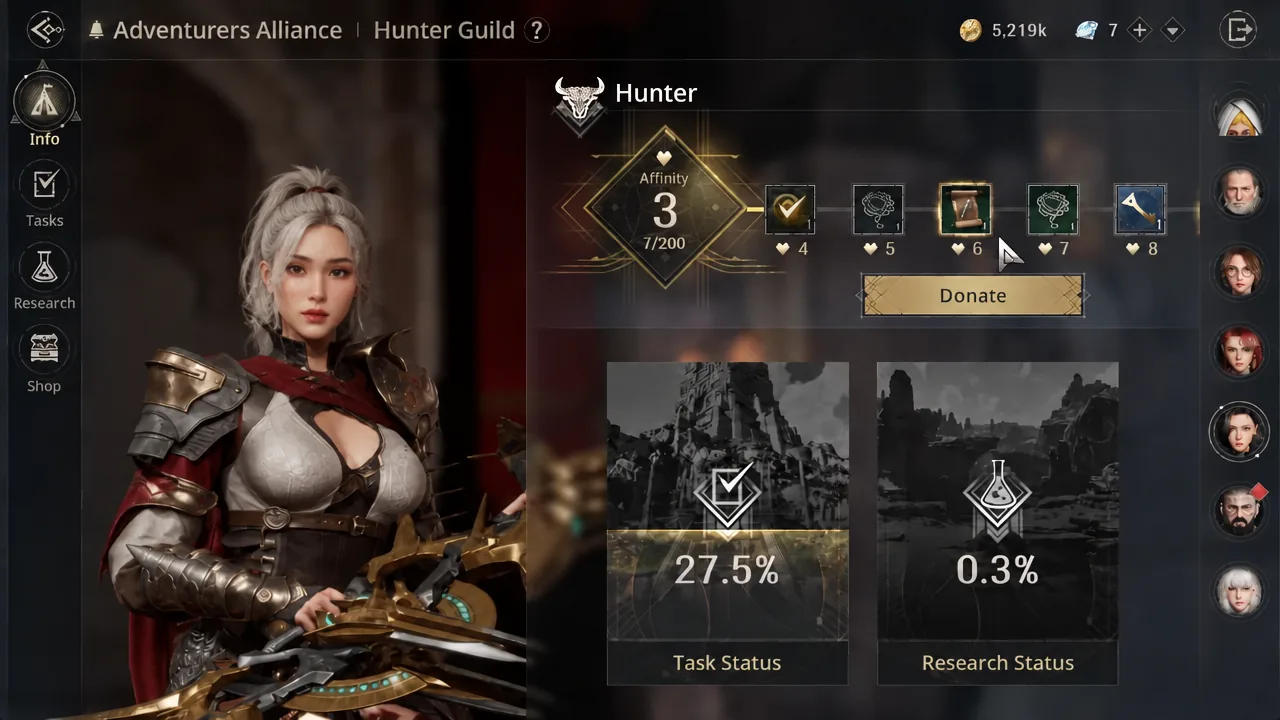
Research: turning junk items into permanent stats
Every guild has a research tab, and this is the part players skip most often. You feed it specific items and it returns stat boosts that stick with your character. The Artisan track handles accessories, so items like Damaged Earrings, Damaged Gem, Rusty Necklace, and Brilliant Necklace stop being vendor trash and become research fuel.
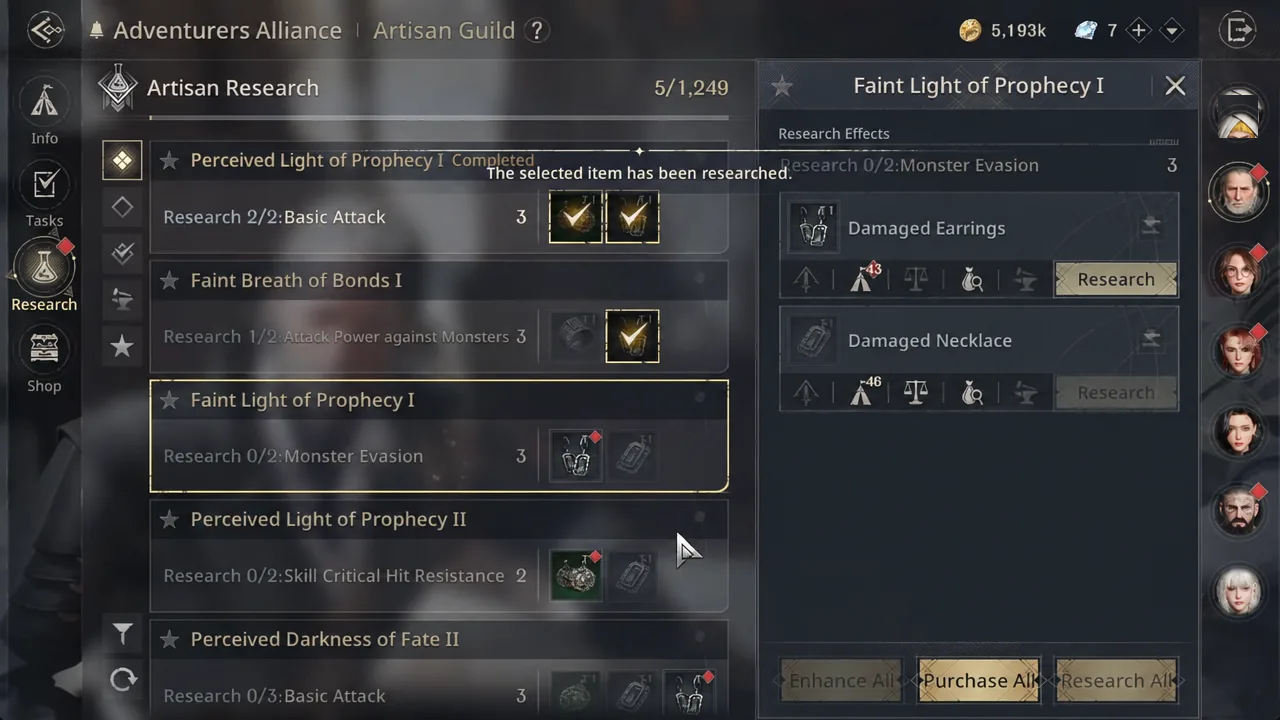
The other research tracks work the same way with different inputs. Blacksmith research covers gear, using materials such as Damaged Fiber, Damaged Mineral, and Etherium Ore. Hunter runs a monster card codex, which you fill in as you kill things. Wayfinder rewards exploration, specifically collecting the shining objects scattered across the map.
Note: hold onto low-grade materials with “Damaged” in the name. Several of them are cheap in the guild shops (Damaged Gem, Damaged Mineral, and Damaged Fiber all sit at 3,000), so buying them outright to finish a research node is often faster than farming.
Guild shop prices worth tracking
Each guild’s Shop tab unlocks more stock as its affinity rises, and there is a Purchase All option for the bulk materials, which saves a lot of tapping when you are stocking up for a craft.
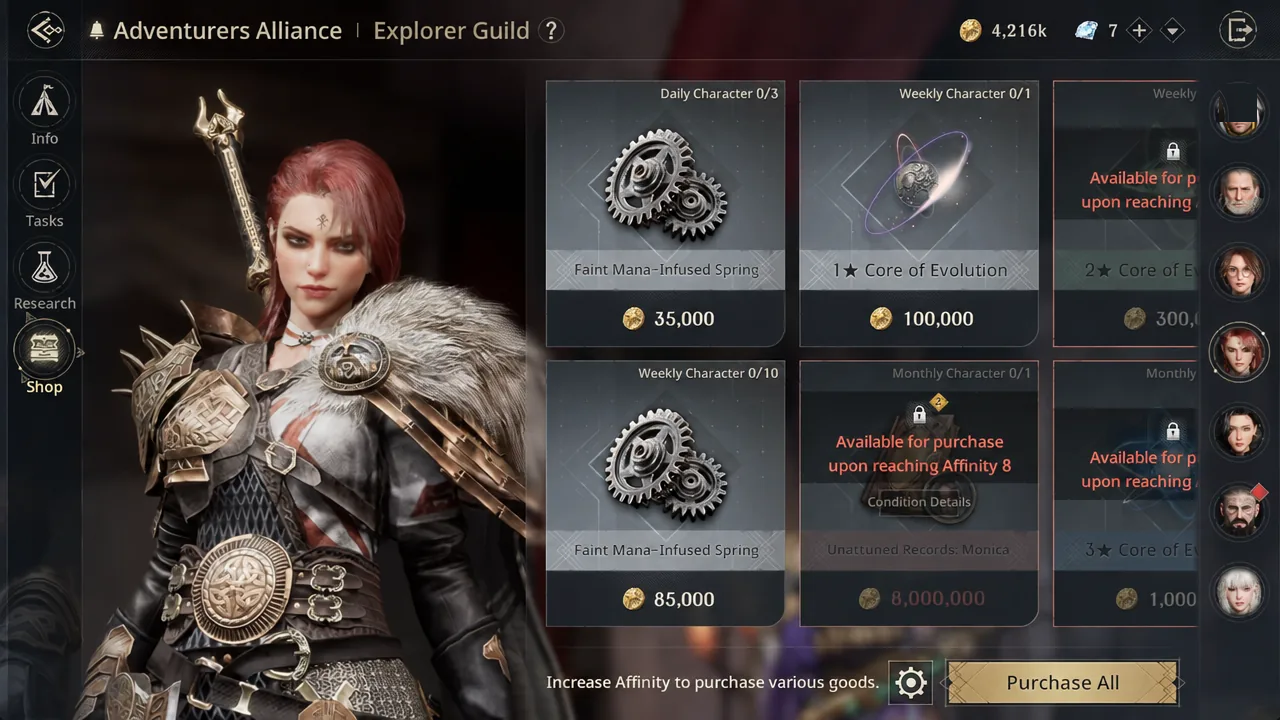
| Item | Guild | Price |
|---|---|---|
| Lesser Relic of Subjugation Chest | Merchant | 100,000 |
| 4-Star Lesser Accessory Blueprint Fragment | Artisan | 2,000,000 |
| 4-Star Lesser Weapon Blueprint Fragment | Blacksmith | 1,500,000 |
| Etherium Ore | Blacksmith | 80,000 |
| Mithril Ore | Artisan | 80,000 |
| Costume Seal | Appraiser | 85,000 |
| Greater Phantom Weapon Summon Chest | Appraiser | 100,000 |
| Appraisers’ Guild Costume Summon Chest | Appraiser | 50,000 |
| Powerstone Refining Stone | Appraiser | 12,000 |
| Core of Evolution | Explorer | 100,000 |
| Faint Mana-Infused Spring | Explorer | 35,000 |
| Daily Additional Commission Contract | Hunter | 35,000 |
| Elixir of Onslaught I | Hunter | 20,000 |
| Bermor Root | Hunter | 10,000 |
| Empty Bottle | Hunter | 2,000 |
| Lesser Card Pack | Wayfinder | 30,000 |
| Intermediate Card Pack | Wayfinder | 400,000 |
| Stardust | Wayfinder | 35,000 |
Faint Mana-Infused Springs and Cores of Evolution are the two Explorer purchases that matter, because they feed glider crafting. Combined with materials such as Cloud Feather and Advanced Gliding Gear, they produce a gliding mount that also carries its own potential abilities.
Constellation cards: equip, level, transcend
Constellation cards come out of the Appraiser Guild and the Wayfinder card packs, and they are the reason affinity grinding pays off long term. Cards slot into your constellation layout, level up by feeding them Stardust, and can be transcended into higher tiers once you have duplicates or the right materials.
Because the strongest cards sit behind higher affinity, the order you raise guilds effectively decides which cards you can chase first. That is the practical argument for Blacksmith before anything cosmetic: its cards feed attack power directly.
Arbiter’s Ordeal: where the upgrade materials come from
Alliance shops sell you the entry price, but the bulk upgrade materials come from Arbiter’s Ordeal, which splits into separate runs depending on what you need.
| Ordeal | Farms materials for |
|---|---|
| Ordeal of Constellations | Constellation card upgrades |
| Ordeal of Binding | Costume binding and leveling |
| Ordeal of Skill | Skill upgrades |
| Ordeal of Gold | Gold income |
Run the ordeal that matches your current bottleneck rather than rotating through all four. If your cards are capped on Stardust, the Constellations run is the answer; if you are short on shop gold for relic chests, the Gold run is.
Why affinity stops going up
Affinity stalling almost always comes down to one of three things. You have no medals left to donate, you have not cleared the guild’s task list, or the guild itself is not unlocked yet because you have not reached the quest or level requirement that opens it. The Artisan Guild is the clearest example, since it stays closed until around level 36.
You will know a donation landed because the guild’s affinity level ticks up on its panel and the next tier of shop stock and rewards becomes selectable. If the shop list has not changed, you have not crossed a threshold yet.
Treated as a daily habit, the alliance is mostly free progression: sweep the notification markers, dump medals into Blacksmith and Merchant, buy the weekly relic chest, and let the rest fill in as you level.