
Two of Palworld’s strongest World Tree passives push raw attack to the top of the charts, but they take opposite approaches to survivability. Twin-Edged Holy Blade goes all-in on damage, while God of Destruction trades a little attack for defense and a big chunk of health. When you dig into how effective health actually behaves during a fight, one of them pulls clearly ahead.
Quick answer: Run God of Destruction on a combat Pal that heals through lifesteal or auto-regeneration. It gives up only 2% attack versus Twin-Edged Holy Blade but converts every point of restored health into far more effective health, reaching up to 40% more total durability in long boss fights.
God of Destruction vs Twin-Edged Holy Blade: Effects compared
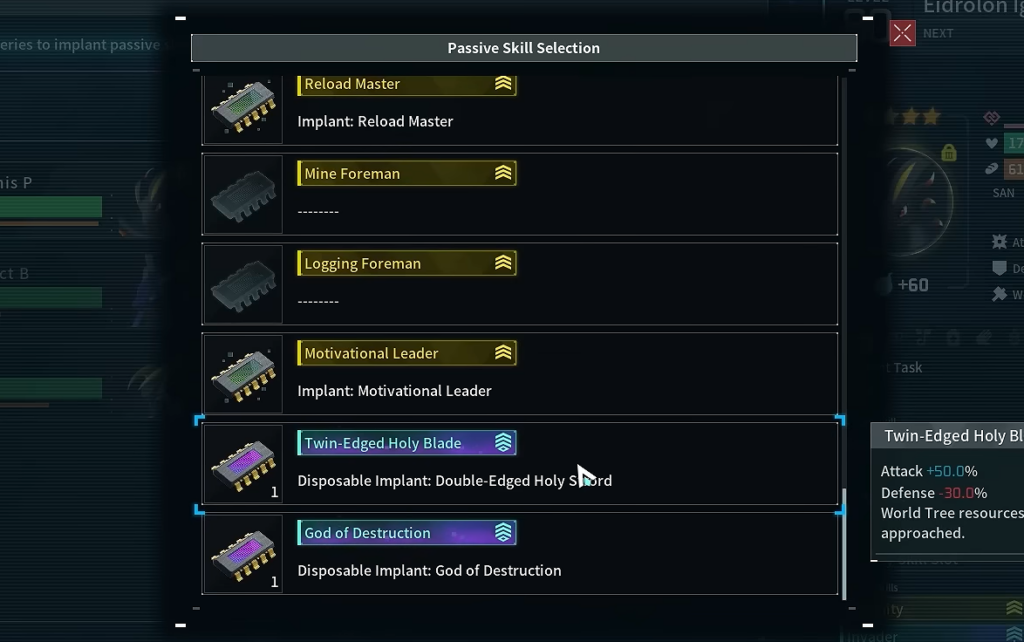
Both are rank +5 World Tree passives, and both keep World Tree resources from vanishing when you approach them. The combat-relevant difference sits in how each one balances offense against defense.
| Passive | Attack | Defense | Max HP |
|---|---|---|---|
| Twin-Edged Holy Blade | +50% | -30% | — |
| God of Destruction | +40% | +20% | -50% |
Twin-Edged Holy Blade is the biggest raw attack passive in the game, but it pays a -30% defense tax. God of Destruction takes a different shape: slightly less attack, a defense boost, and a heavy -50% cut to maximum health.
The attack gap is smaller than it looks
On paper the +50% versus +40% split suggests Twin-Edged Holy Blade should hit noticeably harder. In practice, once you stack full party attack buffs on top of the base stat, the percentage difference shrinks a lot.
| Passive | Attack (full buffs) | Defense (full buffs) |
|---|---|---|
| Twin-Edged Holy Blade | 13,988 | 5,582 |
| God of Destruction | 13,672 | 6,745 |
With everything buffed, Twin-Edged Holy Blade ends up only about 2% ahead on total attack. That tiny edge is not enough to carry a build on its own, and God of Destruction already sits higher on defense before any survivability math starts.

Effective health without healing favors Twin-Edged
Effective Health (EHP) is defense multiplied by current HP, and it tells you how much incoming damage a Pal can soak before dropping. If a Pal never heals during a fight, the raw HP pool matters most, and here the -50% max health on God of Destruction hurts.
| Passive | Defense | HP | EHP (no regen) |
|---|---|---|---|
| Twin-Edged Holy Blade | 2,093 | 17,651 | 36,943,543 |
| God of Destruction | 3,256 | 8,825 | 28,734,200 |
In a no-healing scenario, Twin-Edged Holy Blade holds roughly 29% more effective health. If your Pal takes hits and never recovers, the glass-cannon passive is actually the tougher of the two.
How lifesteal and regeneration flip the result
Real combat rarely happens without healing. Add the Immortality passive, which grants +5% Life Steal, +100% Auto Health Regeneration Rate, and +15% Attack, and the comparison changes completely.
Because God of Destruction raises defense, every point of health it restores is worth more effective health than the same point on a low-defense Pal. Twin-Edged Holy Blade regenerates more raw HP per second thanks to its larger pool, but that HP is cheaper in EHP terms.
| Metric | Twin-Edged Holy Blade | God of Destruction |
|---|---|---|
| Regen with Immortality | 106 HP/s | 53 HP/s |
| EHP restored per second | 221,858 | 172,568 |
Base auto-regeneration runs at 0.3% per second and doubles to 0.6% per second once Immortality is equipped. A Healing Potion adds roughly 15 HP/s on top of that. Twin-Edged still restores more EHP per second in isolation, but the totals reverse when regeneration compounds over a full fight.

Boss fight results: God of Destruction pulls ahead
The longer a fight runs and the more damage a Pal takes, the more God of Destruction’s defense scaling stacks up. Short bursts stay close, but extended fights swing hard in its favor.
| Scenario | God of Destruction | Twin-Edged | GoD advantage |
|---|---|---|---|
| Bjorn 50%, 2 min | 95,047,583 | 92,924,510 | +2% |
| Bjorn 80%, 2 min | 118,858,711 | 108,230,619 | +10% |
| Zenara 80%, 6 min | 763,751,811 | 549,484,148 | +40% |
A short two-minute fight where the Pal only chips away 50% of Bjorn’s health barely separates the two. Push that to 80% of Bjorn’s health and God of Destruction opens a 10% lead. In a six-minute solo run against Zenara, the gap widens to 40% more total effective health. The pattern is clear: the harder and longer the fight, the more God of Destruction wins.

How to get and equip either passive
Neither passive is guaranteed on any wild Pal, and both sit outside the normal wild-passive pool. There are three reliable ways to obtain them.
- Recycle Ancient Relics in the Ancient Relic Recycler to roll a disposable implant. Twin-Edged Holy Blade comes from the Disposable Implant: Double-Edged Holy Sword, while God of Destruction has its own implant of the same name.
- Catch Blue Glowing Pals inside the World Tree, which can randomly roll World Tree passives including these two.
- Breed a Pal whose parent already carries the passive, since offspring can inherit up to four passives.
Once you have the implant, build a Pal Surgery Table at your base and interact with it to install the passive. The surgery itself costs no gold, but the implant is consumed in the process, so finish breeding, rank-ups, and IV work before you spend it.
For a combat Pal that already leans on lifesteal or auto-regeneration and expects to survive drawn-out boss and raid fights, God of Destruction is the stronger pick. Twin-Edged Holy Blade keeps its niche on a pure burst attacker that either avoids damage entirely or never heals mid-fight, but in most sustained encounters the defense scaling of God of Destruction makes it the better combat passive.