Tattered Banners is a turn-based tactics RPG built around leading a mercenary company across a medieval-fantasy realm that reacts to what you do. A demo playthrough of version 0.8.5 lays out the core loop clearly: you pick a background, fight small tactical battles, level up your fighters, gather resources, and eventually raise a company banner that expands what your warband can do. Developed and published by CookieByte Entertainment, it leans on comparisons to systemic sandbox tactics games while carrying its own combat rules.
Quick answer: Tattered Banners is a grid-less, turn-based tactics RPG where you run a mercenary company in a simulated world with faction reputations and a customizable banner. It is planned for Early Access in Q1 2027.
Starting background sets your first three fighters
Instead of building a single hero, you choose an origin that hands you a fixed trio of units with set names, portraits, and classes. The demo picks the “Rural plainfolk” start, which gives a Farmer wielding a scythe, a Poacher with a bow, and a Shepherd carrying a club. The three starters are Shoughur Dealbreaker, Svanuk the Fair, and Cyrilla Crooked Teeth, all at level 1.
Other origins change the mix entirely. The four options each pair three backgrounds together:
| Origin | Backgrounds |
|---|---|
| Rural plainfolk | Farmer (scythe), Poacher (bow), Shepherd (club) |
| Lowborn city gangs | Stablehand (pitchfork), Thief (bow), Thug (club) |
| Witch Hunters | Thug (club), Mystic (fire staff), Inquisition Informant (dagger) |
| Dark Cultists | Cultist (dagger), Zealot (club), Woods Witch (fire staff) |
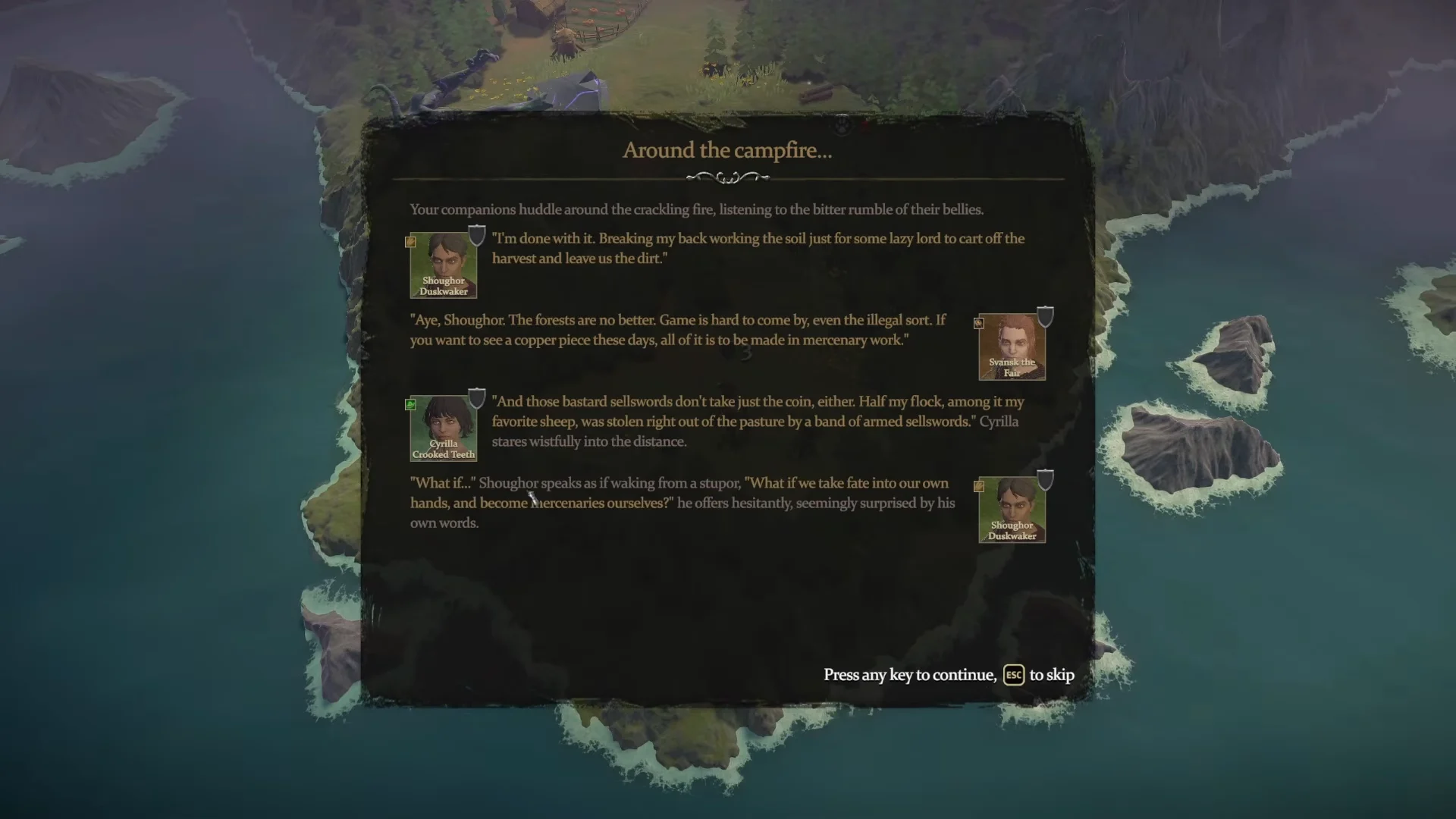
The opening plays out as a campfire scene where the three peasants talk themselves into becoming sellswords, which kicks off the first objective, “ASSEMBLE YOUR BANNER.”
Grid-less combat runs on an initiative timeline
Battles trigger when you meet a hostile group on the overworld, such as a wandering wolf pack, and confirm the Battle Preparations screen. Fights take place on open terrain without a visible grid. Movement paths, target cones, and enemy melee ranges are shown with colored highlights so you can read where units can reach and who can hit whom.
A bar at the top of the screen shows the action sequence, listing each ally and enemy in the order they will act. Two systems affect how you use your turns:
- Attacks cost Stamina. Dropping to zero triggers an “Out of Breath” state that delays the character, cancels their action, and leaves them vulnerable.
- Some attacks have delayed execution, so enemies or allies can disrupt them before they land.
- Moving out of melee range can provoke Attacks of Opportunity.
- Ranged skills like Delaying Volley can push enemy turns further back on the timeline.
The demo also leans on set-up abilities. In the second wolf fight near Kraggen’s Hold, one unit places a Snipe Line reaction while another sets Covering Fire, letting them intercept wolves as they close in rather than waiting to be attacked. Winning a battle produces a Victory screen with XP, level-ups, and crafting spoils like Wolf Claws, Wolf Fangs, and Wolf Pelts.
Specializations lock in each unit’s role
Leveling up lets a unit choose a permanent specialization tied to its background. Each one unlocks combat abilities, reactions, and stat bonuses. The available picks depend on which class the character started as.
| Background | Specializations |
|---|---|
| Farmer | Bulwark, Sentinel, Pyromancer |
| Shepherd | Assassin, Provoker, Bounty Hunter |
| Poacher | Wrathblade, Provoker, Berserker |
In the session, the Farmer takes Sentinel (which grants Covering Fire), the Shepherd becomes an Assassin (Snipe Line plus critical perks), and the Poacher takes Provoker (taunting and disruption). Because origins and specializations can mix freely, the game encourages unusual combinations across a party rather than one fixed archetype per class.
Overworld travel, resources, and settlements
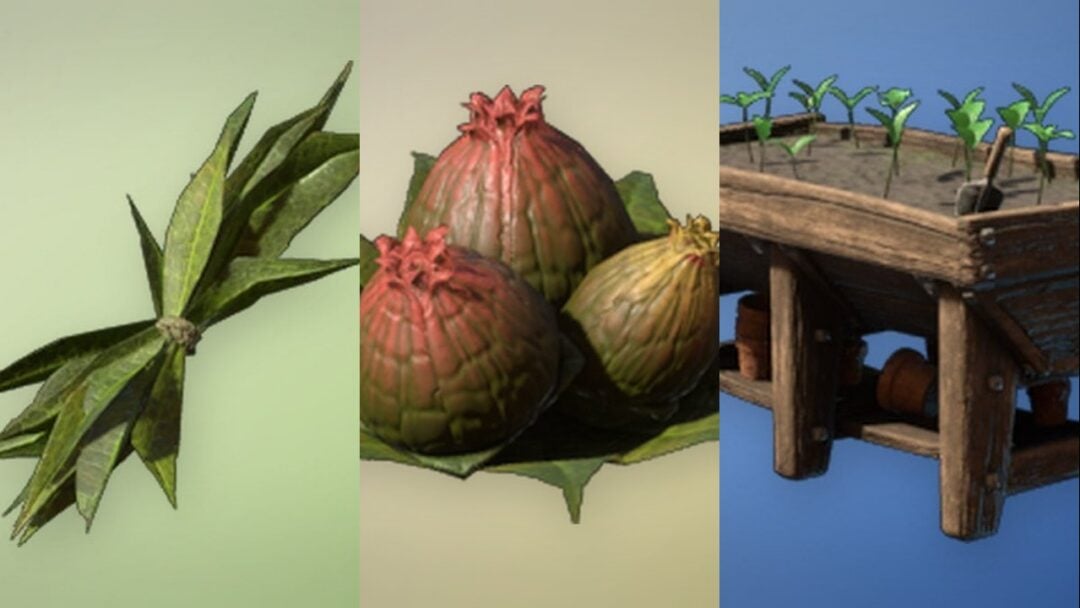
Between fights you move the company across an overworld map dotted with resource nodes and settlements. You can harvest loose Wood on the ground and pick up rarer finds such as Nonumite Ore, described as a material from the depths of the blight that sells for gold. Food items like Bread, Grapes, Apples, and a Drumstick act as supplies that feed your company when resting.
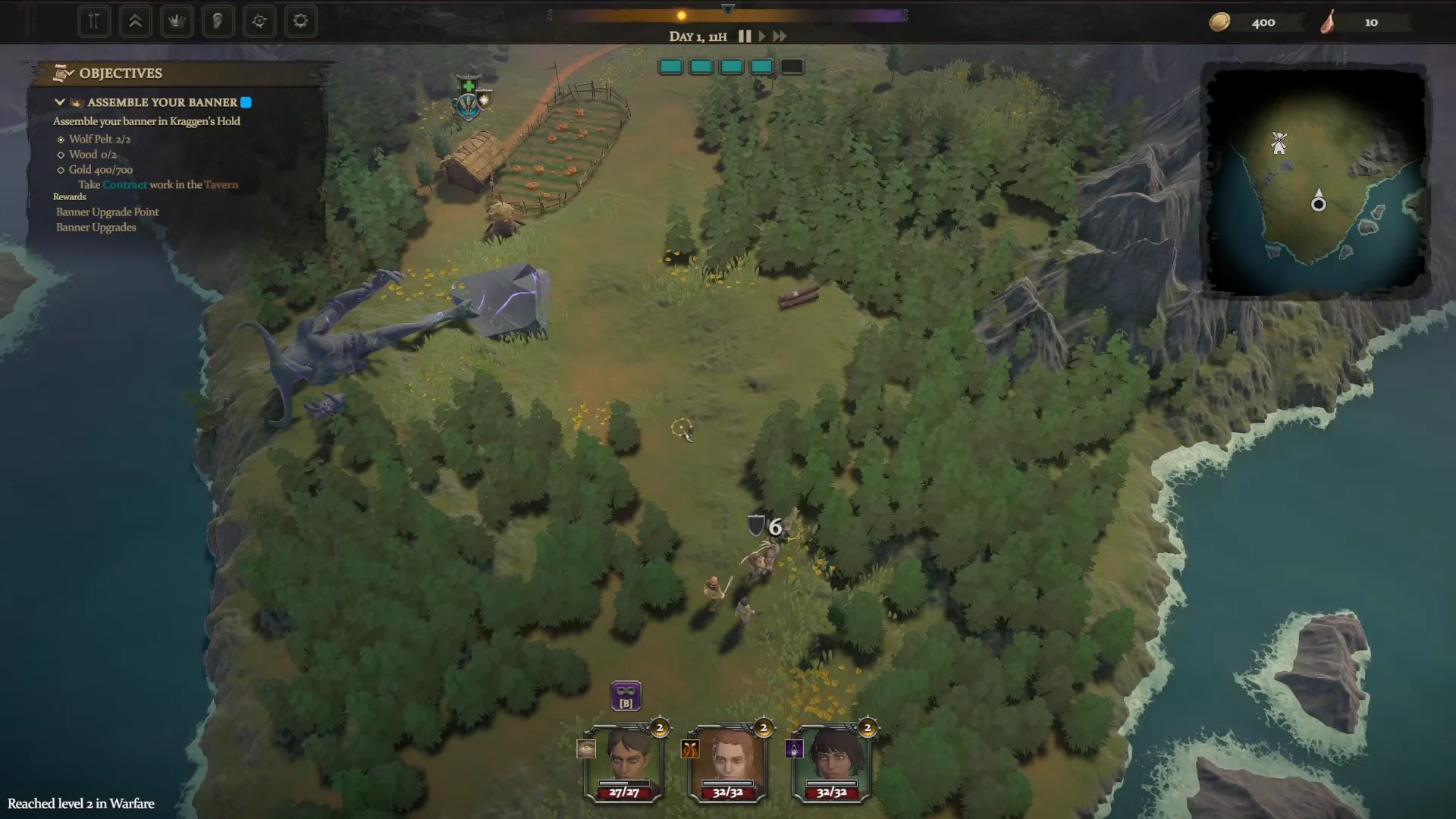
Settlements each hold different services. A Farm produces food and lets you trade, while Kraggen’s Hold contains a Town Hall, Tavern, Market, Warehouse, and Garrison. Trading matters early because selling surplus battle spoils, such as wolf fangs and claws, is one way to build up the gold you need to raise a banner.
Raising a banner unlocks a fourth slot and company skills
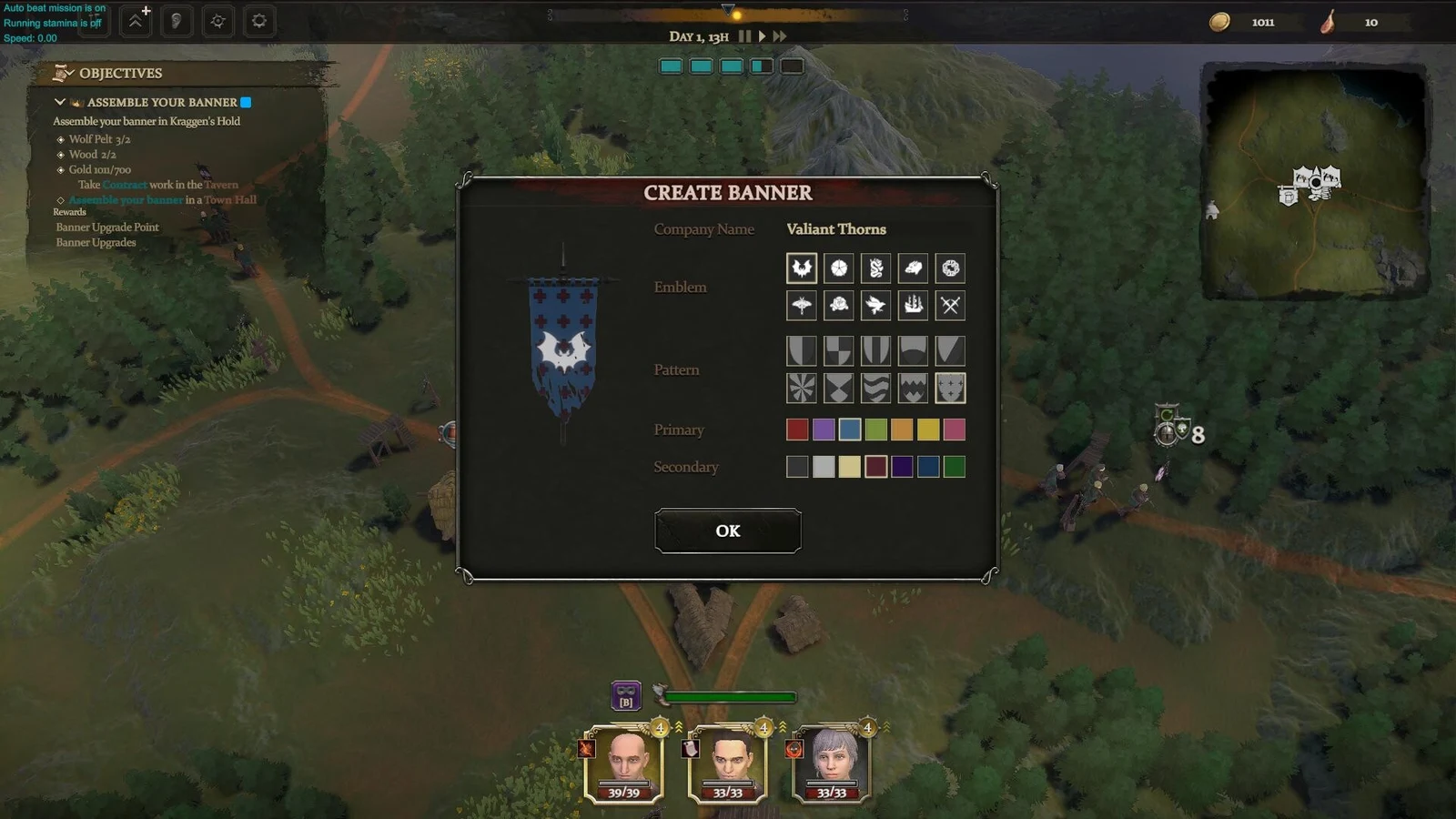
The first major goal is to assemble your company banner in Kraggen’s Hold. That requires 1 Wolf Pelt, 3 Wood, and 700 Gold, after which you visit the Town Hall and select “Raise Banner.” Banner creation lets you pick an emblem, pattern, and primary and secondary colors, then name the company. The demo’s warband ends up called “Falcoons,” though the menu defaults to a placeholder name if you leave it alone.
Creating the banner does two concrete things. It raises the active combat party limit from three units to four, and it unlocks six company proficiencies that level up through play: Warfare, Subterfuge, Trade, Survival, Logistics, and Diplomacy. These sit alongside your roster on the company management screen and shape things like faction standing and contract rewards.
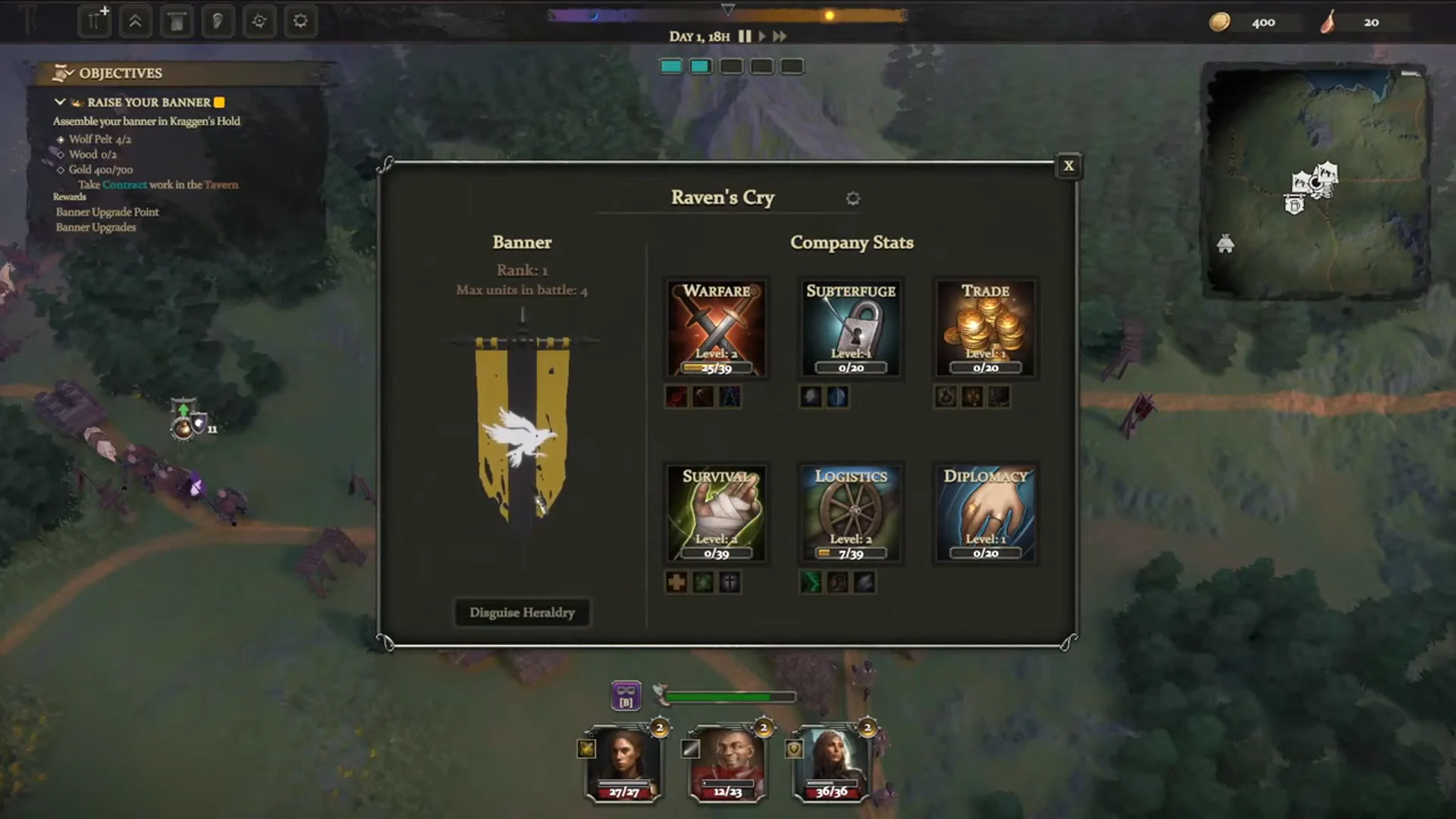
Finishing the banner changes the objective to “Reach Company Renown Level 1”; to achieve it, recruit a fourth member, expand the party, and follow up on rumors.
Contracts, rumors, and recruiting at the tavern
Taverns act as the hub for keeping a company running. In Kraggen’s Hold you can take bounty contracts, hear rumors, and hire new members. The demo accepts two jobs, “Kill Beasts” for 700 gold and “Hunt Down Bandits” for 900 gold, then clears the beast contract by wiping out a four-wolf pack in the nearby forest.
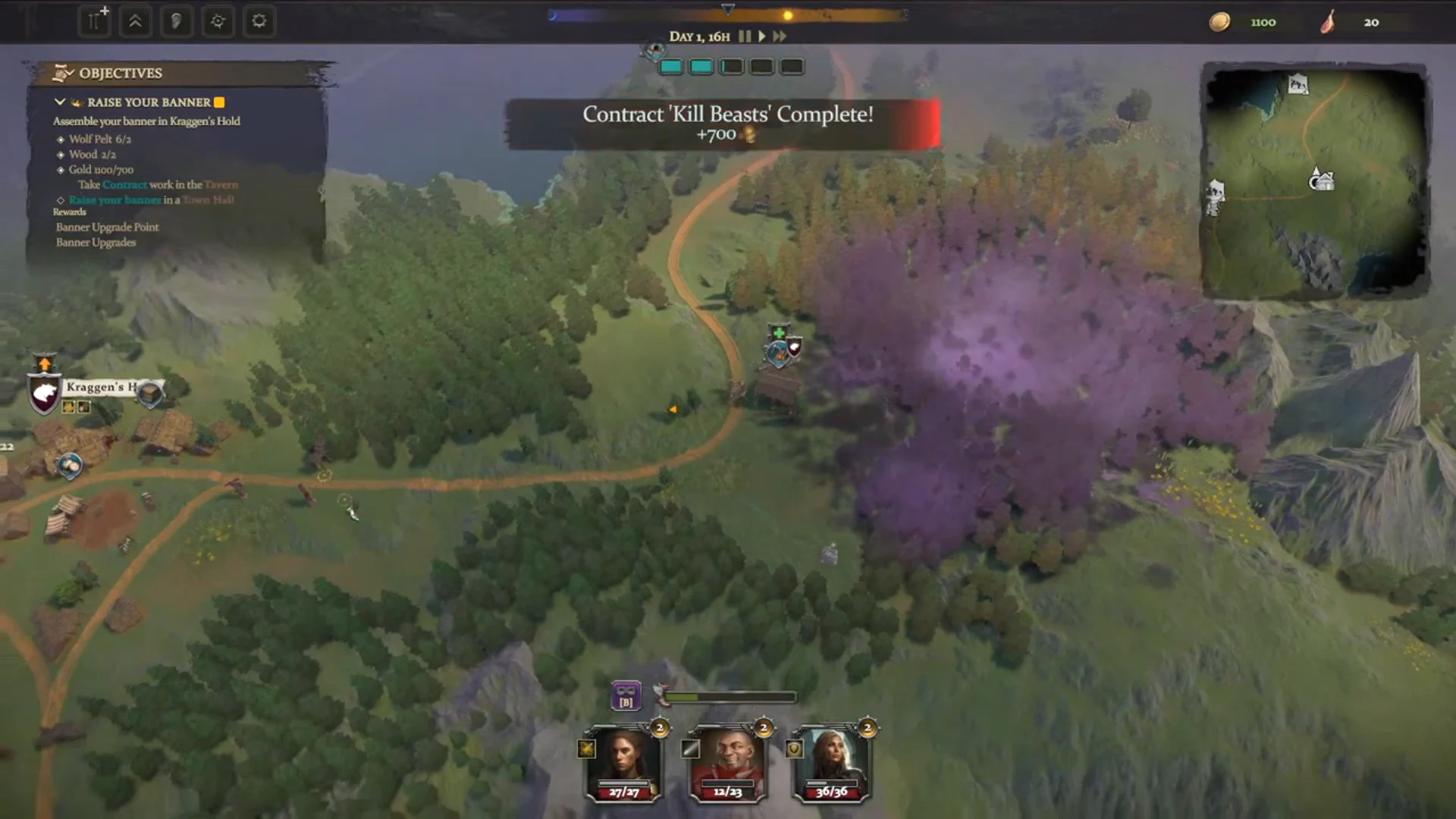
Specific patrons provide rumors. One character tips you off that bandits will take in anyone who strays into their camp after dark, a lead that can reveal hidden interactions when the right conditions are met. Available hires appear in a list where you can compare their stats. In this session, a level 1 Shepherd joins for 360 gold, taking the fourth slot unlocked by the banner.
Faction reputation runs underneath all of this. The game tracks standings across nine major groups, including several noble houses and outlaw bands, and your choices are meant to ripple through that web over time.
Release status and platforms
Tattered Banners is planned to launch into Early Access in Q1 2027 on Windows and Linux, built in Unity with partial controller support. CookieByte Entertainment describes the Early Access window as roughly 6 to 12 months, with the full version adding more classes, locations, interactions, regions, missions, and story, plus features like achievements and full controller support.
The pitch centers on cascading consequences, where actions like torching a farm can cause famine, refugees, and rising bandit power, while stable trade routes let cities grow and expand their influence. You can wishlist or follow the game on its Steam store page to be notified when it becomes available. The demo footage reflects an in-development build, so specific numbers, class names, and interface details may shift before release.