
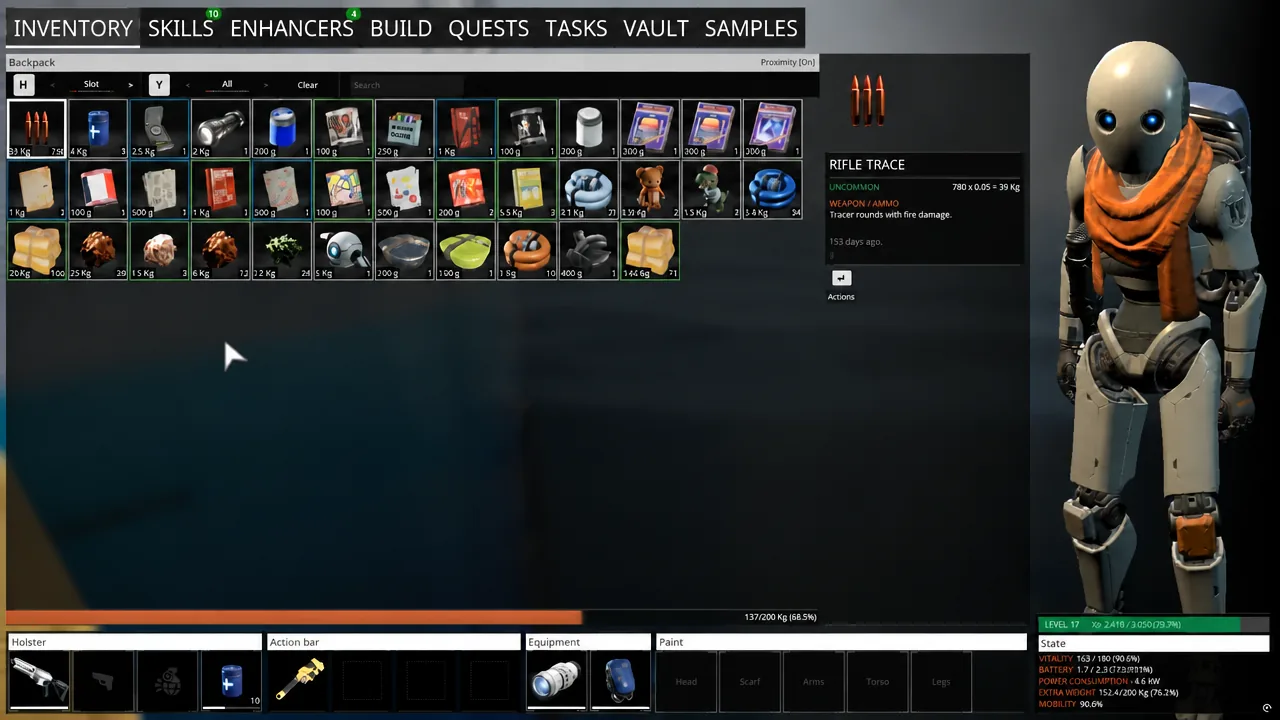
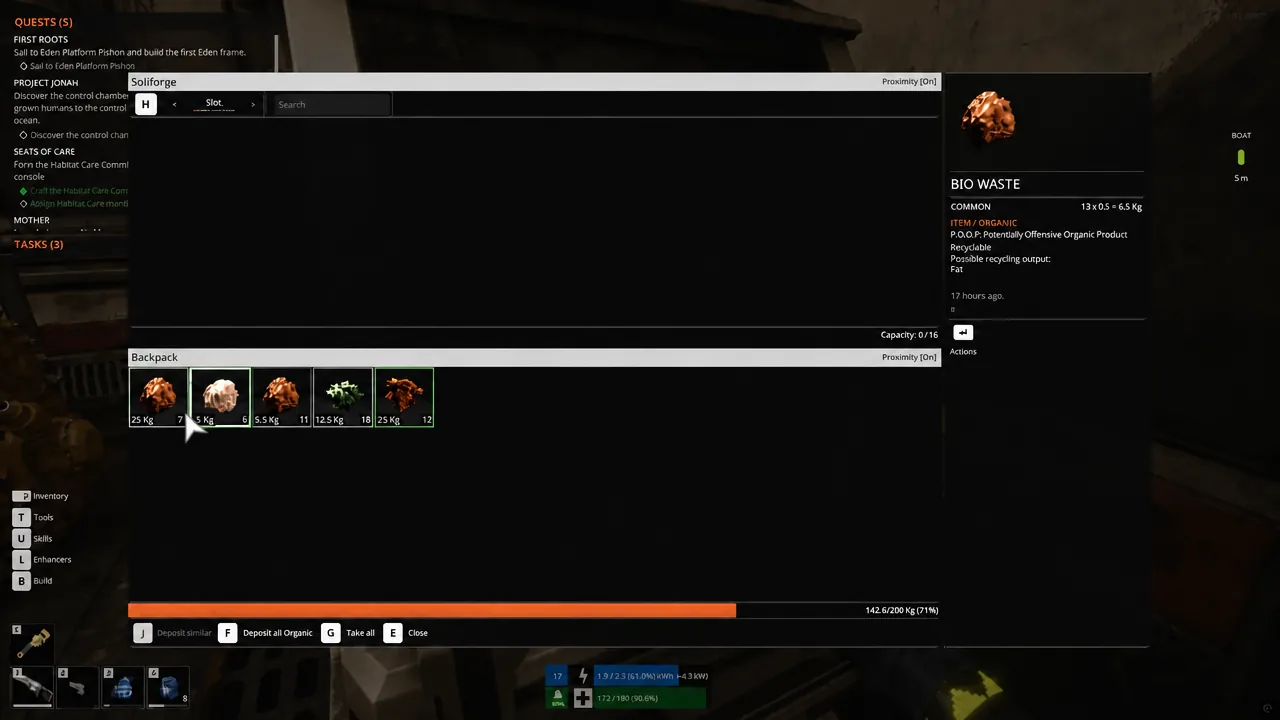
Fat is the bottleneck material for almost every worthwhile recipe in the Food Processor, and it comes from the least glamorous item in the game. Bio Waste, described in your inventory as “P.O.O.P. Potentially Offensive Organic Product,” is the only input you need. The machine that converts it is the Soilforge, and the whole chain is gated behind one skill unlock and two utility connections.
Quick answer: Drop Bio Waste into a Soilforge that has 1.0 kW of electricity and 1.0 L/s of fresh water flowing into it, then walk around to the back of the machine and pick up the Fat off the ground.
Soilforge requirements: level 10, power, and fresh water
The Soilforge is a Tier 1 item recycler. You unlock it in the Skills menu for a single skill point once you hit character level 10, and it will not operate on power alone. Fresh water has to be plumbed in as well, which means a water production machine needs to be running before the forge is worth placing.
| Requirement | Value |
|---|---|
| Skill tier | 1 |
| Skill point cost | 1 |
| Level requirement | 10 |
| Machine type | Item recycler – Tier 1 |
| Electricity | 1.0 kW |
| Fresh Water | 1.0 L/s |
Note: build your water purification first, then the Soilforge. Placing the forge while water production is still offline just leaves an idle machine sitting on your platform.
Where to farm Bio Waste
There are two reliable supplies. The first is passive looting. Bio Waste turns up at points of interest as you clear rooms and strip locations, so you accumulate it while chasing objectives rather than making dedicated trips.
The second is night diving, and it is the one to build a routine around. Creatures spawn underwater after dark, and killing them drops Bio Waste along with other bio materials. Because the spawns keep coming, you are not waiting on point-of-interest respawn timers.

Bring a weapon you are comfortable using underwater and clear nodes and creatures until your stack is healthy. Fat stacks to 100 and each unit weighs only 0.2 kg, so hauling a large batch back is not a load problem.

Tip: the same dives also produce Bio Organic, Bio Light, Bio Seaweed, and Bio Dark, which the Soilforge turns into Omega-3, Vitamin D, Carbohydrate, and Calcium respectively. One trip feeds several material chains.
Running the Soilforge to produce Fat
Confirming it worked, and the two reasons it fails
You know the conversion succeeded when Fat appears in your inventory as a common material weighing 0.2 kg per unit, with the description “Provides energy, supports cell growth, and helps absorb certain nutrients.” If the item is in your inventory, the Food Processor will accept it.
Only two things normally stop the process. A Soilforge missing either its power or its fresh water connection will sit inert with the materials still inside, and players regularly miss finished output because they stand at the front panel waiting for a completion prompt while the Fat is already lying behind the machine.
One more point of confusion worth clearing up. The Food Processor consumes Fat, it does not produce it. Recycling happens in the Soilforge, or in the upgraded Soilforge Prime, and only then does the material move into food crafting.
What Fat is used for in the Food Processor
Fat is an ingredient, never an end product. Six Food Processor recipes call for it, spanning weight, height, balanced growth, and intellect categories, which is why a shortage stalls your whole nutrition pipeline.
| Food | Unlock level |
|---|---|
| High-Fat | 10 |
| Nutri-Core | 10 |
| Physique Fuel | 11 |
| Mind Surge | 11 |
| Immune Boost | 15 |
| Nanite Infusion | 18 |
High-Fat gives a clear sense of the volumes involved. One batch takes 5 Carbohydrate, 5 Protein, and 8 Fat, and draws 500 Wh of electricity plus 100 L of fresh water. The Food Processor is heavy on both utilities, so it is worth batching your food production before you start an incubation rather than during it.
Set the loop up once and it maintains itself. A night dive fills your Bio Waste stack, the Soilforge converts it while you are off doing something else, and the Fat waiting on the floor behind the machine covers several Food Processor runs at a time.