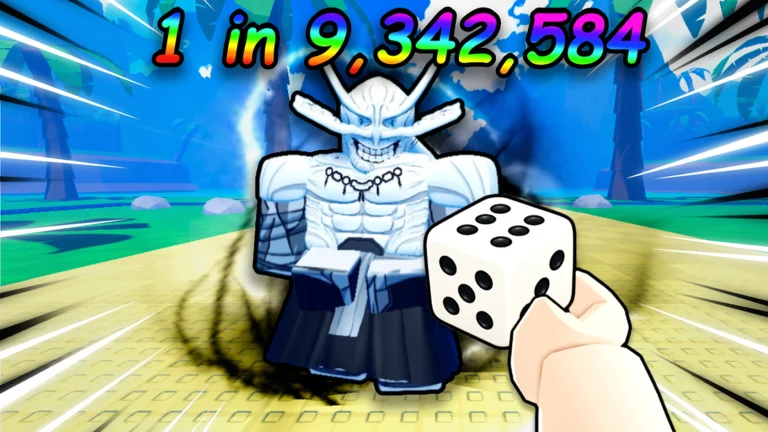
Luck is the number that quietly runs everything in Anime Dice. It does not make one specific character more likely to appear. It decides how deep into the character pool a roll is allowed to reach, which is why rolling a hundred times on a starter die produces a pile of Commons, while a single roll after a tier jump can hand you something that changes your plot income.
Quick answer: Purchase the priciest dice tier currently within your budget, direct your money to Money nodes before Luck nodes, and use Lucky Spins only after making both investments. Rebirth when your income can recover quickly.
Dice tiers and their Luck multipliers
The Dice Shop is the single biggest Luck lever in the game. Every rung roughly doubles the Luck behind a roll, and the starting Nature dice sits at the bottom of a ladder that climbs to 5,000x.
| Dice | Rarity | Luck | Cost |
|---|---|---|---|
| Nature | Rare | 20x | Starting dice |
| Lightning | Rare | 42x | $500K |
| Ice | Rare | 100x | $4M |
| Magma | Epic | 200x | $30M |
| Storm | Epic | 400x | $200M |
| Shadow | Epic | 750x | $1.5B |
| Light | Legendary | 1,500x | $12B |
| Blood Moon | Legendary | 3,000x | $100B |
| Void | Legendary | 5,000x | $1.5T |
Judge the ladder by its overall progression, not by each row separately. Each step gives Luck about twice the previous amount, but the prices rise much more sharply, making the omitted tiers the best value. Storm at $200M is the first purchase that clearly alters your roll results. When Shadow is attainable after a couple of Rebirths, Magma and Storm become wasted spending because their multiplier will soon be replaced.
The ladder does not end at Void. Late-game plots run into dice priced in the hundreds of trillions, so a shop that looks empty of options is usually a sign your income, not your Luck, is the bottleneck.
Upgrade tree priority: Money before Luck
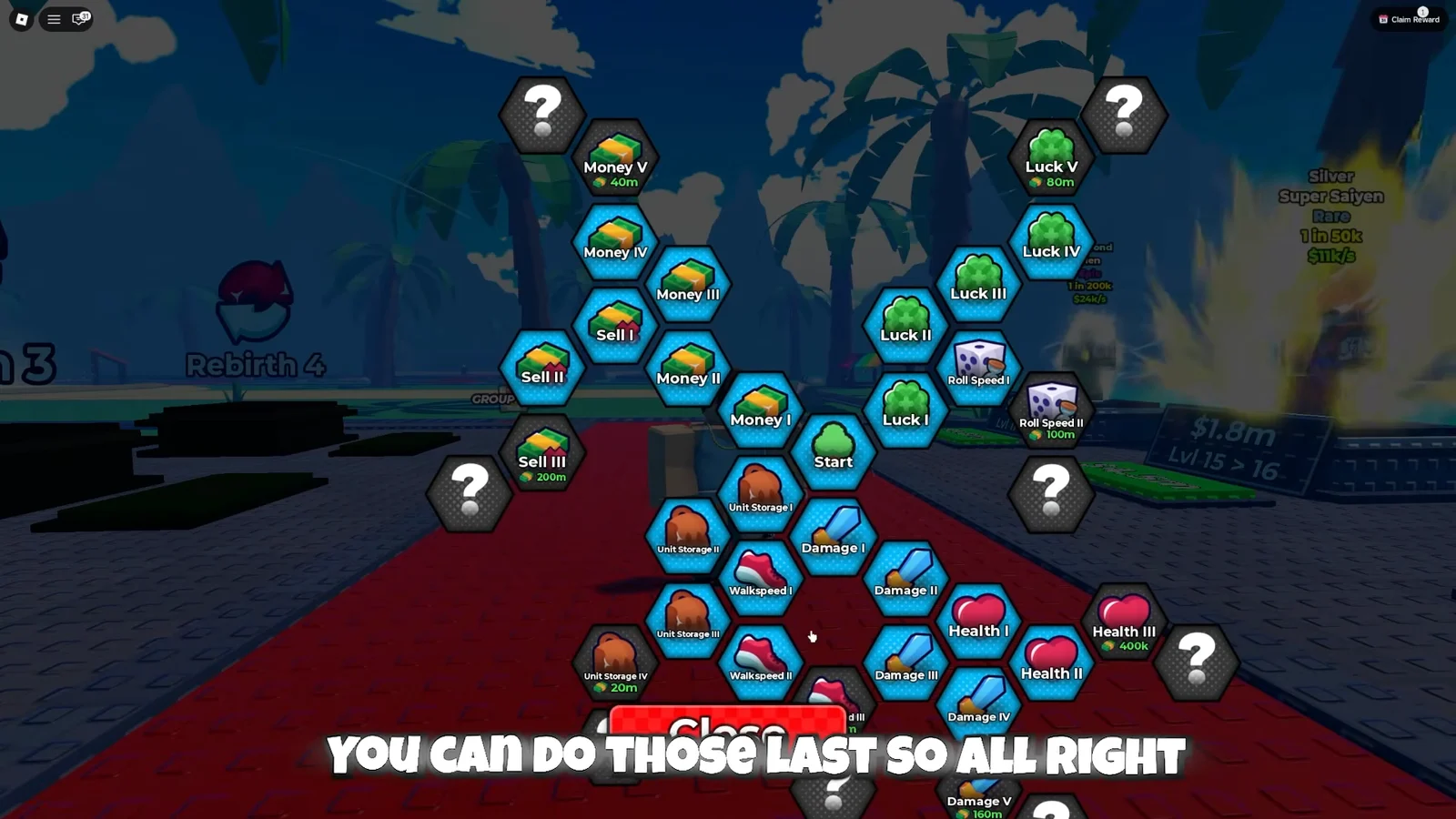
The Upgrades panel lists seven categories, and they are nowhere near equal in value. The order below is the one that keeps cash and Luck feeding each other instead of stalling.
| Priority | Nodes | Why |
|---|---|---|
| First | Money I–VI, Luck I–VI | Funds and improves every roll |
| Second | Roll Speed I–II, Unit Storage I–IV | More rolls, room to hold them |
| Third | Sell I–III, Walkspeed I–III | Faster cash-outs and movement |
| Last | Damage I–V, Health I–V | Tower combat only |
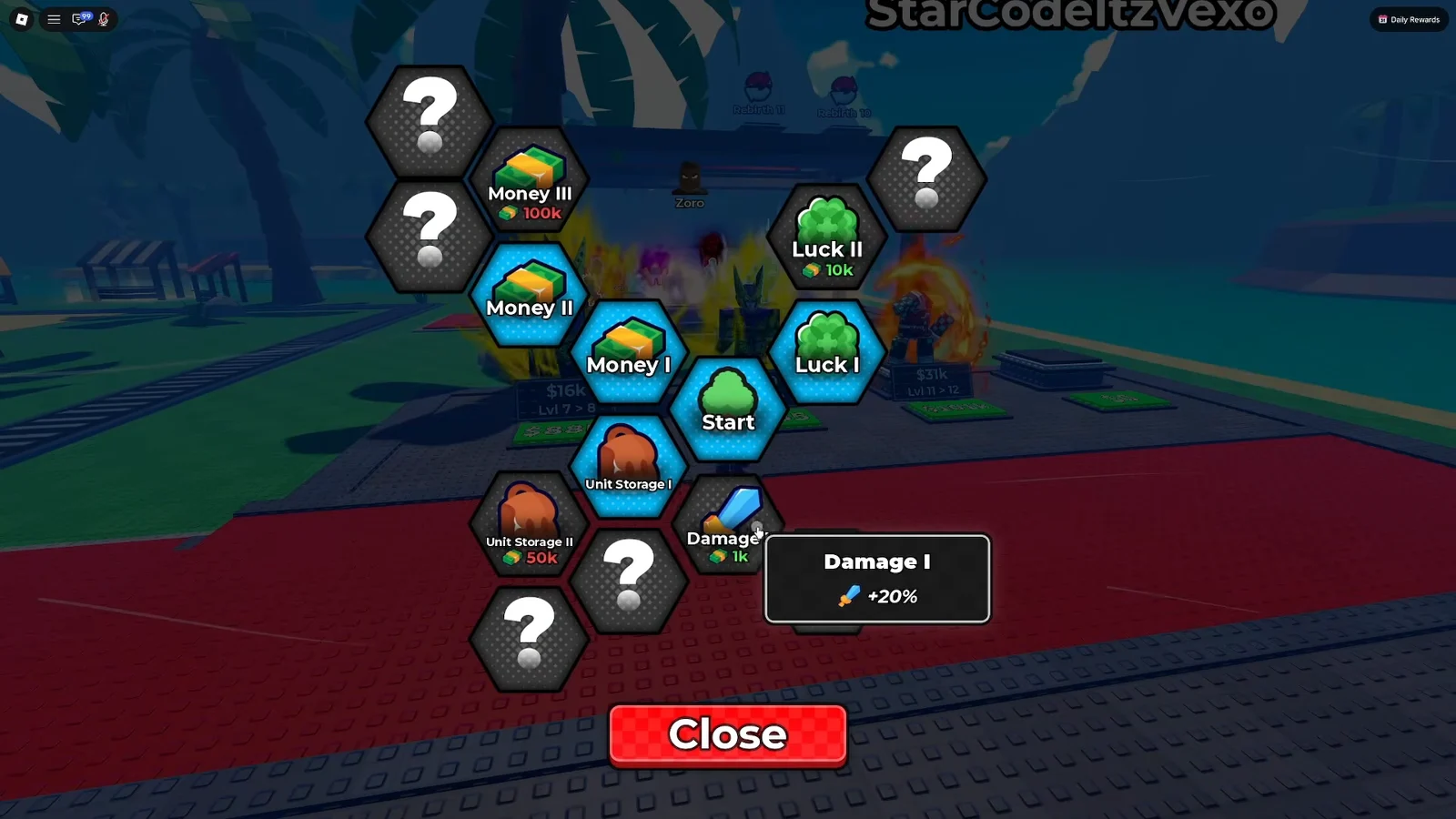
Prioritizing Money has a practical reason. It increases the earnings from your placed units, whereas Luck improves the quality of your rolls. Early Luck can produce stronger units before your economy can pay for the next upgrade. Early Money gets you to that dice tier sooner, and later Luck then works from a much larger base.
The same logic applies inside the Luck line itself. Early nodes add flat percentages, while later ones apply a multiplier to whatever you have already built. Multiplying a small Luck value gives you a small Luck value, so the multiplicative tiers are only worth their price once your flat base and your income are both healthy. Exact node costs shift with balance patches, so read the price in the panel before committing.
Plot income receives no benefit from Damage or Health. Those stats are for Tower runs, so spending coins on either one before Cursed Tower means giving up a Luck purchase.
Rebirth timing for permanent Luck
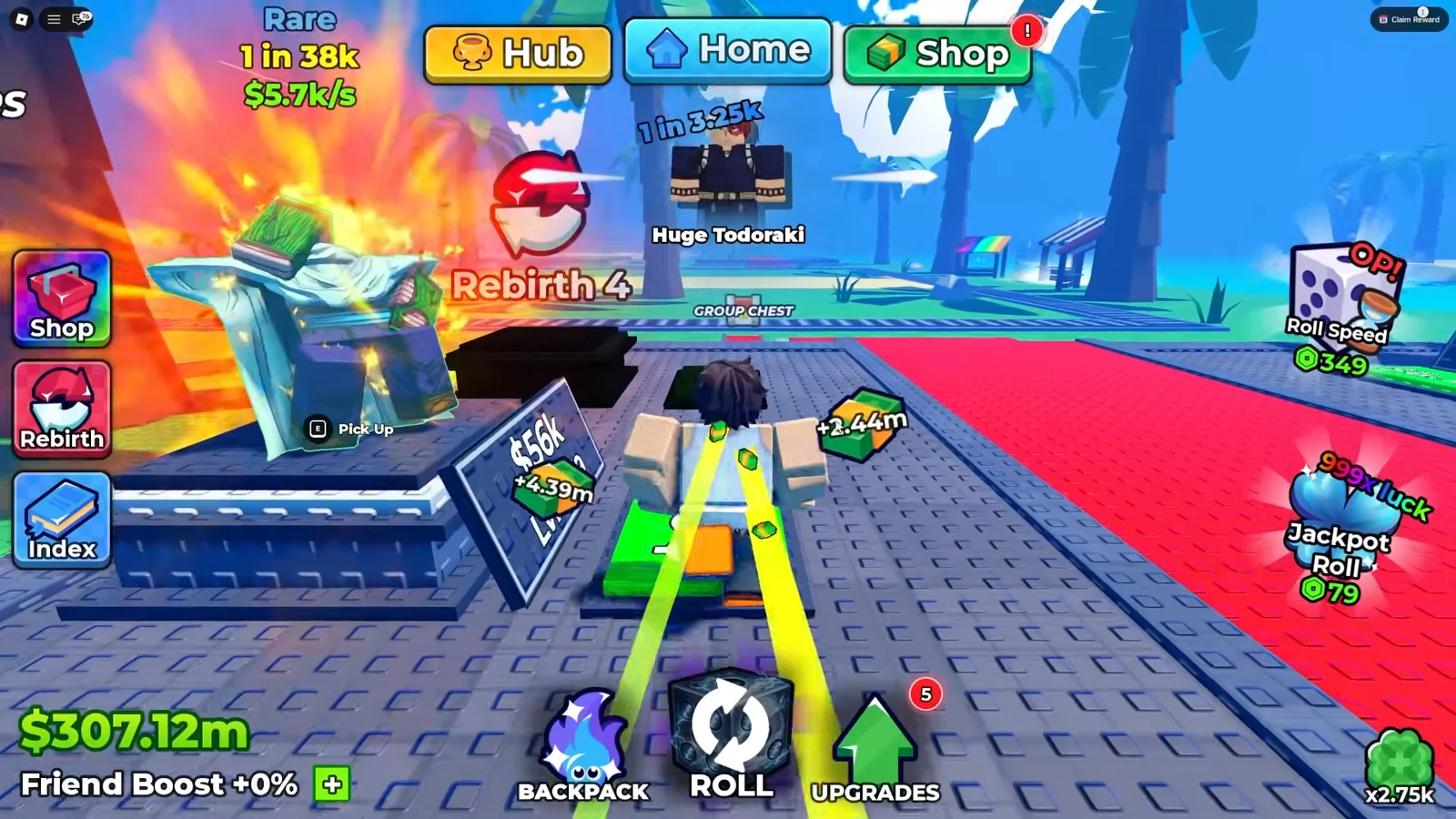
When you Rebirth, your cash disappears but your units remain, while your permanent Luck and Cash multipliers increase. The first reset costs around $50k and changes both stats from 1x to 1.5x. The mid-game reset requires $500M and raises 2x Luck and 2x Cash to 2.5x, giving every later roll a 25 percent increase.
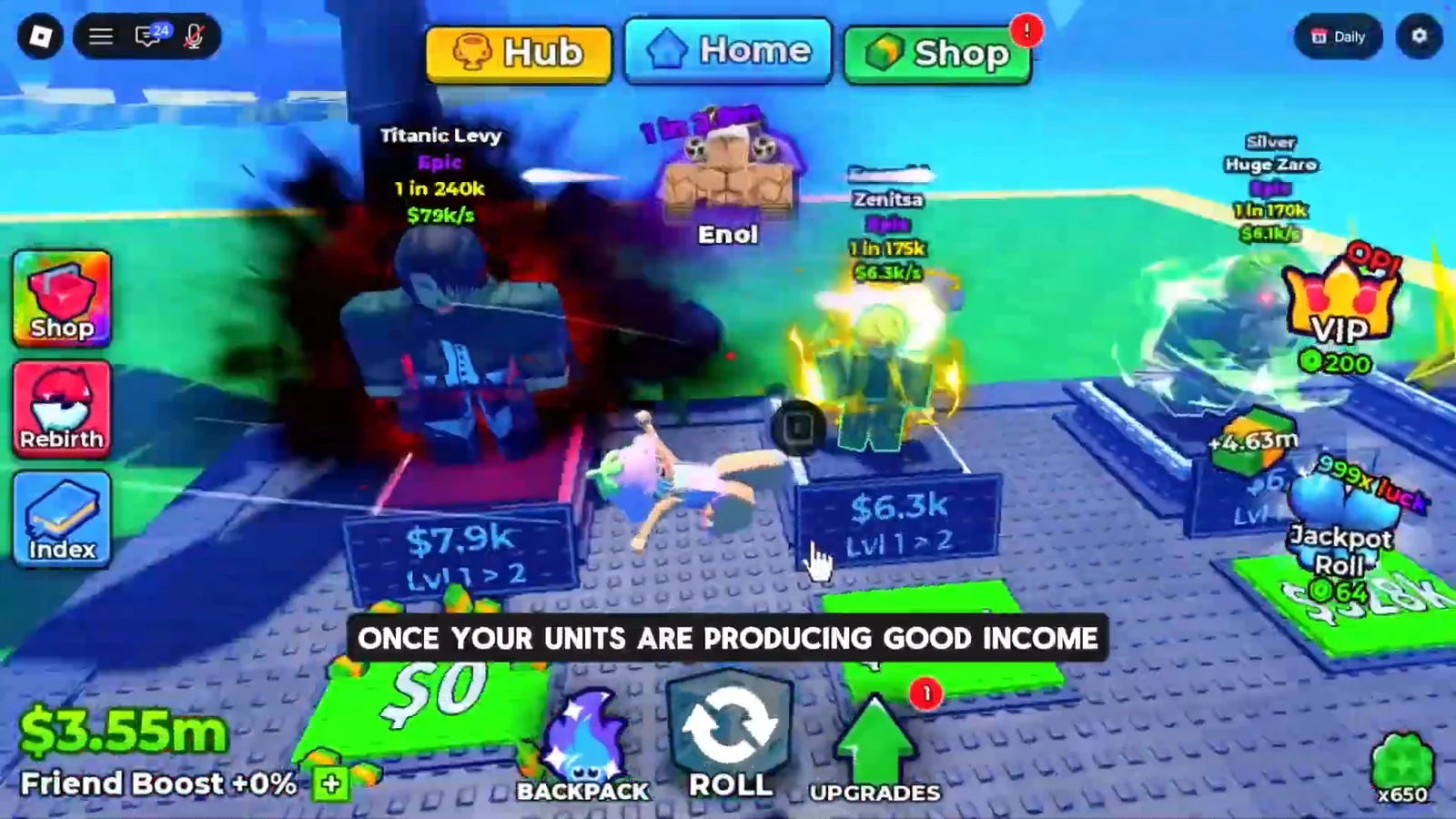
Only your cash is cleared, so anything still in your wallet at confirmation is lost. Spend the amount above the threshold on Money and Luck nodes, use the remainder toward the next dice tier, and then activate the reset. Your equipped units remain on their pads and immediately begin earning again, while the money pads appearing after the reset help recover the first few million within seconds.
The timing test is simple. If your current lineup can rebuild your old income in a short session, the permanent multiplier is worth more than the cash pile. If it cannot, keep building the plot first. You will know it worked when the Rebirth panel shows the new multiplier values and your cash total reads zero.
Lucky Spins, Trait Rerolls, and Gems
Lucky Spins are boosted rolls that cost no cash, and they draw from exactly the same Luck-filtered pool as a normal roll. That is the whole reason to sit on them. A spin used on a starter die pulls from a shallow pool. The same spin used ten minutes later, after a tier purchase and a Rebirth, pulls from a far deeper one.
Before you burn a stack of spins, make sure you have the following in place:
- The best dice tier your cash can currently buy.
- Your Luck multiplier stepped up from at least one Rebirth.
- Free inventory space, so nothing is lost or force-sold.
- A plot that is still earning while you roll.
Trait Rerolls and Gems follow the same discipline. Spend them on units you have decided to keep, not on every Rare that lands. Gems feed the Grades kiosk, and grades are the cheapest multiplier available once dice and Rebirth both cost trillions. Rolling a unit up to S grade has been observed at roughly 7x income, with A+ landing around 4.5x on the way there.
How to sequence a play session
Luck mistakes that stall a plot
- Rolling repeatedly on a low tier dice instead of saving toward the next one.
- Keeping money reserved for a specific dice tier while leaving every Luck node untouched. The nodes compound.
- Buying every rung in sequence when a skip was affordable.
- Leaving plot pads empty, which cuts both online and offline income.
- Judging a unit by its artwork instead of its rarity band, mutation, trait, and grade.
- Expecting a Luck value to guarantee a specific pull. No number does that.
Codes
Working strings include 100KLIKES, 40KCCU, 30KCCU, 20KCCU, 10KCCU, 5KCCU, 1KCCU, UPDATE4, UPDATE3, UPDATE2, UPDATE1, and RELEASE, and they pay out Lucky Spins, Trait Rerolls, and Gems. Open the Shop menu, scroll past the gamepasses to the Codes box, paste one exactly as written, and press Redeem. Each is one-time per account, and a reward popup confirms it landed.

None of these levers work in isolation. Luck decides what the pool can give you, income decides how often you can reach for it, and Rebirth quietly raises both forever. Keep the pads full, buy in that order, and the rarer units stop feeling like accidents.