Zoo Reputation in Planet Zoo 2 measures how well your park is performing, and a higher rating pulls in more guests, which means more money to reinvest. The score is an average of four separate ratings, so the fastest way to climb is to find the factor you are weakest in and push it up before moving to the next.
Quick answer: Go to Overview under Zoo Management and compare Animal Husbandry, Sustainability, Guest Education, and Guest Experience. Improve the weakest score first, then tackle whichever rating is lowest next.
The four ratings that build Zoo Reputation
Reputation is made up of four categories, and each one tracks a different part of your zoo. You can see all of them, plus your overall score, on the Overview screen in the Zoo Management tab.
| Rating | What drives it |
|---|---|
| Animal Husbandry | Average welfare of all animals, plus a subset reaching the Thriving state |
| Guest Experience | Guests’ happiness across their whole visit |
| Guest Education | Education reach and the variety of topics shown to guests |
| Sustainability | Number of sustainable power sources and recycling bins |
Press H to open the Heatmaps toggle. These view modes show the strengths and weaknesses of each part of your zoo, covering animal welfare, guest needs, education coverage, staff happiness, and more. Use them to see exactly where a rating is dragging before you spend money fixing it.
Work on the lowest of the four factors first, then check the Overview again to see how your overall Reputation moved. The graphs under Management > Overview > Graph show trends over time so you can confirm a change is holding.
Raise your Animal Husbandry rating
Animal Husbandry has the greatest influence on your rating. Its score improves when your animals’ average welfare increases and when more animals become Thriving. To locate animals needing help, open Animals in Zoo Management and arrange the list by Welfare, lowest first. Meet those animals’ needs to raise the average.
Meet each animal’s core needs
Every species has its own requirements, and a habitat that satisfies all of them keeps welfare high. Check these before you buy an animal or when offspring grow up.
- Enough space and the correct terrain, such as navigable water, sand, or grass; watch for overcrowding if animals breed.
- The right social group size, since some species want company and others are solitary.
- Correct gender distribution, as some groups should hold only one adult male to avoid fights.
- Food from the correct tray type for herbivores, carnivores, fish, birds, or different sizes, plus water from a body of water, fountain, or trough.
- Appropriate shelter to sleep and shelter from weather, plus cover to hide from guests.
Aquarium animals need suitable salinity, too: Freshwater, Saltwater, and Brackish. Choose the setting using the filtration network. Instead of enclosing the habitat in glass, add several viewing areas where animals can withdraw to private spaces.
Add enrichment and keep animals healthy
Once the basics are covered, enrichment pushes welfare higher. Enrichment splits into Enrichment Toys and Enrichment Food, and both are wanted. Items must suit the species, and in Franchise or Career mode better enrichment has to be researched first, so an animal may not hit maximum happiness until it is fully researched.
Illness, infection, and injuries can affect your animals. Provide vets, vet surgeries, and quarantine zones, and add more vets as your collection grows. Train your vets as well, and act when health alerts indicate that an animal needs attention.
Completing Research on a species reveals its Thriving requirements. Meeting those lifts individual animals into the Thriving state, which the Animal Husbandry rating rewards on top of average welfare.
Raise your Guest Experience rating
Every guest holds their own opinion, and their happiness rises and falls through a visit, so this rating is an average of how satisfied your crowd is. Covering their basic needs first prevents the biggest drops.
- Spread vending machines, kiosks, and restaurants across the zoo for hunger and thirst, and keep prices affordable so guests can buy.
- Build plenty of toilets, starting near the entrance, so one is a few minutes’ walk from anywhere.
- Place benches at regular intervals, ideally facing habitats; some food and drink restores energy, and transport rides help in large zoos.
- Add enough bins, especially in busy areas, and hire caretakers to empty them and clear litter.
- Put information centers and gift shops near the entrance and exit for an extra lift.
Some species bring in more ticket sales than others. Rare, large, and colorful animals attract visitors, who also have individual wishlists. Animals have genetic ratings, so high-quality lions or elephants can help. In the Animal Trading Center, sort species by Appeal to see which ones are most attractive.
Guests also need to actually see the animals. Build a few strong viewing spots around each habitat so visitors do not leave disappointed. Use underwater tunnels for aquariums, and walkthrough sections for species like butterflies, certain birds, and lemurs.
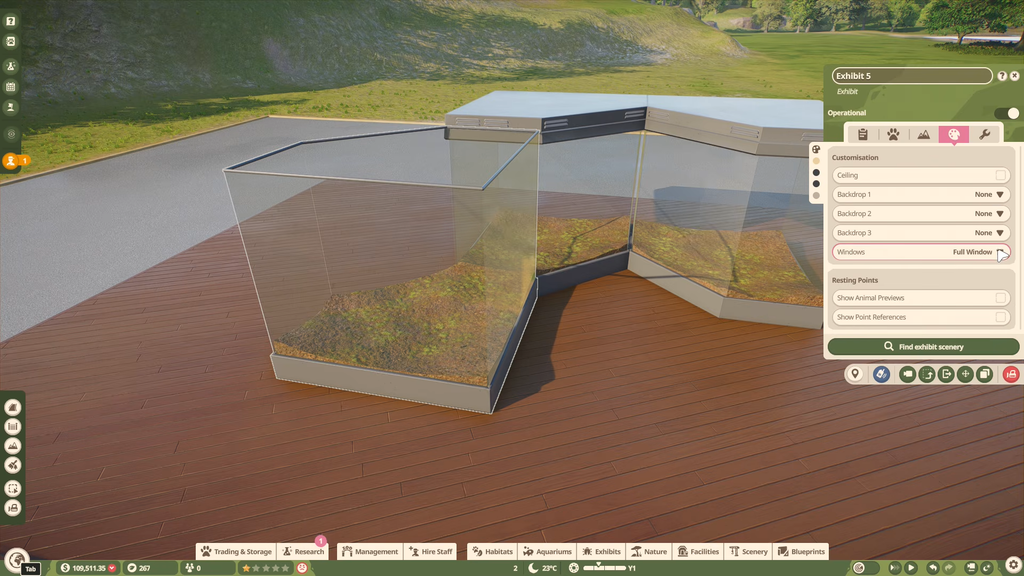
Raise your Guest Education rating
Guests want to learn about animals and conservation, and this rating tracks how much education reaches them and how varied the topics are. The relevant items sit under the Education category in the Facilities section.
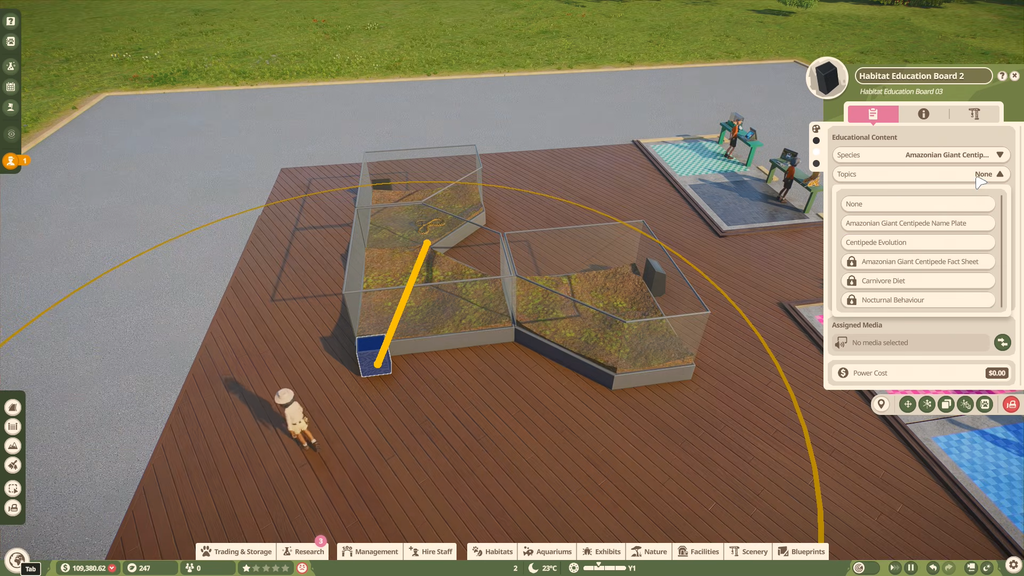
Beyond static items, set up tours led by educators, which earn extra income while teaching guests, and schedule keeper talks in front of popular habitats to reach gathered crowds.
Raise your Sustainability rating
Sustainability is the easiest of the four to lift once you have cash to spend. It depends on two things: the number of sustainable power sources and the number of recycling bins.
Standard generators are cheaper in-game, so they are fine while a zoo is getting established. Once the money is there, swap them for solar panels or wind turbines. Use solar panels in sunnier locations and wind turbines in colder, windier ones, or mix both if you are unsure.
Recycling bins barely cost anything, so place one alongside every normal bin you put down. This is the quickest, cheapest way to move the rating upward.
Confirm your Reputation has gone up
Once you’ve made a change, revisit Overview in the Zoo Management tab. That screen refreshes the four category ratings along with your overall Zoo Reputation, letting you check the result. To track progress over multiple in-game days, go to Management > Overview > Graph and make sure the improvement lasts instead of appearing as a short-lived spike. Continue addressing the lowest-rated factor in turn, and your overall score will rise steadily.