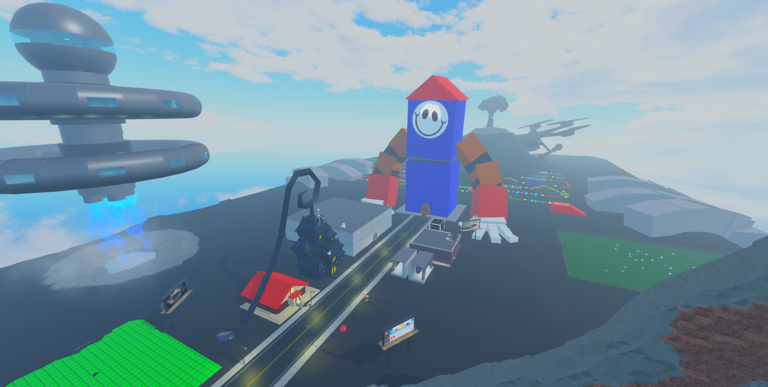
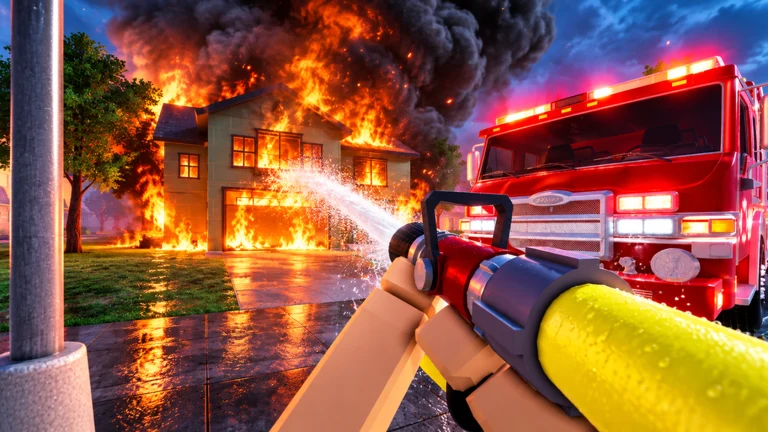
Firefighting Sim drops you into the town of Oak Ridge, where you answer 911 dispatch calls, drive emergency vehicles to the scene, and put out fires or rescue civilians and animals. Every call ends with an incident report that grades your performance and hands you Career XP, which unlocks better vehicles and higher ranks. The game rewards careful, deliberate play far more than speed, so how you handle each run matters as much as finishing it.
Quick answer: Suit up at the station lockers first, press Z to attach to an active call, follow the green road arrows, and spray water only when your reticle locks onto a flame. Higher water efficiency means more XP.
Gear up at the station before every call
Begin each shift in the fire station bay and handle two tasks. Approach the vehicle spawner terminal, hold E to bring up the fleet menu, then select an unlocked option, such as the default Fire Engine. It appears at an unoccupied bay door, ready to drive.
Next, go to the personal lockers beside the bays and put on your complete turnout suit and helmet. This is the mistake new players make most often. Without protective equipment, heat and smoke at a fire will deplete your vitals before you can attach a hose.
Before you leave, visit your tool locker and take a fire axe and chainsaw along with the water hose. You won’t have to return if a locked door or fallen tree stops you.
Accepting calls and driving to the scene
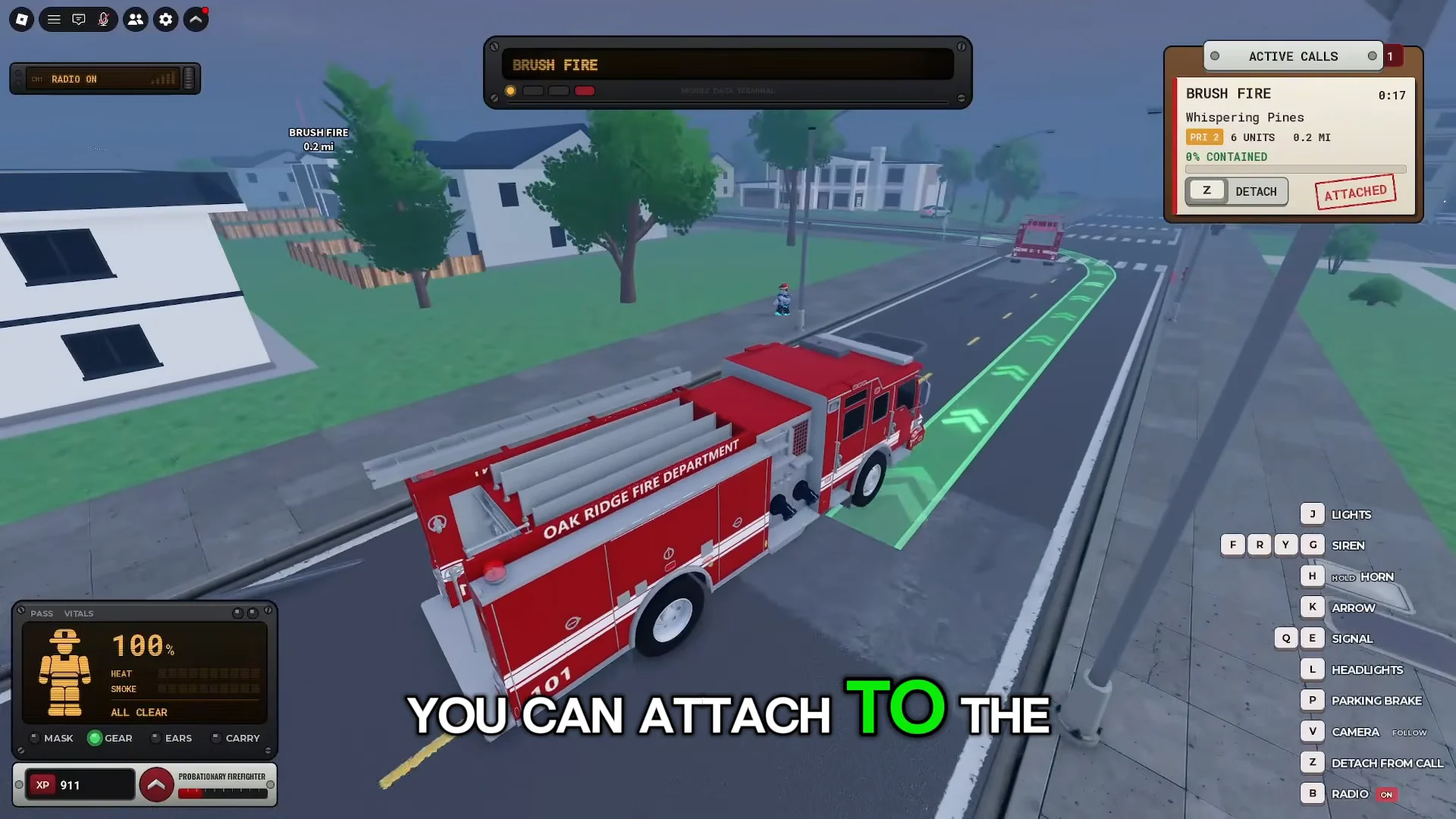
Active emergencies appear in the call box in the top-right corner of the screen. When one drops, such as a Brush Fire out at Whispering Pines, press Z or tap the on-screen prompt to attach yourself to the run. You can detach the same way if you change your mind.
As soon as you attach, bright green arrows appear on the road ahead and lead straight to the incident. Follow them at a steady pace rather than flooring the throttle. Clipping a pole or rolling into a ditch wastes far more time than taking the corners cleanly.
When no calls are showing, there is no point driving around hunting for one. Return to the station, swap to a newly unlocked vehicle if you have one, and wait. Fresh emergencies arrive regularly.
Controls reference
| Action | Key |
|---|---|
| Move | W, A, S, D |
| Jump | Spacebar |
| Interact (hold) | E |
| Equip tool | 1–7 |
| Use tool | Left Mouse Button |
| Accept / detach from call | Z |
| Dismiss message | N |
| Radio | B |
| Accelerate / brake (driving) | W / S |
| Toggle siren (driving) | F, R, Y, G |
Controls may change from one game version to another, so check the prompts on screen whenever you get into a vehicle or equip a tool.
Putting out the fire and conserving water
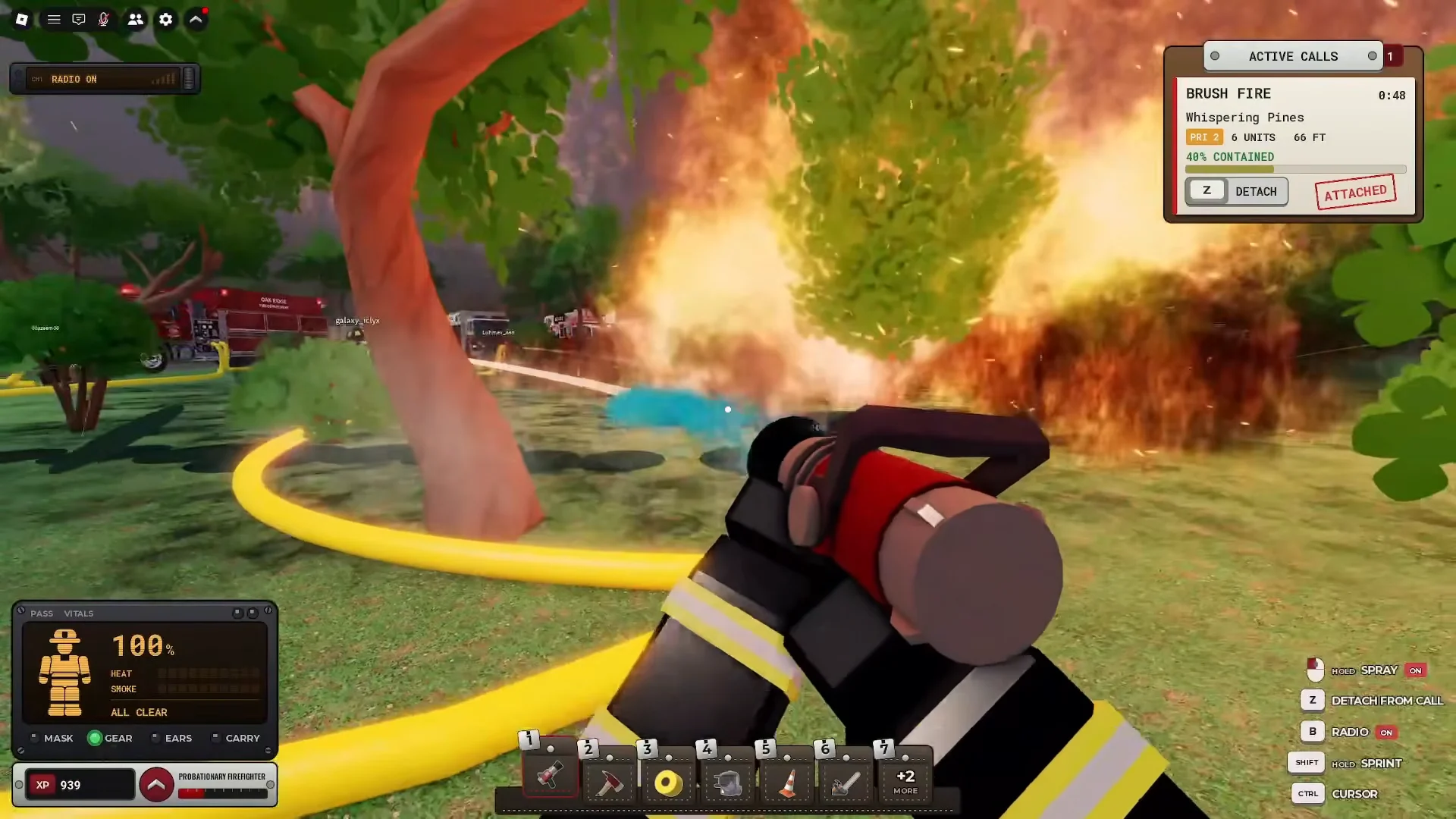
Water efficiency is scored on the incident report at the end of each call, and it directly affects your XP payout. Spraying carelessly can leave you around 48% efficiency, while disciplined aiming pushes that over 72% for a noticeably bigger reward.
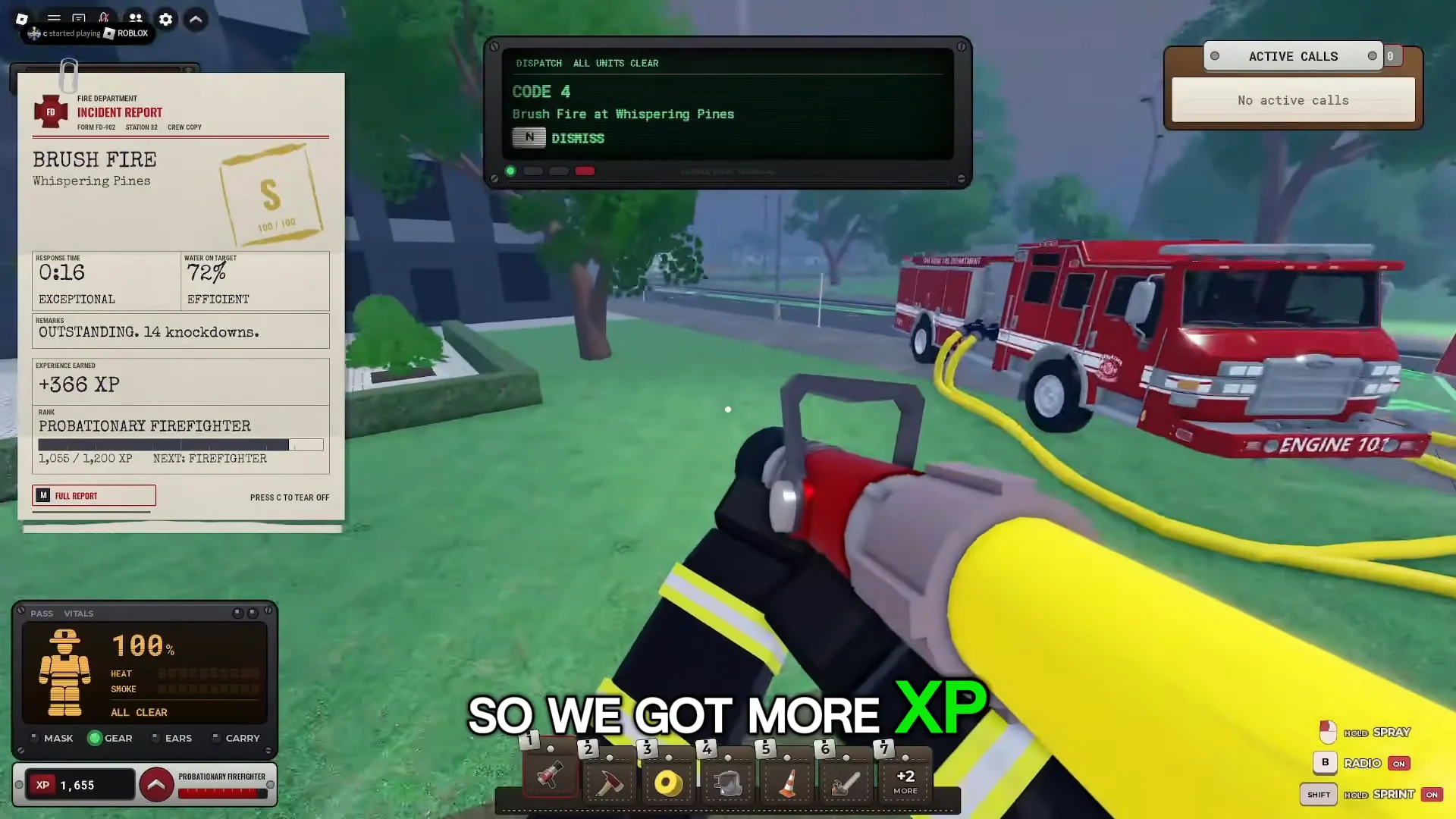
You know a call is finished when the fire reaches 100% containment and the incident report screen appears with your grade, knockdown count, and earned Career XP.
Watching your vitals under heat and smoke
The monitor at the bottom left displays three vitals: suit integrity and health, heat level, and smoke inhalation. Being in the flames rapidly depletes all three.
If the heat spikes or your health starts ticking down, step back out of the plume for a few seconds to stabilize. Health recovers once you move away from the fire, so there is no reason to stand in the flames just to finish off one last patch. Equip the gas mask before entering any smoke-filled interior.
Handling bush fires, building fires, and rescues
Bush fires
Bush fires spread between nearby trees and vegetation, so containing the spread matters as much as spraying. Pull out the chainsaw and cut down trees around the perimeter to create firebreaks between burning and unburned areas. Then concentrate your hose on the remaining active patches. Watch your footing, since stepping into the burning vegetation drains your health.
Building fires
Knock down the accessible exterior flames first, then prepare to go inside. Put on your mask before entering smoke-filled rooms, and use the fire axe to break through any door that blocks your path. A fire engine hose is strong enough for large interior fires where a regular hose is not. Keep checking your heat and smoke meters, and back out the moment your health starts dropping.
Rescue calls
Some calls involve rescuing civilians or animals, such as a cat stuck in a tree. Attach to the call to reveal the location, then get there quickly because other players on the server can complete the rescue first. For a treed cat, climb or jump up to it, interact to pick it up, and carry it down to the correct spot. A completion message confirms the rescue.
Vehicles and how they unlock
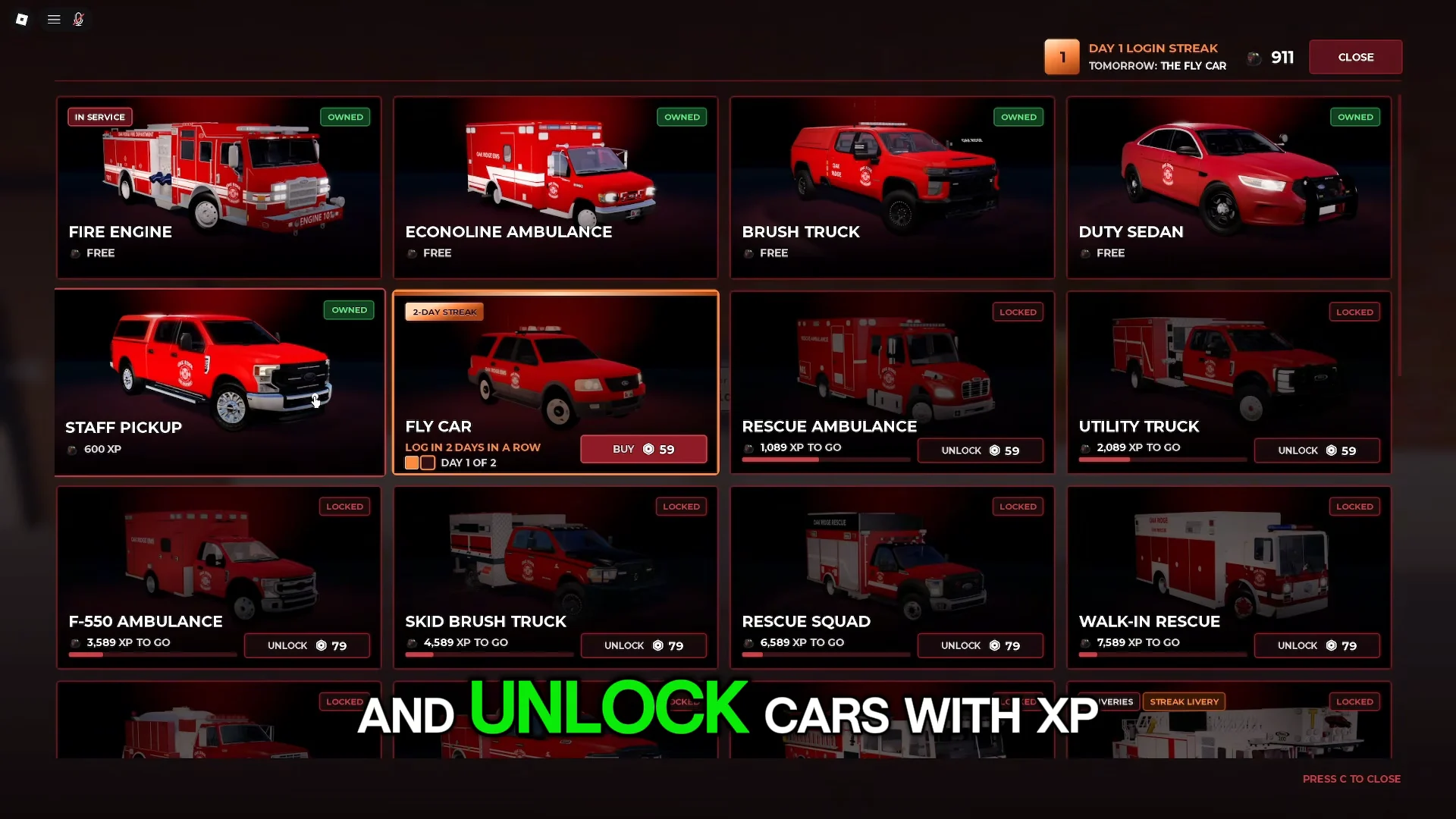
You start with a free Fire Engine and an Econoline Ambulance. More vehicles open up as you reach XP thresholds, and a few can be bought with Robux instead. Pick the rig that fits the call: a light, fast vehicle reaches outdoor brush fires quickly, while a full fire engine carries the equipment heavy fires need.
| Vehicle | Unlock requirement |
|---|---|
| Fire Engine | Free, owned |
| Econoline Ambulance | Free, owned |
| Brush Truck | 200 XP or 199 R$ |
| Duty Sedan | 400 XP or 199 R$ |
| Fly Car | Log in 2 days in a row, or 59 R$ |
The XP curve is fair enough that spending Robux to unlock standard rigs early is rarely worth it. Earning the Brush Truck and other pumpers through regular calls comes quickly if you keep your efficiency high.
Ranking up and earning XP faster
Career XP carries you from Recruit up through ranks like Probationary Firefighter, Firefighter, Engineer, and Lieutenant, toward Fire Chief at the top. There are 14 ranks in total. Open your Personnel File from the HUD to see your current rank, completed calls, login streak, and progress toward the next promotion.
Three parts of that file reward regular check-ins:
- Daily Challenges: three rotating tasks that grant bonus XP for duties like forcing doors, carrying victims, or scoring high grades.
- Login Streaks: consecutive daily logins give flat XP boosts and can unlock bonus vehicles such as the Fly Car.
- Badges: Long-term milestones earned by knocking down hundreds of hot spots and keeping water accuracy high.
Beyond that, the fastest XP comes from how you run each call. Complex emergencies pay far more than simple ones, and the incident report awards higher grades, up to S rank, for thorough work with minimal wasted water. Respond to calls as soon as they drop, match the vehicle to the job, aim your hose precisely, and contain bush fires before they spread. Speed helps, but leaving flames burning or draining your tank hurts your grade more than it saves time.
Firefighting Sim codes
There are no active codes, and the game has no code redemption menu at this time. That means there is nothing to enter for free rewards right now. If the developers add a code system in a future update, redemption would happen through whatever menu they build for it. Until then, XP from completing calls is the only way to unlock vehicles and climb the ranks.