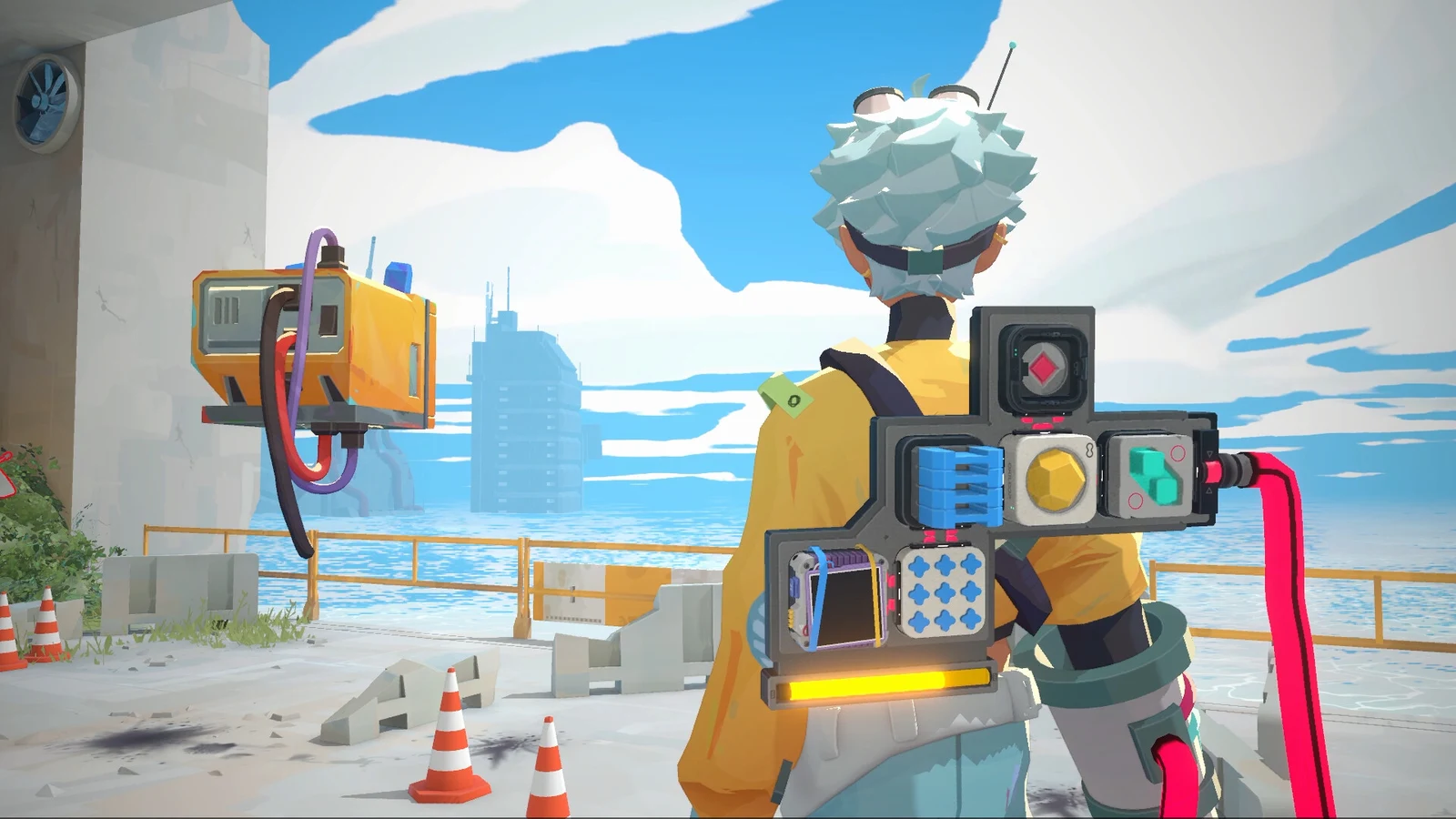
Modulink is a puzzle-action adventure built around a single idea: a grid of modules bolted to your backpack decides how you fight, cross gaps, and crack open sealed machinery. Developed by brainglyph and published by HypeTrain Digital, it drops a white-haired protagonist into overgrown, brutalist facilities where every weapon, shield, and bridge comes from slotting shaped pieces into that grid in real time.
Quick answer: Modulink combines third-person exploration, circuit-style logic puzzles, and ranged combat, all powered by a rotatable grid of modules you equip on the character’s backpack. It is open for wishlisting now; no release date is currently confirmed.
What Modulink is and who made it
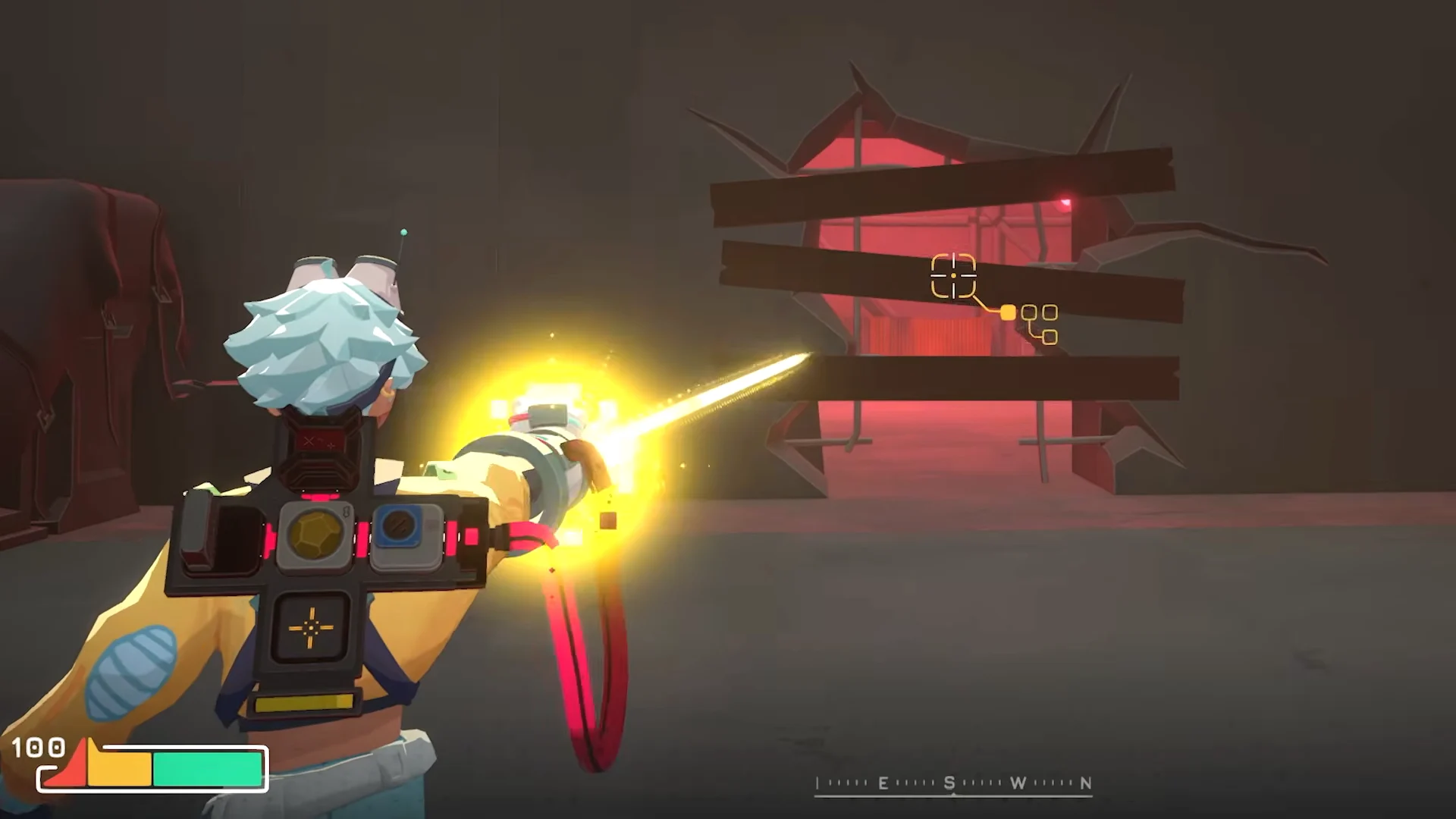
The game folds four pillars together: exploring futuristic environments, experimenting with gear, solving puzzles, and fighting robotic enemies. You play a stylized anime-cyberpunk character with pilot goggles, cybernetic facial seams, an orange-and-white cropped jacket, and teal cargo trousers. A cable runs from the backpack rig to a gauntlet on the arm, which is where the modular system translates into actual weapons and tools.
Development is handled by brainglyph, with HypeTrain Digital publishing. The project is co-funded by the European Union through the Creative Europe MEDIA program. A levitating yellow robotic companion, styled like an old CRT monitor, follows the protagonist through the world.
How the module grid works
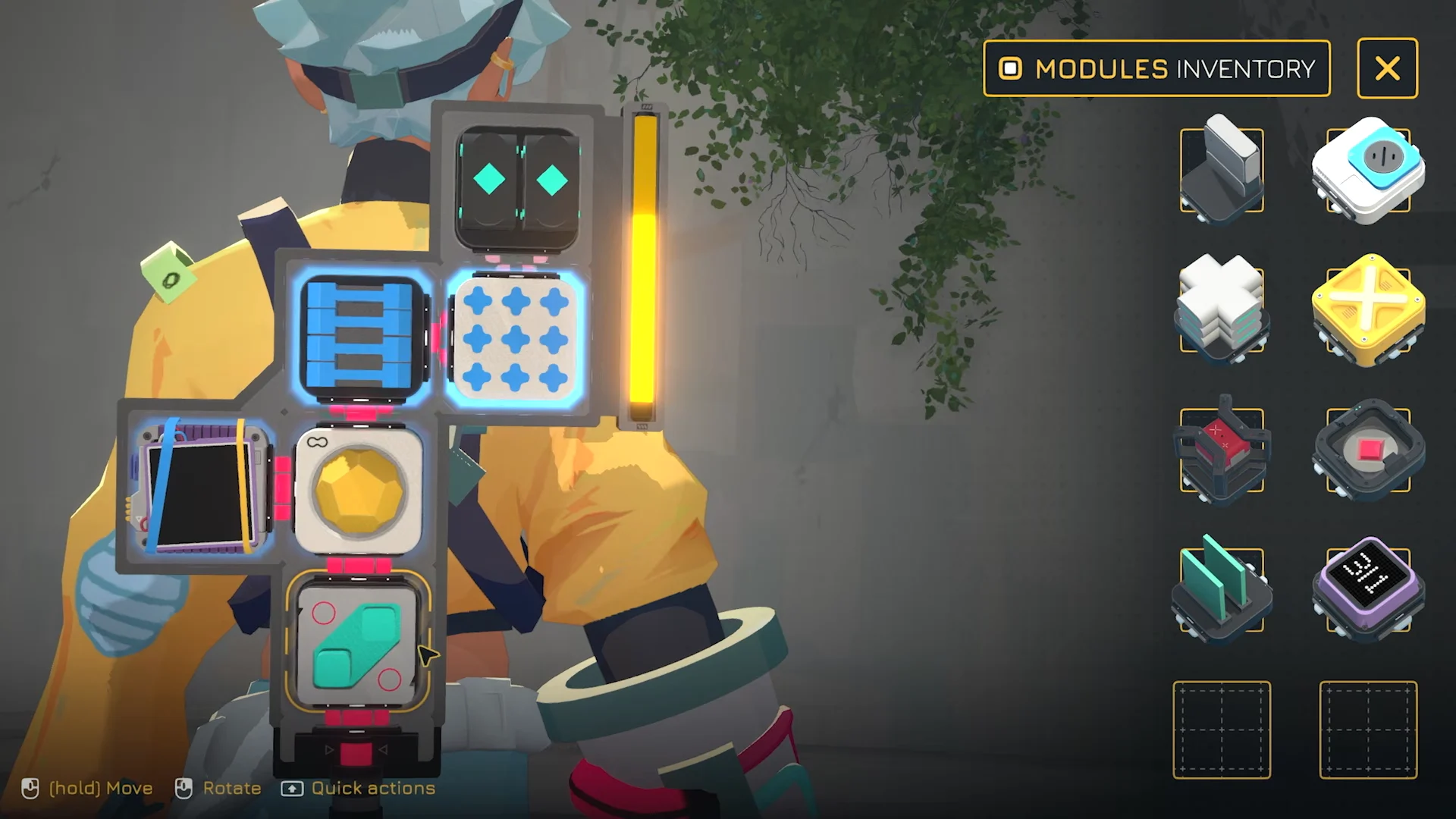
The backpack holds a grid-based socket system. You move, rotate, and drop modules into that grid, and the arrangement you build determines what the gauntlet does. Modules come in distinct geometric shapes, so fitting them together is part puzzle, part loadout design. You can change boards, perform quick moves, and swap pieces on the fly rather than through a static menu.
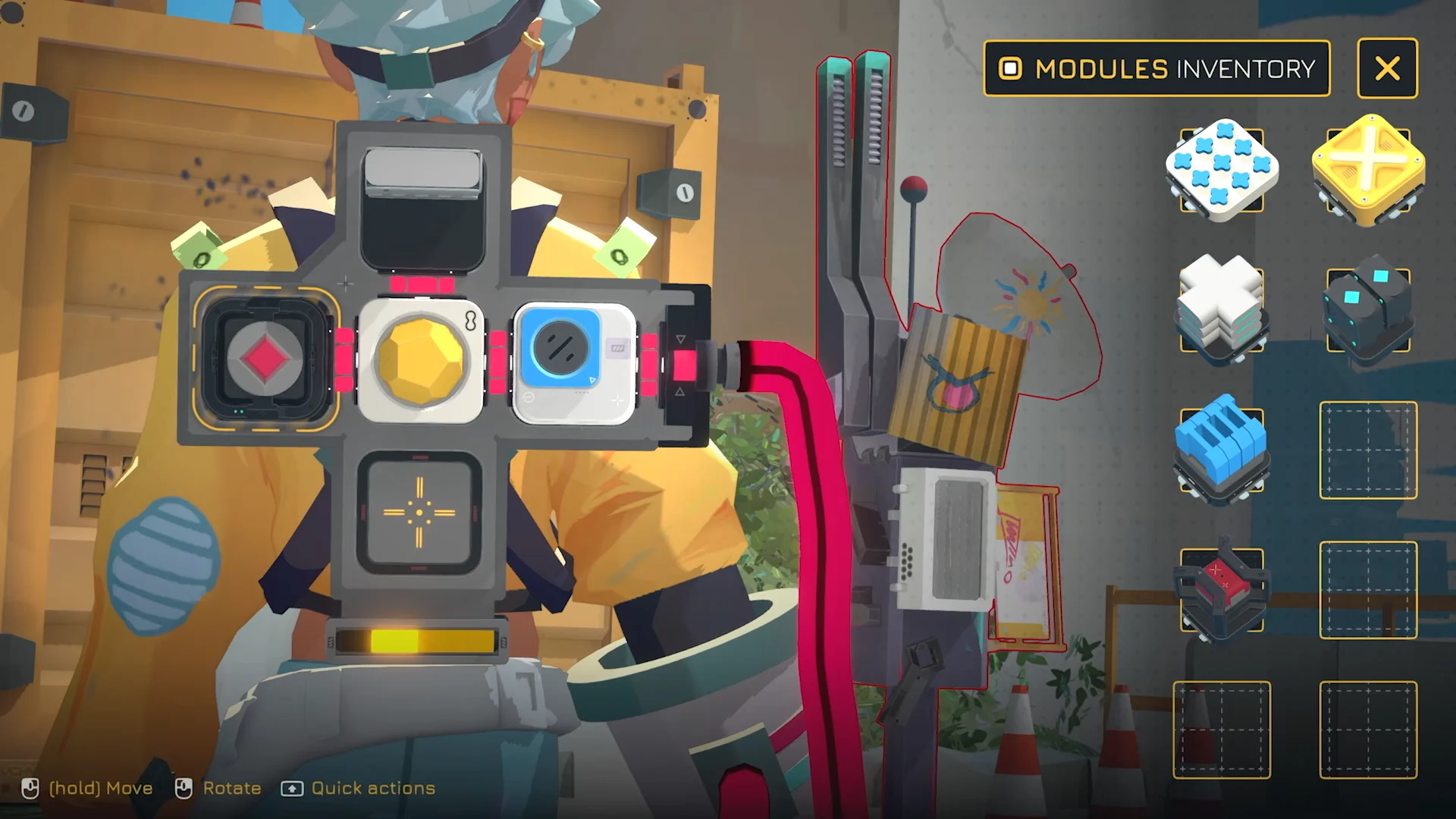
Each module has its own role. Some fire, some modify, and some defend. The named pieces shown so far give a clear picture of the system.
| Module | Code | Function |
|---|---|---|
| BULLT | #01 | Standard projectile fire |
| ELECTR | #02 | Electric-type attack |
| BOOM?! | #04 | Explosive effect |
| FREQ+ | #05 | Increases fire rate; works with BULLT and LASER |
| LASER | #07 | Continuous beam |
| COMBI | #08 | Combination module |
| PINKY | #09 | Named module (details hidden) |
The FREQ+ module is a clear example of how pieces interact rather than just stack. It raises shot frequency and is marked as compatible with both BULLT and LASER, so modifiers change the behavior of the weapons sitting next to them in the grid.
Discovering and logging modules
Scan objects throughout the world, furniture included, to uncover modules. Record each discovery in the registered modules codex, a numbered list with at least 16 slots; until found, many entries remain unknown and display as “?????”.
The codex also carries notes written in-character. The entry for BOOM?! reads “This just blows me up!!” alongside “There must be something else to it…”, hinting that some modules need to be understood before they pay off. Entries track a “USER VALUES” counter, such as 0/3 rising to 2/3, suggesting modules reveal more as you learn or configure them.
Puzzles at circuit terminals
Exploration is gated by logic puzzles at industrial terminals. You arrange and rotate circuit tiles across connected interface boards to route power through machinery. Solving them opens paths forward, such as a glowing hard-light bridge thrown across a chasm or a massive spherical reactor core spinning up.
The same move, rotate, and change-board controls used for combat loadouts apply here, so the puzzle language and the weapon-building language share one system. That keeps the central mechanic consistent whether you are powering a door or shaping an attack.
Combat against drones and bigger threats
Combat is ranged and happens in real time. Take on aggressive turrets and robots with lasers, rapid projectiles, and barriers, switching module arrays during a fight to change your output. As encounters grow tougher, expanding the grid allows larger, more complex setups.
The combat HUD puts a green-and-yellow health bar in the lower-left with a numerical value, plus targeting reticles, damage numbers, and objective markers along the bottom of the screen. Encounters build toward larger set pieces, including a colossal mechanical construct that powers up as the protagonist sprints into an open arena.
Release status and where to wishlist
Modulink is positioned as an upcoming title and ends its reveal with a call to wishlist. No official release date or time is confirmed right now, so any specific launch window would be speculation. The full reveal below walks through each pillar in order, from exploration to the final arena.