Path of Idle: Old Gods Rising rewards planning far more than reflexes. You never swing a sword yourself. Your role is closer to a coach who scouts a roster, sets the lineup, and then walks away while the fights resolve on their own. The players who stall in the first hour are usually the ones trying to micromanage every battle instead of building the systems that make the whole roster stronger.
Quick answer: Start as Warrior or Cleric, upgrade the Prison before recruiting any hero, pour spare gold, blood, and bone into Worshipper Infusion, raise the Temple level cap before spending Ancient Blood on Baptisms, and develop six heroes so both battle lines can run at once.
Pick Warrior or Cleric to start
Six classes are available from the start: Warrior, Mage, Hunter, Cleric, Priest, and Mercenary. Warrior and Cleric give you the smoothest opening hours. The Warrior can summon extra support units mid-fight, which puts more bodies on the field at no additional cost. The Cleric buffs your whole line and heals it steadily through a battle, which is what carries you into harder difficulties.
Class choice is not permanent. Because progression keeps ticking in the background, switching later does not leave you behind. Pick the class that looks fun, get comfortable, and move on rather than agonizing over the decision.
| Class | Role and early strength |
|---|---|
| Cleric | Support that buffs the whole line and heals on a steady drip; weak solo damage but essential for higher difficulty. |
| Warrior | Hybrid damage/tank that summons extra support units, adding free bodies to the field. |
| Mage | Easiest ranged class to run with strong AoE, but the smallest health pool. |
| Priest | Flexible melee caster with strong builds like Bone Chill, but the most complex to manage. |
| Hunter | Standard archer with decent ranged damage and fairly one-dimensional builds. |
| Mercenary | Available at launch; role still being evaluated. |
Upgrade the Prison before you recruit anyone
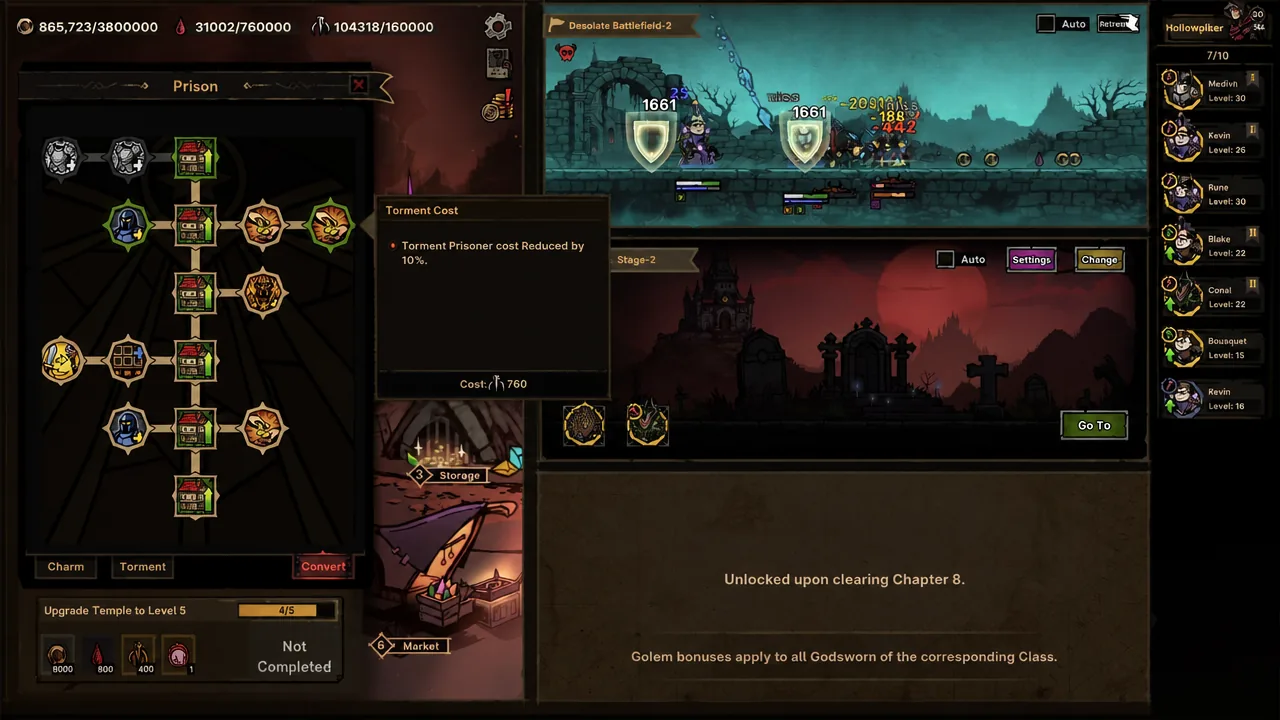
The Prison is where you spend gold to convert defeated enemies into playable heroes, called Godsworn. It is the most important building in the early game, and the timing of your upgrades matters more than most new players realize.
Prison upgrades only raise the starting stats of heroes recruited after the upgrade. Heroes already on your roster do not improve retroactively. So every hero you charm at a low Prison level is a permanently weaker hire, and you will end up re-recruiting the same heroes a few hours later.
Upgrade the Prison first, then recruit. When you do recruit, prioritize heroes with a summon ability. Extra units on the field are one of the strongest effects available early, and they cost nothing extra to run.
Feed the Worshipper through Infusion
Your character, the Worshipper, is the account itself rather than a fighter. It never enters combat. What it does is Infusion, a system that spends gold, blood, and bone on permanent stat gains that apply to everything you own.
Infusion is the only upgrade that never becomes obsolete. Heroes get swapped out and gear gets outleveled, but Infusion keeps paying off across your entire roster for the whole run. Whenever you have spare currency, put it here.
Raise the Temple cap before spending Ancient Blood
The Temple turns Ancient Blood into Baptisms, which push individual heroes up in level and raise their damage ceiling. There is a limit to how far a single hero can be pushed, and that limit is set by the Temple’s level. The Temple unlocks after Chapter 2.
Do not dump every drop of Ancient Blood into Baptisms the moment you get it. A Baptism improves one hero right now, while a Temple upgrade raises the cap for every hero you will ever field and reduces the Ancient Blood each Baptism costs. Raise the ceiling before you press against it.
Build six heroes, not three
Two battle lines run at the same time, and a third opens up after Chapter 8. Each line takes up to two heroes, so a working setup needs six developed heroes rather than three dominant ones propped up by a weak bench.
Concentrating all your gold and Baptisms on your top picks feels productive at first, but it creates a real wall once your second line has to pull its weight and cannot. Spread your resources across all six heroes from the start. It is slower for the first hour and much faster after that.
Gear priority: wear orange, bank green sets
Equipment comes in gray, blue, yellow, and orange rarities, plus green set pieces that sit on their own track. Orange gear has the best raw stats and the strongest affix potential, and its base stats can be pushed further through forging.
Green set pieces are individually weaker than the orange equivalent and only pay off once you complete the full set. Chasing a set early means fighting half-dressed in weak gear for a long stretch. Wear the best orange you find, keep set pieces in Storage, and finish sets when the drops come to you.
The Workshop is where you forge and upgrade equipment, and its level gates which gear tiers and affixes can exist at all. That gate applies whether or not you are actively crafting, so upgrade the Workshop with Sacred Bones when you can spare them. Runewords add another layer, and the in-game explanation is thin, so socketing pieces and watching the result teaches more than the tooltips do.
Manage Storage and the Market
Storage space is tight, and there is currently no way to batch open or batch sell a stack of low-level boxes. You clear them one at a time, so it pays to dump low-tier junk on a schedule every time you check in rather than letting it pile up. Upgrading the Market improves your buy and sell prices, which makes that cleanup steadily more profitable.
Actually go idle
The entire combat system is full-auto real-time. Every mode, including Expedition, Exploration, the Divine Tower, Alternate Dimension, and Finality, runs in the background without you watching. Set your lines, close the client, and come back later to collect the loot. The players who get the most out of the game are the ones who let it run.
Known issues worth knowing early
A few quirks can catch new players off guard. Demo saves do not carry over to the release build, so if you played the demo you are starting fresh. The Cleric set uses a sword, and swords cannot cast Masteries, so that pairing does not behave as expected. There is also a reported conflict between Ice Barrier and Wildguard boots. The game is locked to 60 FPS, which causes some animation hitching, though that is a visual issue rather than a progression one. There is no DPS meter, so comparing hero performance means reading percentages rather than a clean damage readout.
Play the first two hours in that order and you will clear the wall that traps most new players. Lock in a starting class, get the Prison upgraded before you charm anyone worth keeping, keep the Worshipper fed, raise the Temple cap ahead of your Baptisms, and grow all six heroes together. The systems do the heavy lifting once they are set up correctly, which is the whole point of a game you are meant to leave running.