
The single biggest change to Career Mode in EA FC 27 is that a player’s Overall Rating is no longer a fixed number tied to age and potential. Ratings now move up and down during the season based on how each player is actually performing, how happy they are, and how physically ready they are to play. That one shift breaks the old habit of building a squad and leaving it alone.
Quick answer: Dynamic OVR raises or lowers a player’s current rating in real time using three inputs, Form, Morale, and Match Fitness. Play a player regularly and keep them fit and happy and their OVR climbs; bench, mistreat, or overplay them and it falls.
The three inputs that move a player’s OVR
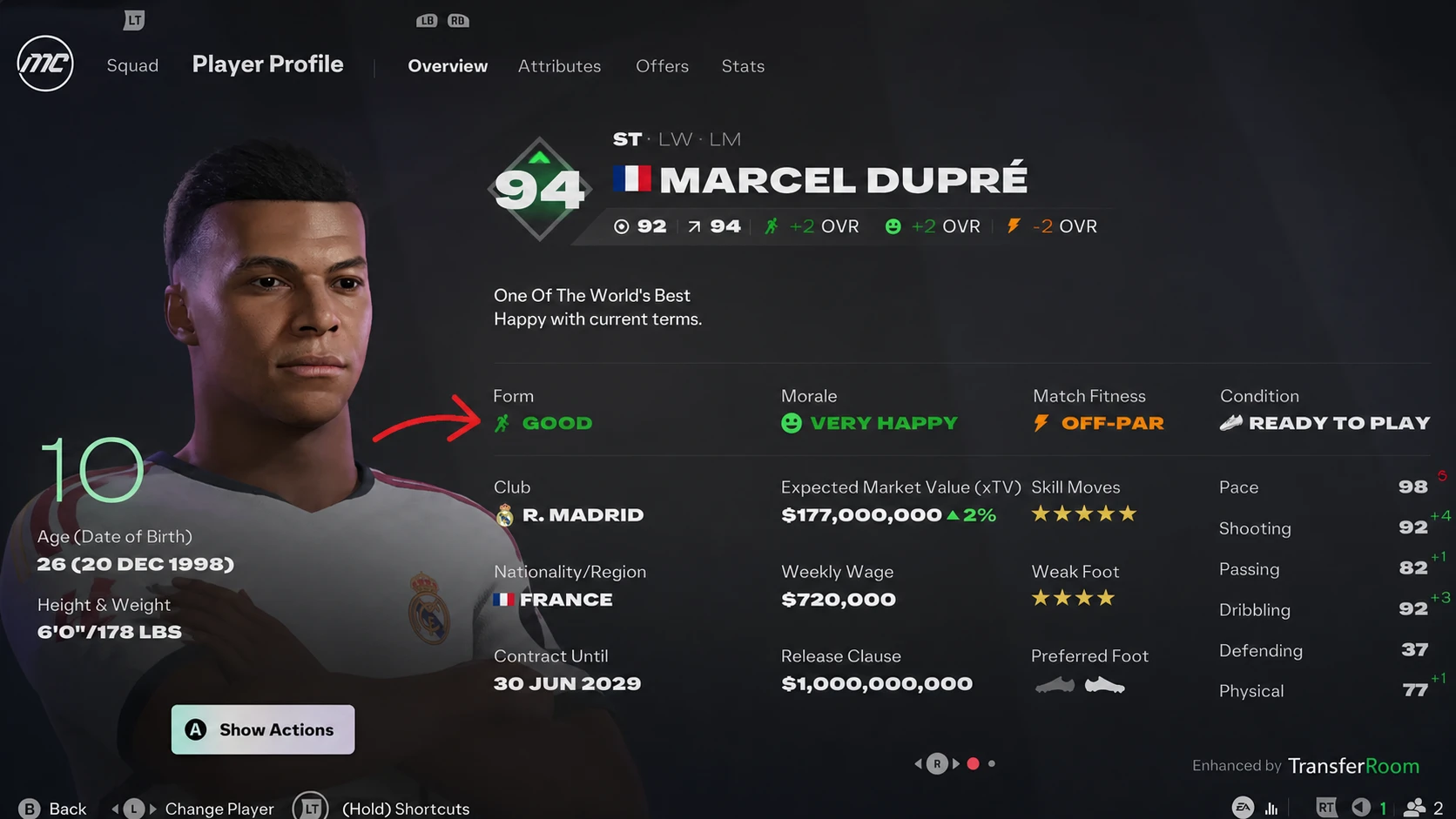
Dynamic OVR pulls together features that used to work in isolation and turns them into one connected system. A hot streak pushes a rating up; a long slump or a spell on the bench drags it down. Everything traces back to three pillars.
| Input | What drives it | Effect on OVR |
|---|---|---|
| Form | Match performances, tied to the player’s age, baseline OVR, and potential | Boosts attributes relevant to the player’s role, a winger in form gains pace and crossing rather than defending |
| Morale | Playing time, benchings, and manager press conference comments | High morale lifts the rating, low morale actively lowers it |
| Match Fitness | Recent energy levels and injury status, replacing the old training plan system | Poor fitness removes any boost and increases injury risk when the player is fielded |
Form is the most direct lever. A young academy player who hits good form sees a large OVR spike that also speeds up their long-term potential growth, while a veteran already near their ceiling gets a smaller, steadier bump. Morale is the most volatile of the three, swinging quickly based on your decisions.
Why the bench-and-rotate strategy is dead
In older EA FC titles you could keep a strong first eleven and a decent bench, let training plans quietly grow both, and swap in a squad player whenever a starter dipped. That set-and-forget approach no longer works.
Under Dynamic OVR, players who sit unused do not grow passively in the background. Their rating slides instead. You have to give bench players minutes and keep their morale up, or they lose value. Bench an unhappy star and their OVR drops right away, which can turn a squad asset into a liability if you leave it unmanaged.
Match Fitness and the reworked injury system
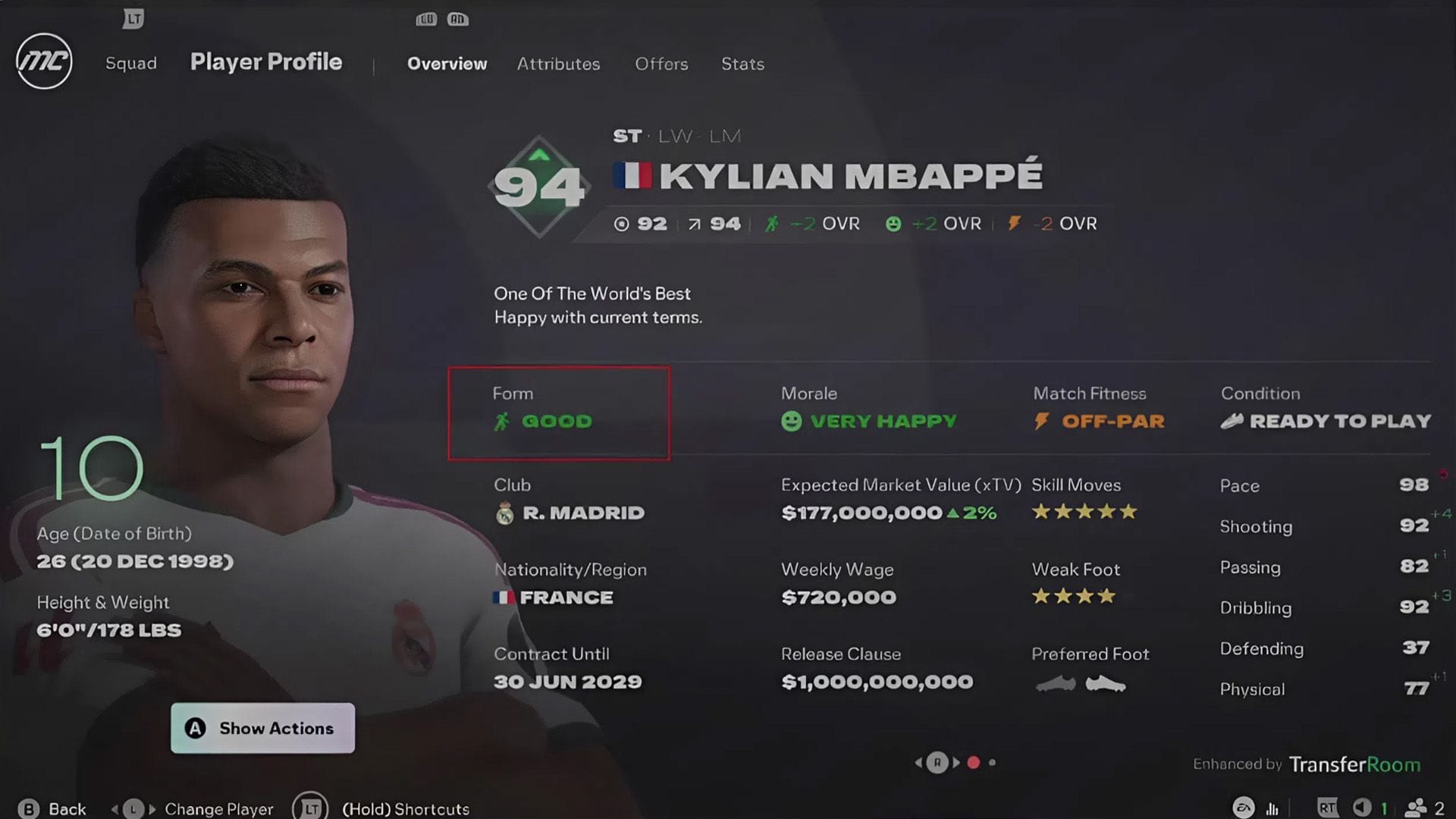
Match Fitness takes over from the old training plan menu and tracks how physically ready a player is based on recent workload and injury status. Field a player who is unfit or freshly back from injury and they get no OVR boost, plus a much higher chance of picking up a serious, long-term problem.
The injury system is more realistic too. Small knocks linger and keep chipping away at Match Fitness rather than clearing instantly. That forces a real decision before big matches. You weigh the risk of starting a key player carrying a minor strain against resting them and avoiding an absence that could last months.
Growth trajectories and the streamlined coaching staff
Player development no longer follows one predictable curve. Prospects now fall into distinct paths, so careers unfold differently from save to save.
- Early bloomers who peak young
- Late bloomers who develop slowly then surge
- Steady growers who improve gradually over time
The coaching staff has been trimmed to 12 core coaches across the key departments. Coaches no longer hand out artificial stat boosts. Instead, their quality decides how accurately they read a player’s true potential ceiling. A top-tier coach gives you a reliable reading, while a weaker one may misjudge how far a player can actually grow, which matters when you are deciding who to develop or sell.
Dynamic OVR applies to every club, not just yours
The fluctuating rating is not limited to the team you manage. It runs across every club, so AI transfer targets swing in and out of form the same way your players do. A player on a hot streak can outperform their usual level, and a slump can knock down someone you were about to sign.
That plugs straight into the rebuilt transfer market, which uses TransferRoom to power values and active bidding from rival clubs. Player prices now respond to potential, rating, form, and the buying power of the club chasing them, alongside new performance and buy-back clauses. The practical result is a Moneyball-style approach, where you spot undervalued players, time sales around a good run of form, and use clauses to protect long-term deals.
When you can play it and the pre-season boost
EA Sports FC 27 launches on September 25, 2026, with up to seven days of early access for Ultimate and Ultimate Plus edition owners from September 18. Full details on each version sit on the official EA Sports FC 27 page.
Pre-ordering the Ultimate Edition includes a Career Dynamic OVR Pre-season Boost, a head start on the new rating system before your first competitive fixtures. Beyond that bonus, the mechanic itself is standard across Career Mode.
The takeaway is simple. Every match, press conference, and rotation choice now feeds directly into your players’ live ratings, so your management decisions shape the squad far more than a fixed number on a card ever did.