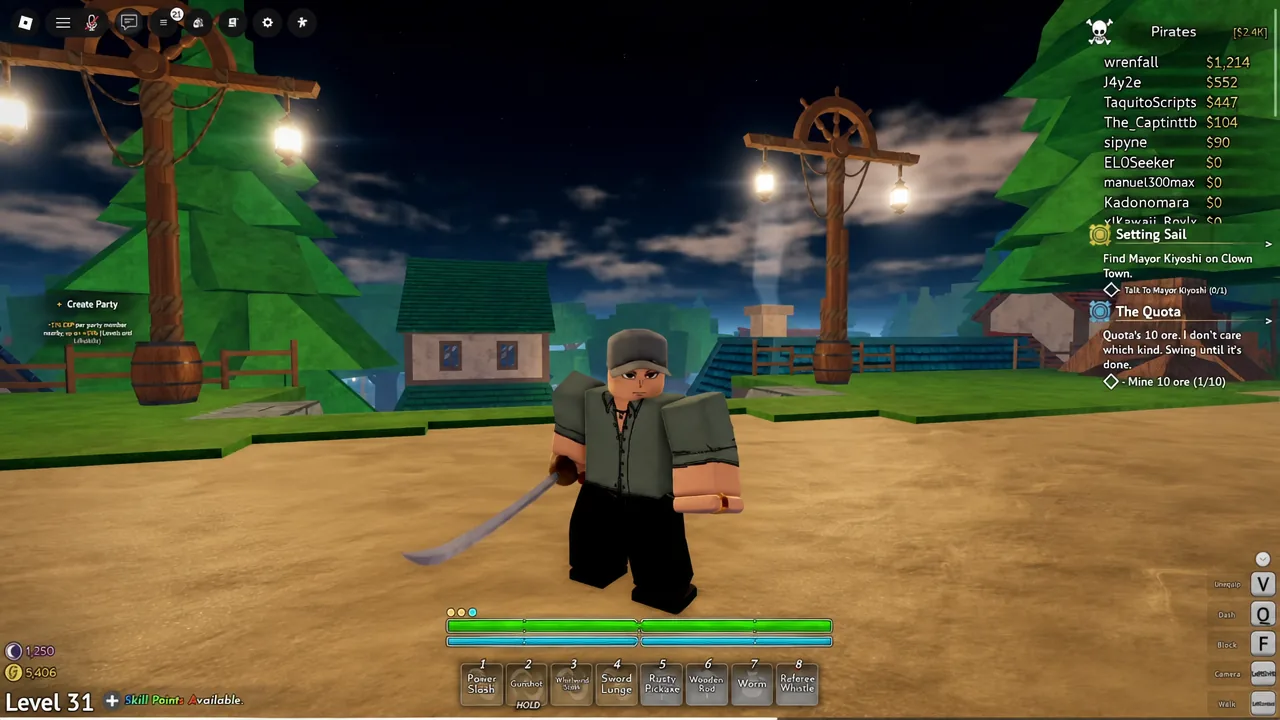
The opening stretch of Grand Blue is short but easy to waste. Anchor Town hands you stat points, life skills, a fighting style trainer, a free Cursed Fruit, and a level 30 boss, and none of it is signposted in a strict order. Do it in the right sequence and you can be on a boat heading for the second island in about an hour.
Quick answer: Put early stat points into Health and Strength, take Shiro’s sword training and Almighty Calvin’s dig quest in Anchor Town, then farm Axe-Hand Logan at the Marine Base using Zoro’s repeatable “Tyrannical Captain” quest until you hit level 30 and can buy a Rowboat.
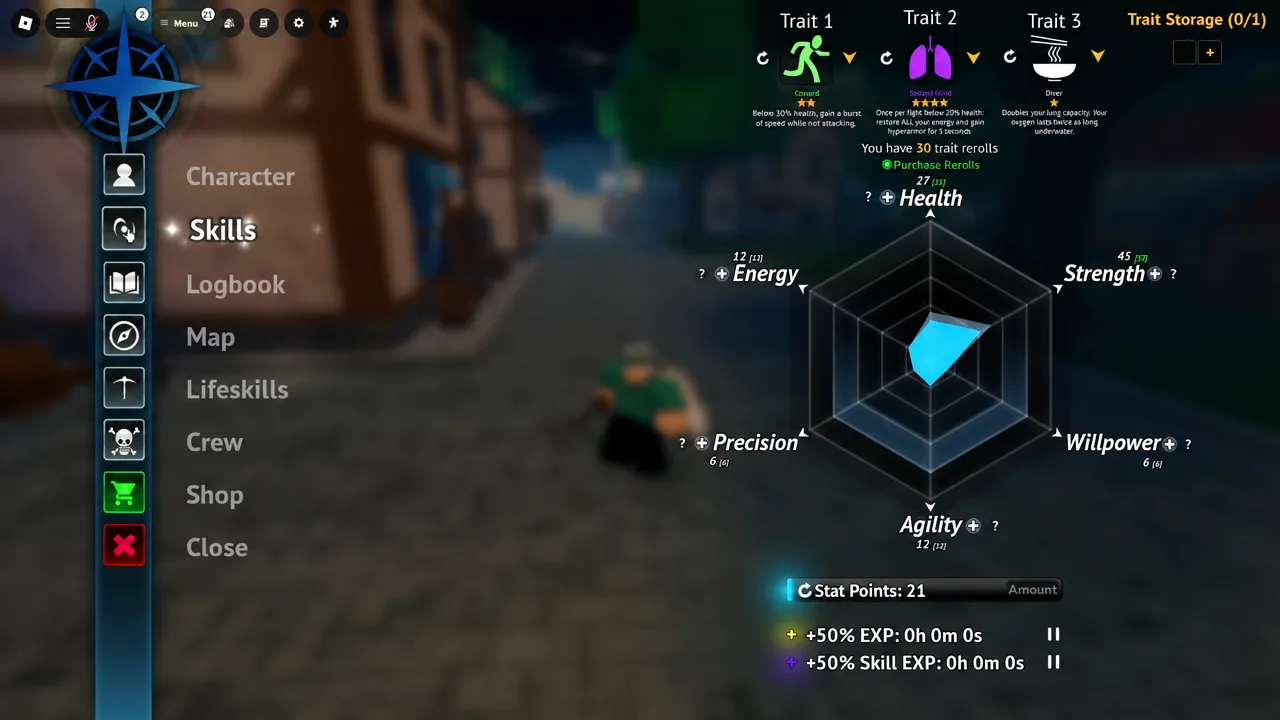
Stat points: what to raise first
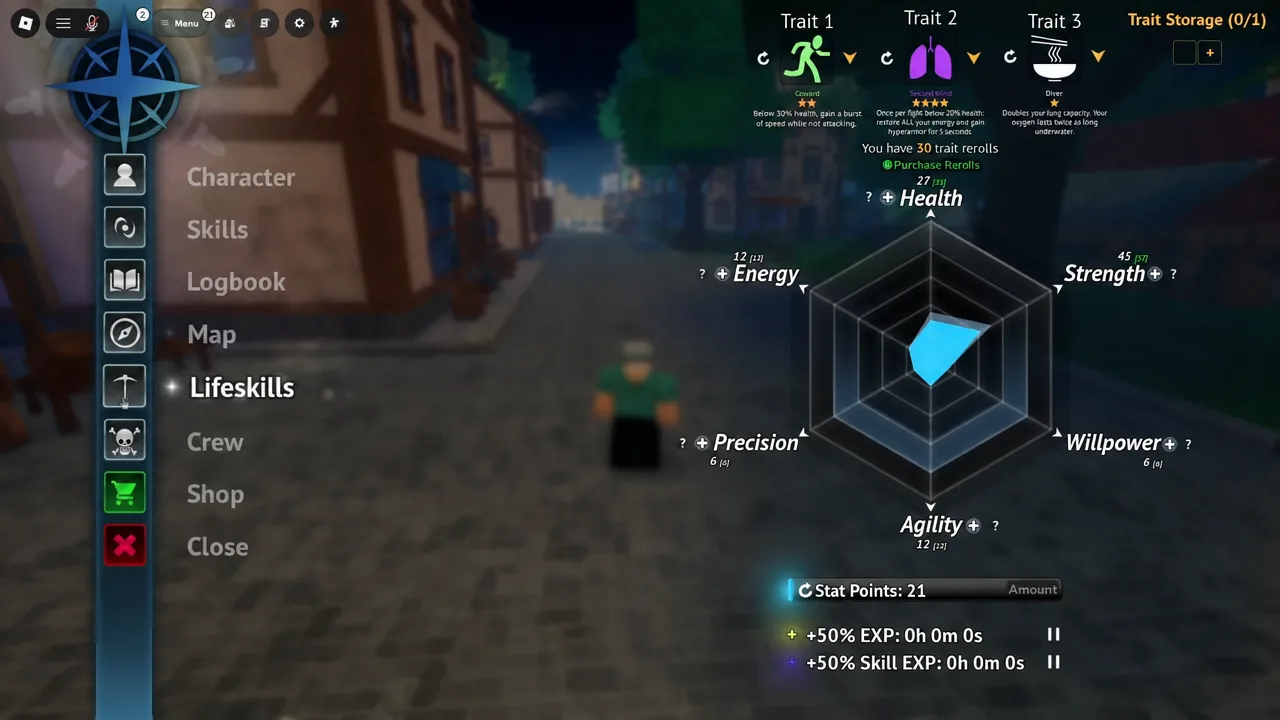
You get six stats to spend points on, and the early game does not punish you for a simple spread. Health keeps you alive through boss phases you have not learned yet, and Strength raises the damage on the light attacks you will be throwing constantly. Energy becomes the third consideration once you start leaning on skills, because abilities drain it quickly.
| Stat | Early-game role |
|---|---|
| Health | Top priority. Survives Axe-Hand Logan’s grabs and spin attacks. |
| Strength | Top priority. Raises M1 and melee damage for camp clearing. |
| Energy | Fuels skills. Add points if you are running dry mid-fight. |
| Willpower | Situational early. Safe to leave until you settle on a build. |
| Agility | Situational early. |
| Precision | Matters more if you build around the gun sidearm. |
Open the menu in the top-left corner to reach your character screen, where stats, traits, and reroll counts all live. Traits are rolled separately and can matter later, with effects like stronger food buffs, longer buff duration, a speed burst below 30 percent health, or an extra dash.
How the combat layers stack
Three things share your damage output. Your fighting style is what your M1 and M2 do. Weapon arts sit on top of that. Cursed Fruit abilities occupy the number keys. They do not replace each other, and the light attack string is the layer that carries you through the first island.
| Action | Bind |
|---|---|
| Movement | W, A, S, D |
| Interact with NPCs and objects | E |
| Light attack | M1 |
| Heavy attack | M2 |
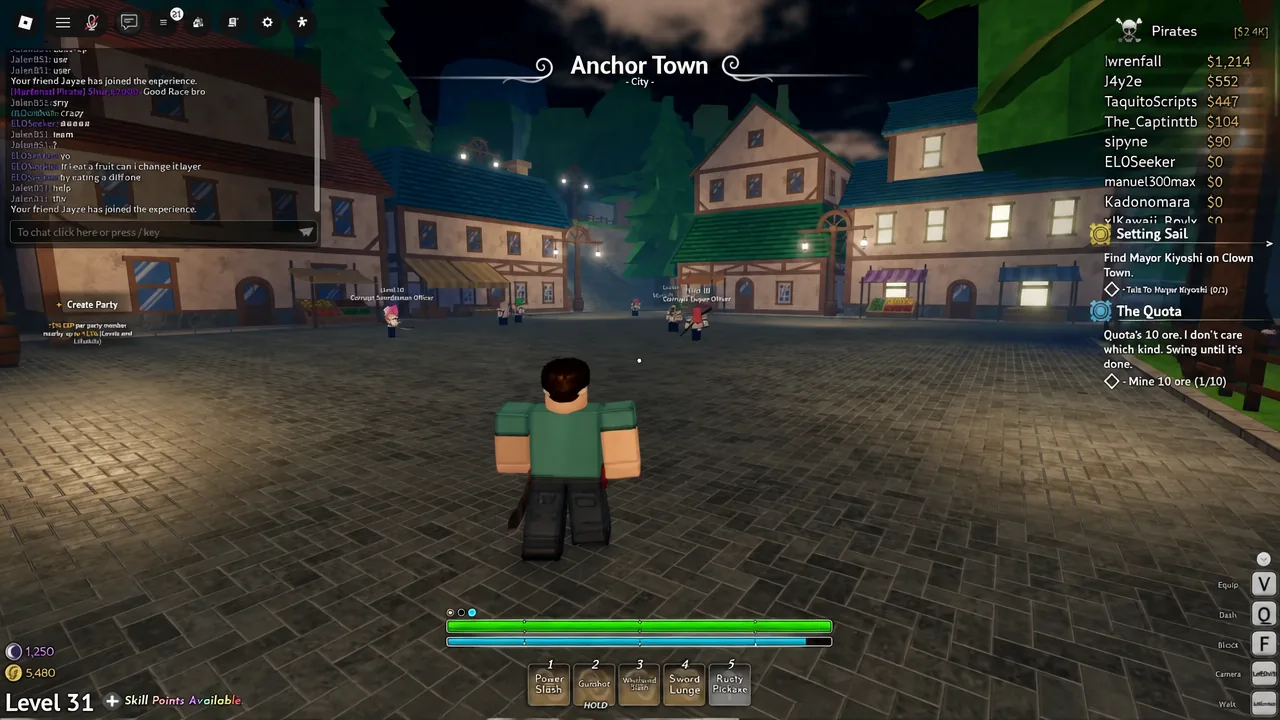
| Skills | 1, 2, 3, 4, 5 |
A workable habit early on: clear trash with M1, save M2 for the end of a string or a knocked-down enemy, and press a skill only after a light attack has already landed. Opening with heavy attacks or dumping every cooldown into low-level enemies is how you arrive at a boss with an empty bar.
Blocking matters more than it does in most Roblox pirate games. Boss attacks are meant to be blocked or dodged rather than traded through, and wasting your block early in a fight is a common way to lose one.
Unlocking skills and sword training with Shiro
Skills are not bought from a menu. Enemies drop them, and Marine Captains in particular hand over sword abilities such as Whirlwind Slash, Sword Lunge, and Power Slash. That alone is a reason to fight things instead of running past them.
Shiro is the Swordsmanship trainer in Anchor Town, and his quests are damage checks. One early task asks for roughly 200 sword damage before it pays out, and completing it unlocked Power Slash. Because the requirement is tied to specific skills, you have to actually use the ability being trained rather than punching your way through.
Abilities can also evolve rather than being replaced. Power Slash, for example, can be upgraded so the slash fires a projectile, and further upgrade options let you pick damage buffs for skills you already use. Bosses feed into this too, since defeating them can award extra skill slots on top of experience and stats.
You are not locked into a blade, either. A gun is available as a secondary weapon with its own skill set, so a ranged build is viable if you would rather keep your distance.
How to get a free Cursed Fruit from Almighty Calvin
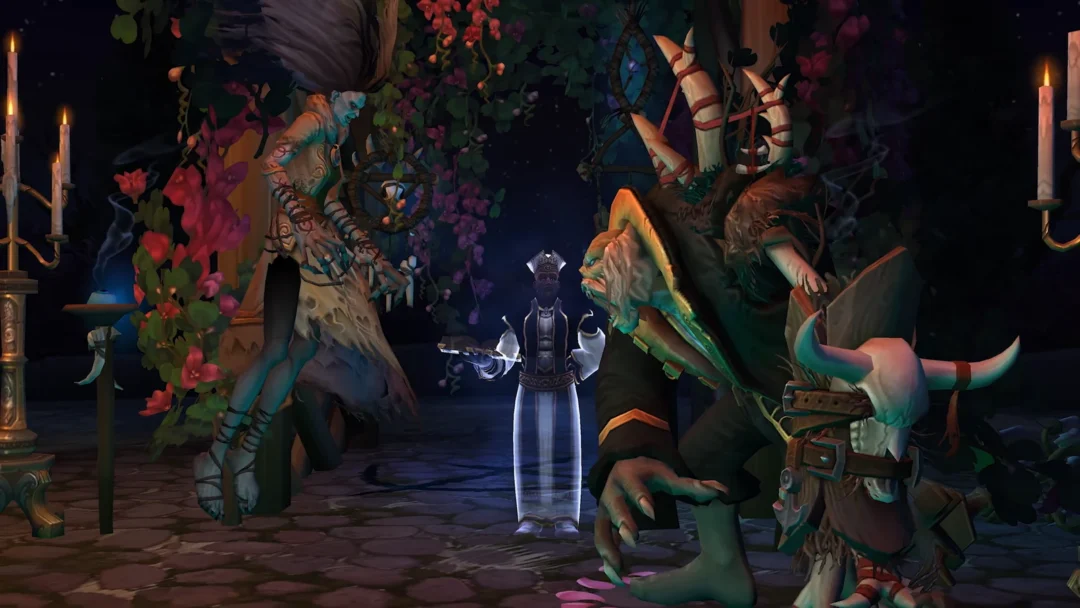
Cursed Fruits are the Devil Fruit equivalent here, and the cheapest one you will ever get comes from a wizard standing on a raised stone ledge on the right side of Anchor Town. The “Wizards Apprentice” quest costs nothing and takes a few minutes.
Note: you can only have one fruit eaten at a time, and eating another replaces it. Fruits can be stored rather than destroyed, so a spare is not automatically wasted. Beyond the quest, Fruit Chests bought with in-game currency, the Fruit Trader, and random island spawns are the other routes to a fruit, all of them slower or luck-based.
Lifeskills in Anchor Town: mining, fishing, farming, and cooking
Each lifeskill has its own tree and its own skill points, earned by doing the activity. They are not required to reach level 30, but mining and fishing feed early quests and give you something to do while quest cooldowns run.
| Lifeskill | Where to start in Anchor Town |
|---|---|
| Mining | Rock face on the left side of town; smelt ore at Blacksmith Shinozaki. |
| Fishing | The beach, using gear bought from Ricky. |
| Farming | Has its own tree and skill points earned through practice. |
| Cooking | Has its own tree; pairs with traits that boost food buffs. |
Mining needs a pickaxe and runs on a timing-based mini-game, with copper ore as the first material you will pile up. The early quest “The Quota” asks for ten ore, so the trip doubles as quest progress.
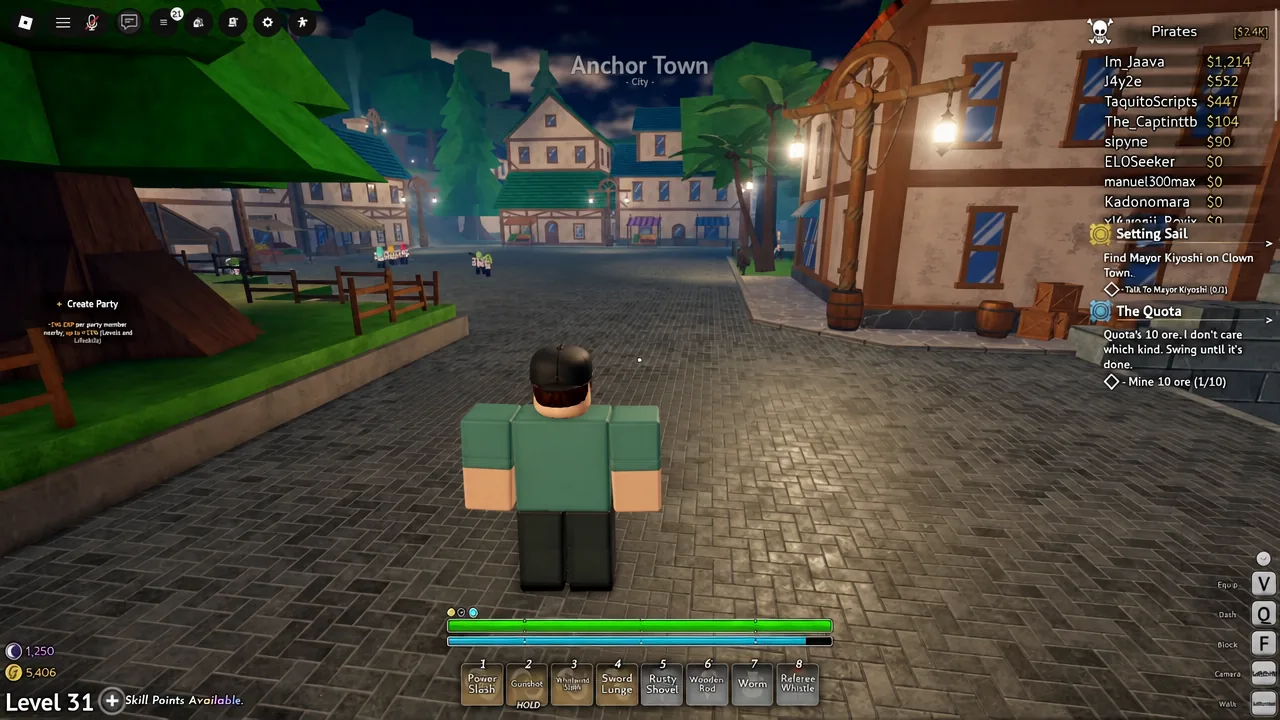
Fishing needs two purchases from Ricky at the beach: a Wooden Rod for 75G and Worms at 5G each. Equip both, cast, and keep the green bar lined up with the moving fish icon to land the catch and bank the experience.
The Logbook is worth opening while you are in menus. Its Achievements chapter pays out Celestial Coins, and the remaining chapters cover Fighting Styles, Fruits, Islands, Mobs, Quests, Sidearms, Skills, and Titles.
How to reach level 30 with Axe-Hand Logan
Level 30 is the gate for leaving the first island, and the fastest way there is a single repeatable boss.
How to set sail to Clown Town
Hitting 30 unlocks the “Setting Sail” quest and access to the Boat Shop on the Anchor Town beach.
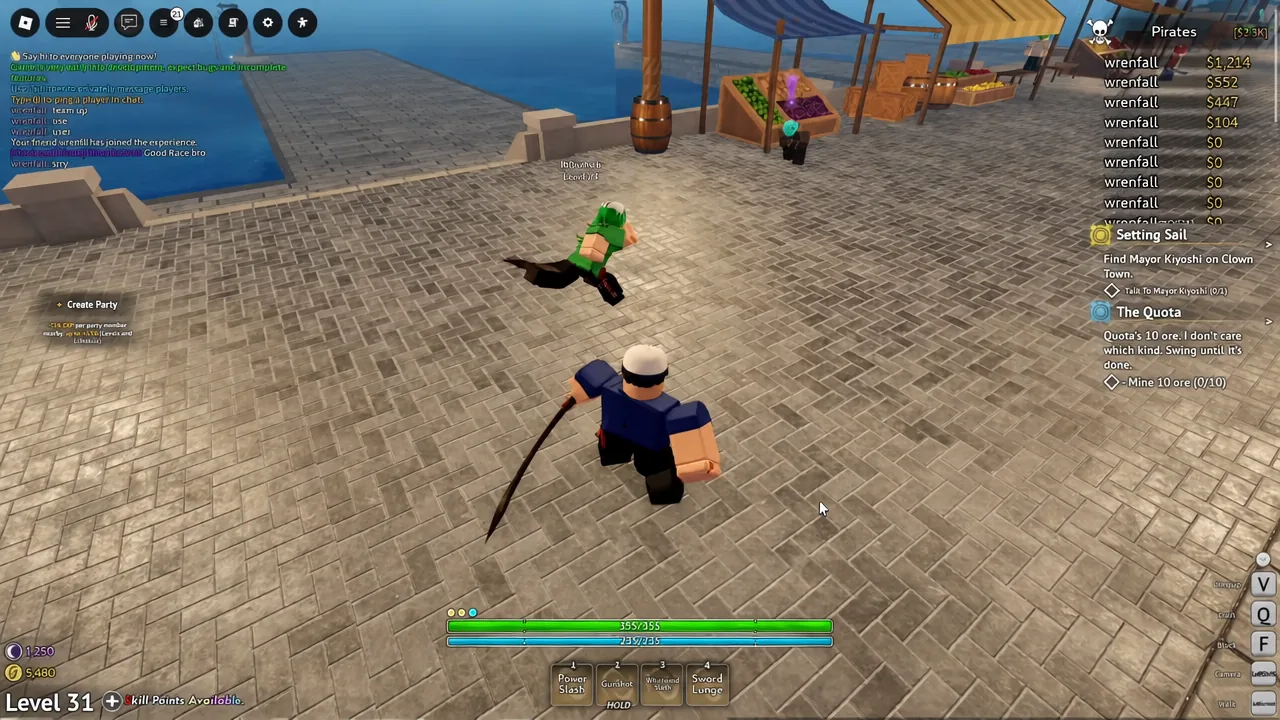
You will know it worked when the tracker swaps from “Setting Sail” to the new Clown Town objective and your respawn returns you to the island rather than Anchor Town.
Grand Blue codes and how to redeem them
Codes hand out rerolls and chests rather than raw power, but the Trait Rerolls are worth grabbing before you settle on a build.
| Code | Reward |
|---|---|
Release! | 10x Trait Reroll, 5x Race Reroll |
TwitterGoalReached! | 1x Fruit Chest, 20x Trait Reroll |
Race rerolls also sell for Robux, at roughly 100 rerolls for 5,000 Robux, with rarities running from Rare and Epic up to Legendary and a Celestial Human variant at about a 0.1 percent chance. Daily activities, quests, and Logbook achievements pay out currency as well, so the paid route is a shortcut rather than a requirement.
Grand Blue is still in Early Access, so expect ghosting hits and the occasional skill that plays twice. If an ability does not register, land an M1 first and press the number key again rather than panicking through your whole bar. Once you are docked at Clown Town with a fruit eaten, a trained sword skill, and thirty levels behind you, the rest of the map opens up on the same loop: quests, camps, a boss door, then the next island.