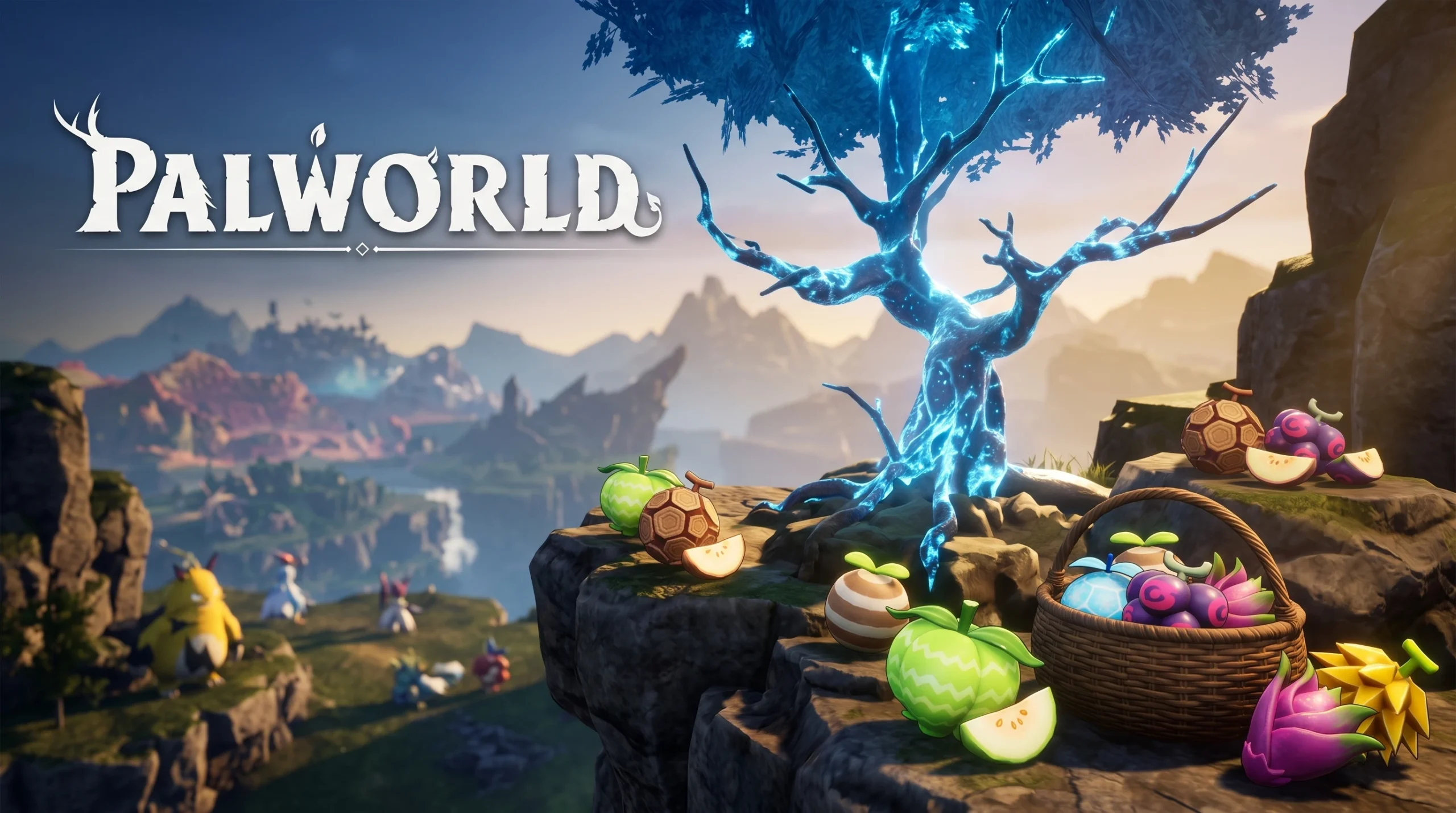
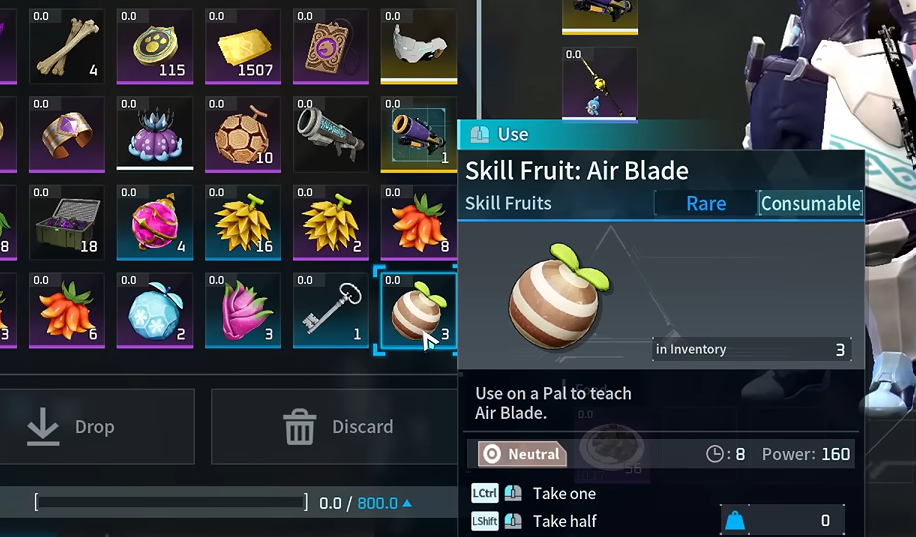
A Skill Fruit in Palworld 1.0 is a one-use item that permanently teaches an Active Skill to whatever eats it. Feed one to a Pal or a captured human, and that unit learns the skill on the spot, regardless of its own element. A Water Pal can fire off a Fire skill and it works exactly as it would on a Fire-type. The 1.0 release ships 92 skill fruits, and the honest truth is that most of them are filler. The handful that matter are the ones you build a loadout around.
Quick answer: Harvest fruits from blue-tinted Skill Fruit Trees and dungeon chests, feed the best one for your Pal’s role into that Pal, then keep three Active Skills equipped at a time. Buy Geyser Gush and Wind Burst from merchants for 1,500 gold each as your cheapest 600-power nukes.
How Skill Fruits work in Palworld 1.0
Learned movesets top out at five skills per Pal, but fruits overwrite freely. That is the whole reason to farm them. A single high-tier fruit is the fastest damage upgrade in the game, since it slots straight over whatever the Pal picked up from leveling. Once a Pal knows more than three skills, you are not stacking everything it has eaten. You are choosing which three go into the active loadout.
Two rules matter before you commit a fruit. First, the skill stays in the Pal’s learned pool forever, so a wrong choice is not wasted, it just sits unused until you swap it in. Second, the fruit itself is consumed and cannot be re-rolled. If you feed it to the wrong Pal, that copy is gone, and you farm another.
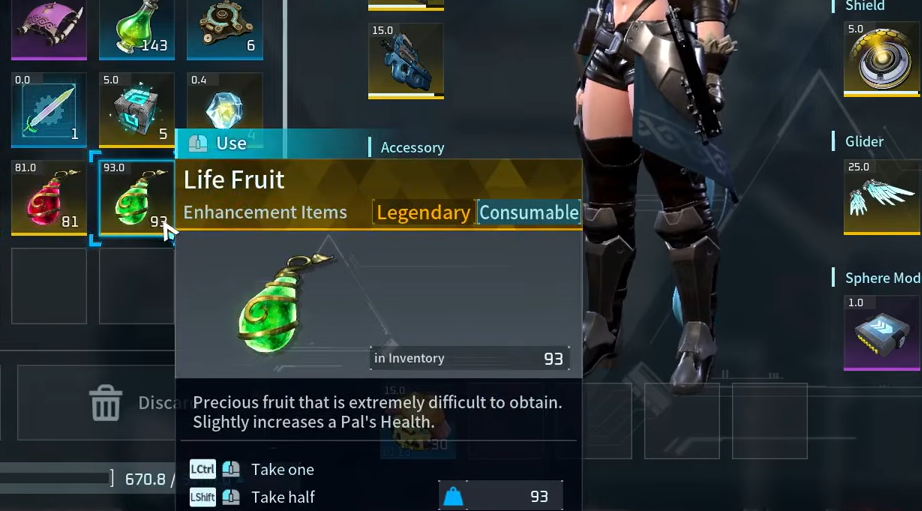
Don’t confuse Skill Fruits with the Potential-Increasing Fruits (Life Fruit, Power Fruit, Stout Fruit). Those raise a Pal’s stat ceiling and drop from the boss Bellanoir Libero. They share the word “fruit” and nothing else.
Where to farm Skill Fruits
Biome does not decide a fruit’s element. Skill Fruit Trees spawn a random fruit of any element no matter where they grow, so a tree in the snowiest corner of the map can hand you a Fire skill. Route your farming around tree density instead of chasing an element by location. The main island alone holds around a dozen known trees, with more in the Feybreak region.
Dungeon chests are the second reliable source. Fruits show up as a secondary loot roll next to gear and materials, so clearing a dungeon doubles as a fruit run. The only method that removes the randomness is the Skillfruit Orchard, unlocked at Technology Level 48 for 200 Wood, 50 Paldium Fragments, and 30 Pal Fluids. Plant a fruit you already own, assign a Pal with the Watering work suitability, and harvest a fresh batch, typically two copies of the same fruit. There is a low chance of a third fruit that is a different skill of the same element, which is the practical way to pull rarities like Holy Burst and Flame Funnel. Treat that mutation as a bonus, not a plan.
Best Skill Fruit per element
These are the default picks worth building around, using the internally consistent 1.0 skill values. PWR is base power and CT is cooldown in seconds. Tree loot means it can drop from any Skill Fruit Tree; merchant entries list the gold price.
| Element | Top pick | PWR / CT | Source |
|---|---|---|---|
| Electric | Lightning Bolt | 450 / 20s | Tree loot |
| Water | Hydro Laser | 450 / 20s | Tree loot |
| Grass | Circle Vine | 300 / 16s | Tree loot |
| Ice | Diamond Rain | 600 / 30s | Tree loot |
| Dark | Dark Laser | 450 / 20s | Tree loot |
| Ground | Rocky Impact | 600 / 30s | Merchant · 5,000g |
| Dragon | Beam Slicer | 350 / 16s | Merchant · 5,000g |
Electric has the deepest bench, since every ranked fruit is a clean hit with no gimmick. Water covers the whole game, with Splash carrying the early levels, Hydro Slicer bridging the midgame, and Hydro Laser finishing as a top single-target beam. Grass leans on Circle Vine, which sprouts roots across a target’s hitbox and hits big enemies far harder than its listed 300 power suggests. Ice puts up the highest numbers on paper with Diamond Rain, though several of its heavy hitters only pay out when every part of the attack lands.
Fire is the weak pool in 1.0. Its skills exist, but the element leans on outside combos rather than a standout fruit of its own, so don’t expect a Fire fruit to carry a build the way Electric or Water will.
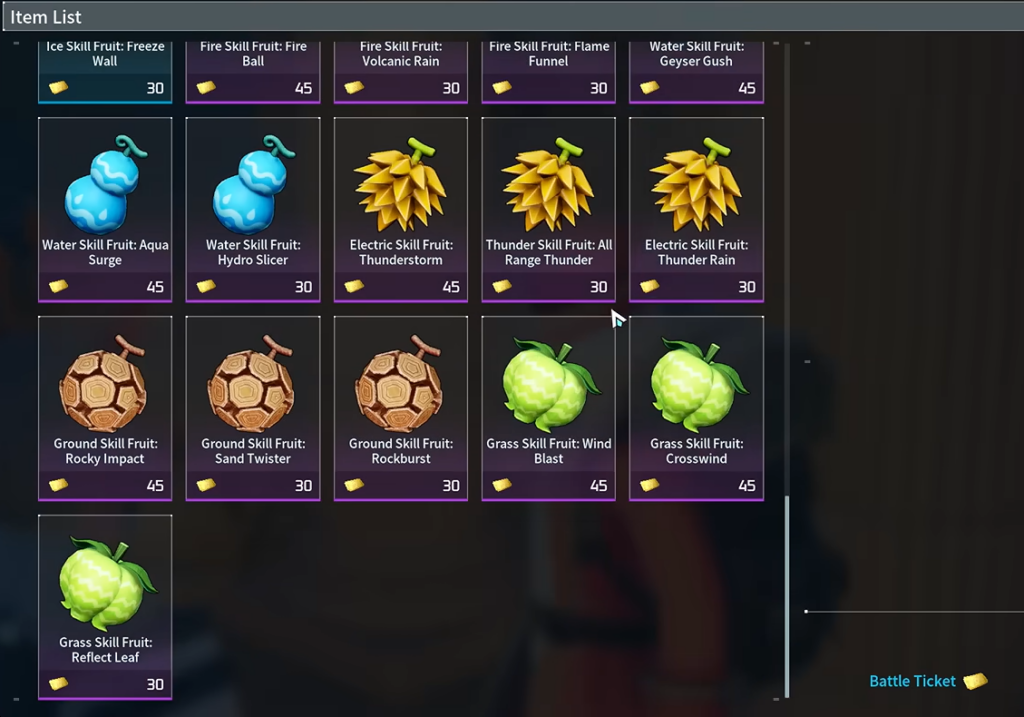
The two 1,500 gold nukes to buy on sight
Most 600-power fruits cost 5,000 gold at a merchant. Two do not. Geyser Gush (Water) and Wind Burst (Grass) both hit for 600 power on a 30-second cooldown and sell for just 1,500 gold, making them the cheapest 600-power skills in the game. Grab both whenever a merchant stocks them.
| Fruit | Element | PWR / CT | Best against |
|---|---|---|---|
| Geyser Gush | Water | 600 / 30s | Big-hitbox bosses only; whiffs on small targets |
| Wind Burst | Grass | 600 / 30s | Packs and multi-target fights |
For raid-scale fights, Absolute Frost (Ice) is one of only two 700-power fruits in the game, but it is wasted on anything without a hitbox large enough to eat the whole storm. Save it for alphas and raid bosses.
Building a three-skill loadout
The common mistake is filling all three slots with big, slow skills that spend the fight on cooldown. Spread the cooldowns instead so the Pal is always doing something.
Type synergy stacks on top of this. A skill that matches the Pal’s own element gets a damage bonus, and a super-effective hit against an opponent roughly doubles its damage while a resisted one is halved. Feeding an off-element fruit is still often the right call, since it covers a matchup the Pal’s natural moveset cannot touch. Reserve that off-element slot for coverage, not raw damage.

Confirming a fruit worked, and why numbers disagree
After you feed a fruit, open the Pal’s skill list. The new Active Skill appears in its learned pool immediately. If the Pal already had three skills equipped, the game asks you to swap one out before the new skill goes live, so the loadout only changes when you confirm the replacement. That prompt is your confirmation the fruit was consumed correctly.
You will also run into wildly different power figures between trackers. Some list Fire Ball at 150, others at 600, with no patch note to explain the gap. When a number only shows up in one place, and you cannot cross-check it, treat it as an estimate and confirm the real value in the Pal’s own skill menu before committing a build around it. The menu inside the game is always the tie-breaker.