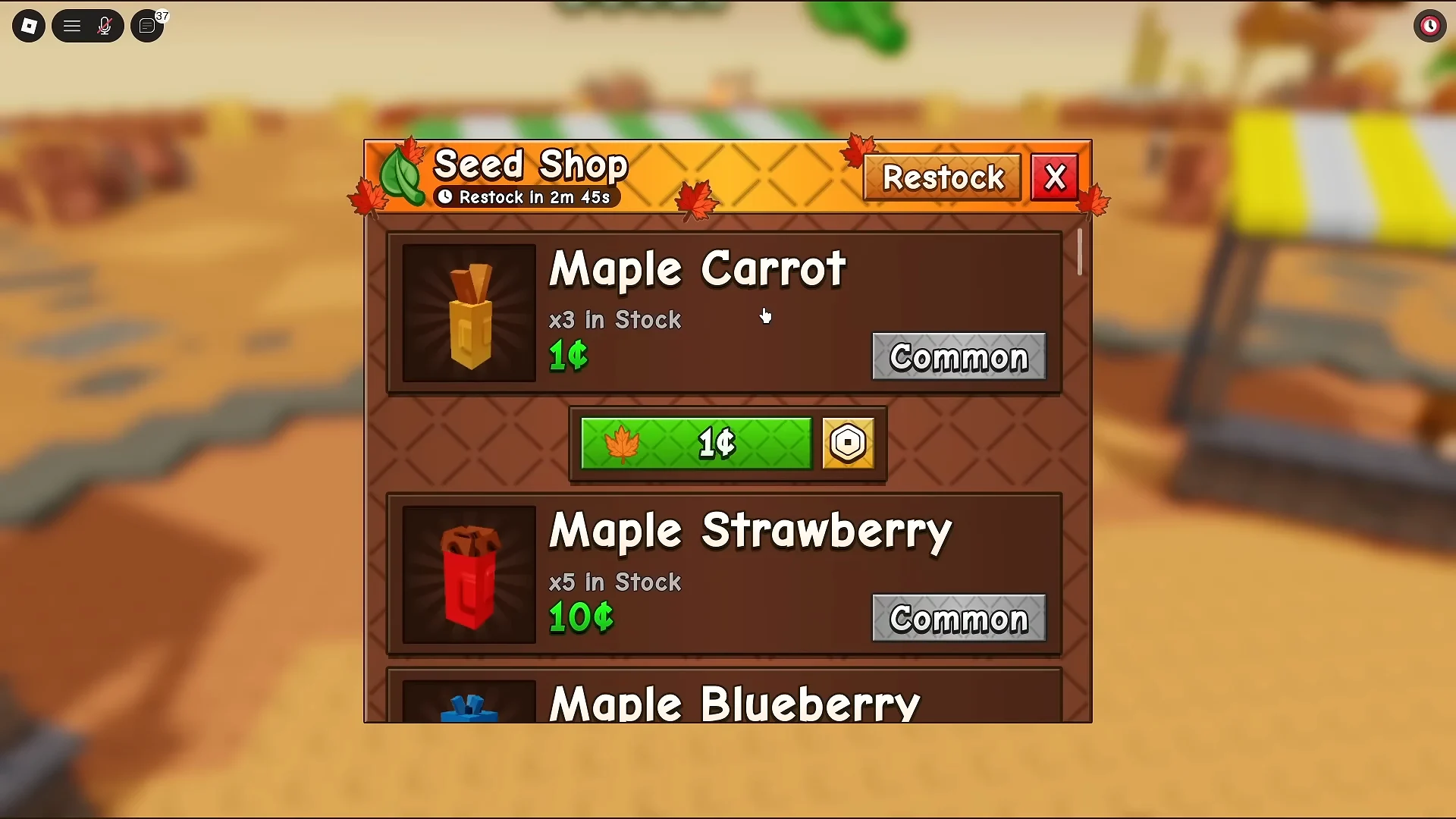

Leaf crunching is a deceptively simple money loop. Leaves spawn on your dirt plot, you walk over them, and each crunch pays out cash. Everything after that first step is scaling — better leaves on the pedestal, more leaves falling per wave, a wider pickup area, and resets that make the whole cycle pay more than it did before.
Quick answer: Place the highest-tier leaf you own on your plot, spend cash on Spawn Rate, Range, and Leaf Rain Amount, push Leaf Luck for better rolls, and rebirth once you hit $10,000.
How the leaf crunching cash loop works
Your plot is the engine. A green Spawn Leaf button rolls a leaf onto the pedestal, and once you place that leaf on the dirt, copies of it start raining down across the plot. Stepping on them converts them to cash instantly, so the whole game is a walking pattern over your own lawn.
The first leaf you are likely to see is a Soggy Birch, followed by early placements such as Hazel. Those are placeholders. The real jumps come from rolling rarer species and from mutation traits, which is why cash spent on rolls tends to pay back faster than cash spent on anything else in the opening minutes.
Three leaderboard boards sit near the spawn area — Top Cash, Best Leaf, and Top Time. Best Leaf is the useful one, because it tells you what the ceiling looks like before you sink money into a species you already outgrew.
Leaf types, prices, and roll rarity
Leaves come out of the spawner as a roll, and you choose whether to buy the result. Prices are quoted per leaf, so a cheap species is cheap to mass-place and an expensive one is a commitment.
| Leaf | Cost or rarity | Where it appears |
|---|---|---|
| Soggy Birch | First spawn | Spawn Leaf pedestal |
| Hazel | Early placement | Your plot |
| Alder | $42 per leaf | Leaf roll |
| Willow | Roll result | Tree pedestal spawner |
| Soggy White Oak | $62 per leaf | Leaf roll |
| Field Maple | Roll result | Leaf spawner |
| Crunchy Elm | Rare, 1 in 500 | Leaf roll |
| Aspen | Roll result | Leaf roll |
| Magnolia | High value | Seen on other plots |
Rarity tags matter more than the sticker price. A Crunchy Elm pulled at a 1 in 500 chance is worth building around, while a $42 Alder is a stopgap you will replace within a rebirth or two. If you want a preview of what a late-game plot looks like, walk over to a neighbor’s base — high-value Magnolia leaves are usually the giveaway.
Upgrade board stats: Spawn Rate, Range, and Leaf Rain Amount
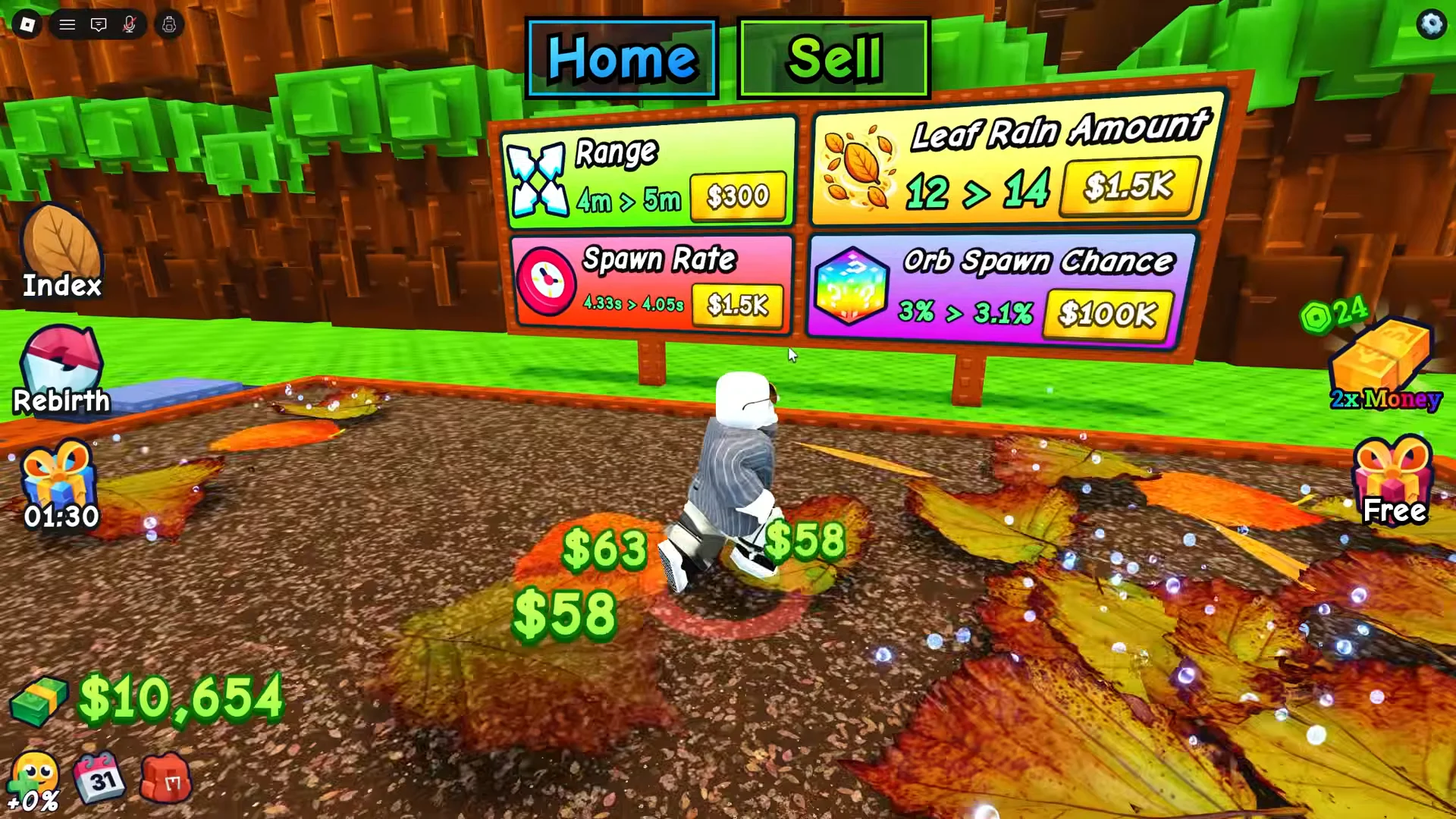
The stat board next to the plot holds the core farming upgrades. Range widens the area you cover, Leaf Rain Amount controls how many leaves fall, and Spawn Rate sets how quickly they come back. Each level is bought with cash, and prices climb as you go.
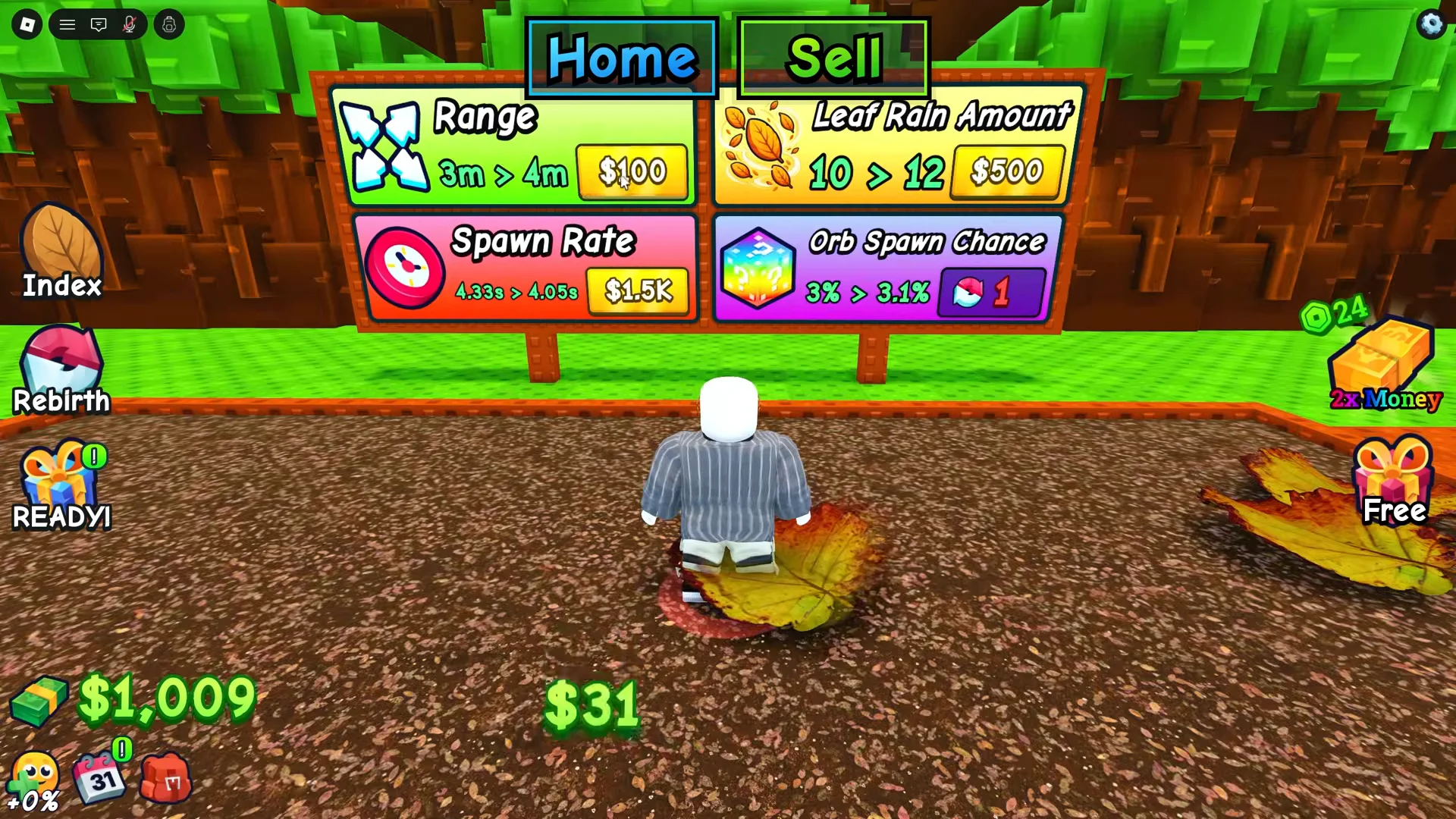
Leaf Luck sits on its own sign and works in multipliers. It starts at 1x and the first purchase takes it straight to 4x, with further levels available as your cash pool grows — level 6, 7, and 9 all become realistic within a couple of rebirths. Rare pulls like the Crunchy Elm start showing up once Leaf Luck is stacked.
Leaf Rolls is the other lever worth tracking. It is cheap early and brutal later, so buy the first level when it is still affordable rather than waiting.
| Purchase | Cost |
|---|---|
| Leaf Rolls level 1 → 2 | $5,000 |
| Base Level 5 → 6 pad | $30,000 |
| 5-minute time warp gift | $74,802 |
| Leaf Rolls (later level) | $2,000,000 |
Base Level is bought by standing on an upgrade pad rather than at the board, and it gates how far your plot can be pushed. The jump from 5 to 6 runs $30,000, which is usually the first purchase that forces you to actually farm instead of impulse-buying.
Mutations, mystery orbs, and the Index
Mutations are traits layered on top of a leaf, and they are the cheapest way to raise a plot’s output without rolling a rarer species. A floating rainbow mystery orb drifts through the area — collect it and the trait is applied to a leaf.
You can also pull a Trait Roll out of the Free Gifts menu, which is worth claiming whenever it is available. The Index menu tracks both halves of this system, with separate pages for Leaves and Mutations, so it doubles as a checklist of what you have actually discovered.
Check the Index before buying a roll result. If the species is already recorded, the only thing you are paying for is a higher-tier replacement, not a new entry.
Rebirth requirement and when to reset
Rebirth is where the billions come from. The Rebirth menu lists a requirement of $10,000 for the first reset, which is reachable inside the opening minutes once Leaf Rain Amount and Spawn Rate have a few levels on them.
Rebirth 1 and Rebirth 2 come quickly. The efficient pattern is to buy Leaf Luck and the cheap stat levels first, roll for a better leaf, then reset — resetting with a weak leaf on the plot wastes the ramp you just paid for.
Free cash sources: daily gifts, time warps, and the +100 Leaves pad
Several systems hand you progress without a purchase. Use all of them before you grind manually.
- Daily Gifts — claim Day 1 onward from the menu; the streak keeps running as you log in.
- Free Gifts — includes Trait Roll rewards for mutations.
- Time warp — a 5-minute skip, purchasable for $74,802, that banks offline-style earnings.
- +100 Leaves pad — a green pad that triggers a mass leaf drop across the plot.
- Sell stand — dump spare leaves for cash; four low-tier leaves sell for around $129.
The +100 Leaves pad pairs well with a fully upgraded Range, since a wide pickup radius lets you clear the entire drop before it despawns. Selling is the opposite — it is cleanup, not income, and only worth doing when your inventory is clogged with leaves you will never place.
How to confirm your progress registered
Three checks tell you the loop is working. The rebirth counter should tick up to Rebirth 1 and then Rebirth 2 after each reset. The Index should show new entries under Leaves and Mutations after a roll or an orb pickup. And the upgrade board should display the next level and its new, higher price immediately after a purchase.
For a longer-range check, the Best Leaf leaderboard shows where your plot sits against other players. If your placed leaf is not moving that board at all, the bottleneck is the species on your pedestal, not your stat levels.
Other Roblox leaf games built on the same loop
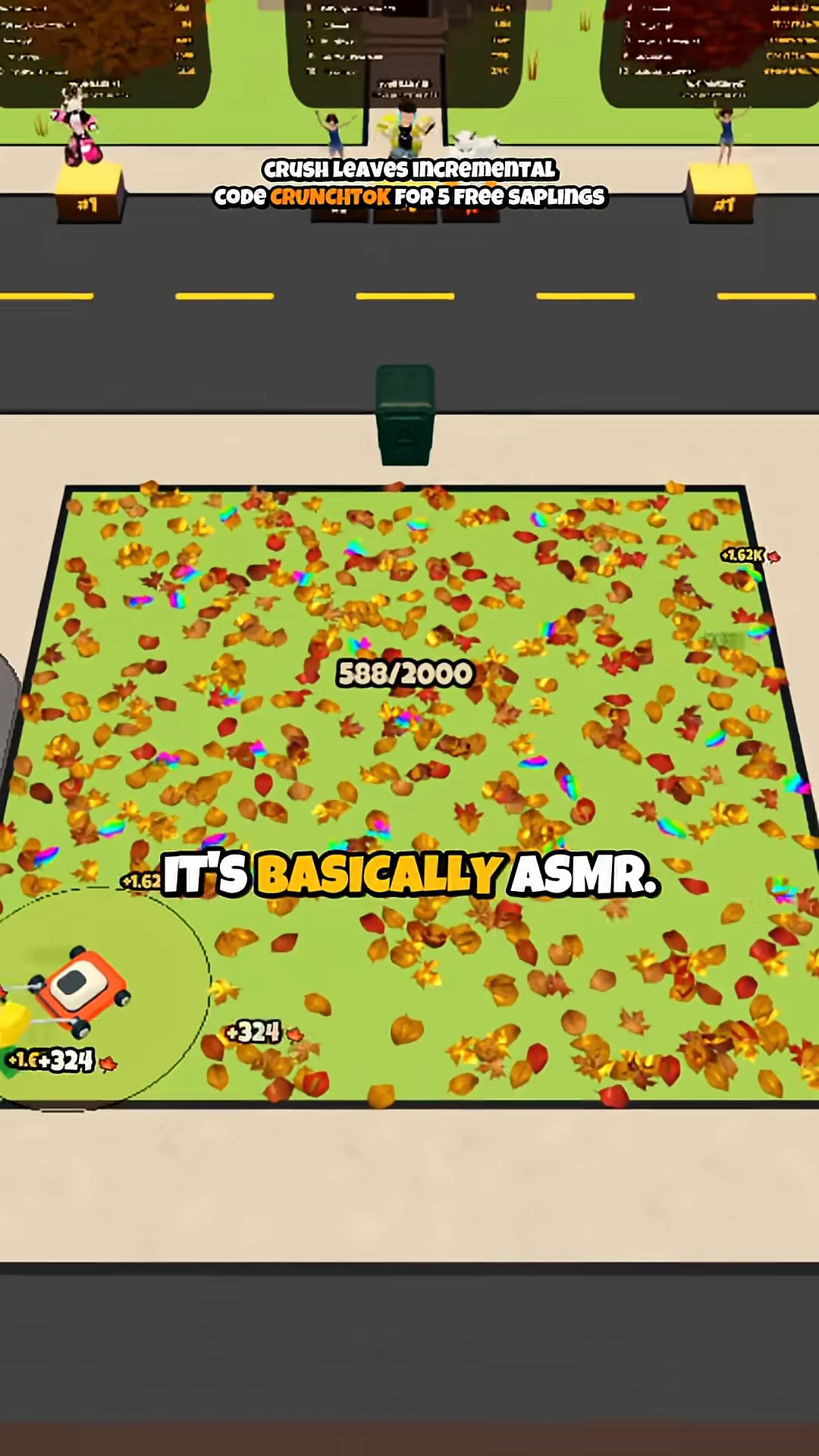
The crunch-and-upgrade formula shows up across several Roblox leaf titles, with different tools bolted on top. Crush Leaves Incremental swaps walking for a small red lawnmower that clears leaves in a radius and dumps them into a bin for multiplied coin payouts. Its rebirth prompt asks for 10K coins, and the promo code CRUNCHTOK grants 5 free saplings.
Another common variant runs on raw leaf count instead of cash. You start with a basic rake, buy Leaf Spawnrate, Leaf Value, and Max Leaf Amount upgrades, and work toward a rebirth portal that demands 1M leaves before it hands over a new tree and island access.

Past that first reset, the structure opens up. A bridge leads into Gnome Fortress, where apples buy floor upgrades, a Goldmine, and gnome miners. Later rebirths at 15B, 30B, 50B, and 500B leaves unlock tree variants and eventually Big Leaf Inc., a third island where collected leaves, apples, and gold are sold automatically every 30 seconds for dollars.

Leaf blower and vacuum versions follow the same shape with different labels. There, the LEAVES UPGRADES board carries Increase Growth Rate, Increase Leaves Value, and Increase Leaves Amount, while a separate REBIRTH UPGRADES board handles Double Leaves Gain and Expand Vacuum Radius. Rare silver, golden, and diamond leaves drop into the normal spawn pool as high-value pickups, and a second island gate opens at 10k Rebirths.
The lesson carries across all of them. Spawn rate and value multipliers compound, resets are meant to be taken early and often, and the single highest-tier item you have placed — leaf, tree, or seed — sets the ceiling on everything else you buy.