
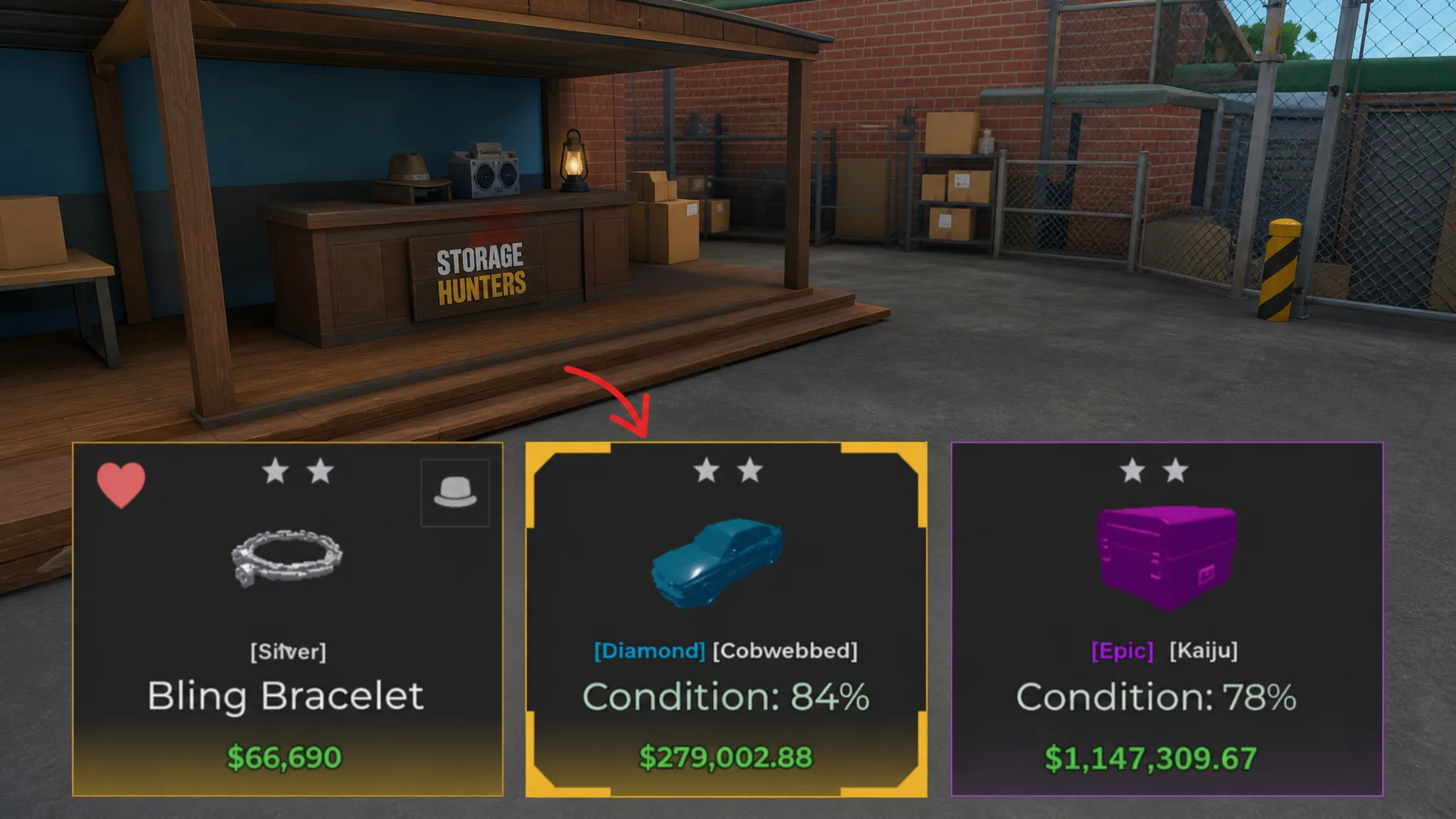
Mutations are the single biggest lever on your bank balance in Storage Hunters: Open World. Each one is a tag that lands on an item after you win an auction and start sorting through the locker, and each tag carries a multiplier that changes the item’s final sell price. Most push the value up, a couple push it up dramatically, and one drags it below the base price.
Quick answer: There are 24 mutations. Void is the highest broadly confirmed multiplier at 35x, the community mutation table now lists Secret at 50x, Dirty is the only negative at 0.8x, and stacked mutations add together rather than multiply, so Silver (2x) plus Gold (4x) sells for 6x, not 8x.
Every mutation and its value multiplier
The multiplier is applied to an item’s base price at the moment you sell it, so the auctioneer’s valuation shows the plain base value and the mutation bonus only appears when a customer buys the item off your shelf. Here is the full roster ordered from the smallest payout to the largest.
| Mutation | Multiplier |
|---|---|
| Dirty | 0.8x (lowers value) |
| Cobwebbed | 1.2x |
| Pure | 1.5x |
| Moonlit | 1.5x |
| Silver | 2x |
| Huge | 2x |
| Tiny | 2x |
| Antique | 2x |
| Spotless | 3x |
| Gold | 4x |
| Firefly | 5x |
| Ancient | 5x |
| Corrupted | 6x |
| Wet | 6x |
| Shocked | 6x |
| Diamond | 8x |
| Gem | 10x |
| Chrome | 12x |
| Timeless | 12x |
| Hologram | 15x |
| Void | 35x |
| Secret | 50x (community-listed) |
| Rainbow | Not yet confirmed |
| Black | Currently unobtainable |
Note: The 50x Secret value comes from the community mutation table and is not an official figure, so treat it as the highest publicly listed number rather than a confirmed one. Rainbow appears in the roster but its multiplier has not settled, and Black exists only in the game’s data and cannot currently be farmed. Everything else in the table is community-confirmed.
How stacked mutations are calculated
An item can roll more than one mutation, and this is where most players lose money in their heads. Mutations add together, they do not multiply. If an item carries Silver (2x) and Gold (4x), the combined multiplier is 6x because 2 plus 4 equals 6. It is not 8x, and it is certainly not the number you would get from multiplying the two.
That difference matters enormously at the high end. A theoretical Void (35x) paired with Diamond (8x) lands around 42x, not the roughly 280x you would reach by multiplying. If you bid into an auction expecting multiplicative math, you will overpay and bleed cash fast. Always sum the multipliers before you decide what an item is worth.
Because the effects add, chasing two mid-tier mutations rarely beats landing one top-tier roll. A stack is only worth building when the base item is already valuable. Weak loot with a big multiplier still sells for very little, which is why a Void roll on a ten-cent item is trivia, not income.
Which mutations are worth chasing
Value comes down to two things, the raw multiplier and how rare the roll is. Exact drop rates are not published, so the practical order below ranks by multiplier and how big a base item you should save the roll for.
- Top-end payout: Secret (50x, community-listed) and Void (35x) are the game-changers. A single Secret or Void on an expensive item can outsell an entire haul of ordinary wins.
- Reliable high value: Hologram (15x), Chrome (12x), Timeless (12x), and Gem (10x) sit in the double-digit range and are far less rare than the top tier, making them strong everyday targets.
- Solid stacking partners: Diamond (8x) and the 6x trio of Corrupted, Wet, and Shocked add meaningful dollars on high-base items even before a bigger roll lands on top.
- Avoid chasing: big multipliers on cheap floor loot. Save the high-tier rolls for expensive machinery and Exclusive-class accessories.
How to increase your mutation chances
Every item you pull from a won auction has a random chance to roll one or more mutations. You cannot control which mutation lands, but you can raise the odds and push toward specific ones. The mutation system is area-agnostic, so the same rolls appear in Junk Yard, Back Alley, Farmyard, and Shipyard. The only real difference between areas is base price, which is why Shipyard lockers make every mutation hit worth far more.

| Weather | Boosted mutations |
|---|---|
| Moonlit | Moonlit, Firefly |
| Rainy | Wet, Shocked |

Dealing with the Dirty mutation
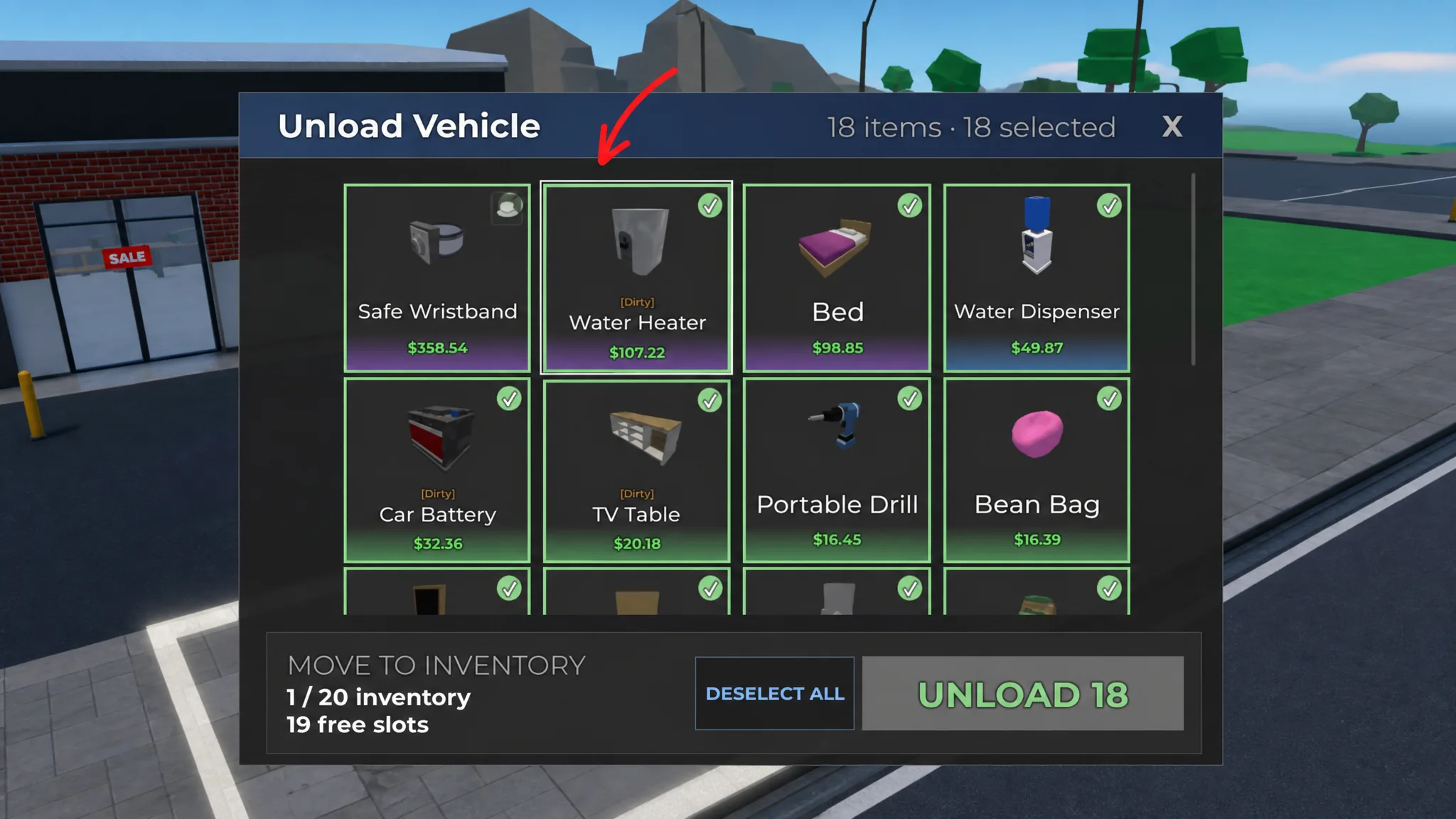
Dirty is the only mutation that reduces value, applying a 0.8x multiplier that drops the item below its clean base price. Never sell a Dirty item on reflex. Two things fix it. Take the item to the Cleaning Shop inside the Shopping Mall to strip the mutation and restore full base value, or check whether another positive mutation rolled on the same item, since even one extra bonus cancels the penalty.
Treat a Dirty tag as a discount signal, not a reason to overbid. Even after cleaning, the item is only ever worth its normal base value, so it does not become a bargain simply because you can remove the penalty. Aside from Dirty, mutations cannot be removed once they land, which means every value-boosting roll is permanent.
The winning approach is simple to state and harder to resist ignoring under bidding pressure. Pair the strongest mutation you can manage with the highest base-value item you can find, build your luck through Gavel Trophies and accessories, sort under the right weather for weather-locked rolls, and save the Time Capsule for the finds most worth boosting. Add multipliers, never multiply them, and a single Secret, Void, or Rainbow roll on the right item can pay for a very long run of ordinary auctions.