You park a truck beside a mine or a farm, point a line at the little roadside shelter, and nothing happens. The truck pulls in, sits for a few seconds, and drives off still showing 0/6. The industry keeps its full stockpile, the line earns nothing, and no obvious error pops up on the road. In Transport Fever 3 this is not a bug. A Road Stop is built to drop cargo off, not to pick it up.
Quick answer: A Road Stop can only unload cargo. To load a truck at an industry, build a Universal Cargo Station next to it, connect it to the road with a short street, and put that station on the line in place of the Road Stop at the pickup end.
What a truck does at a Road Stop beside an industry
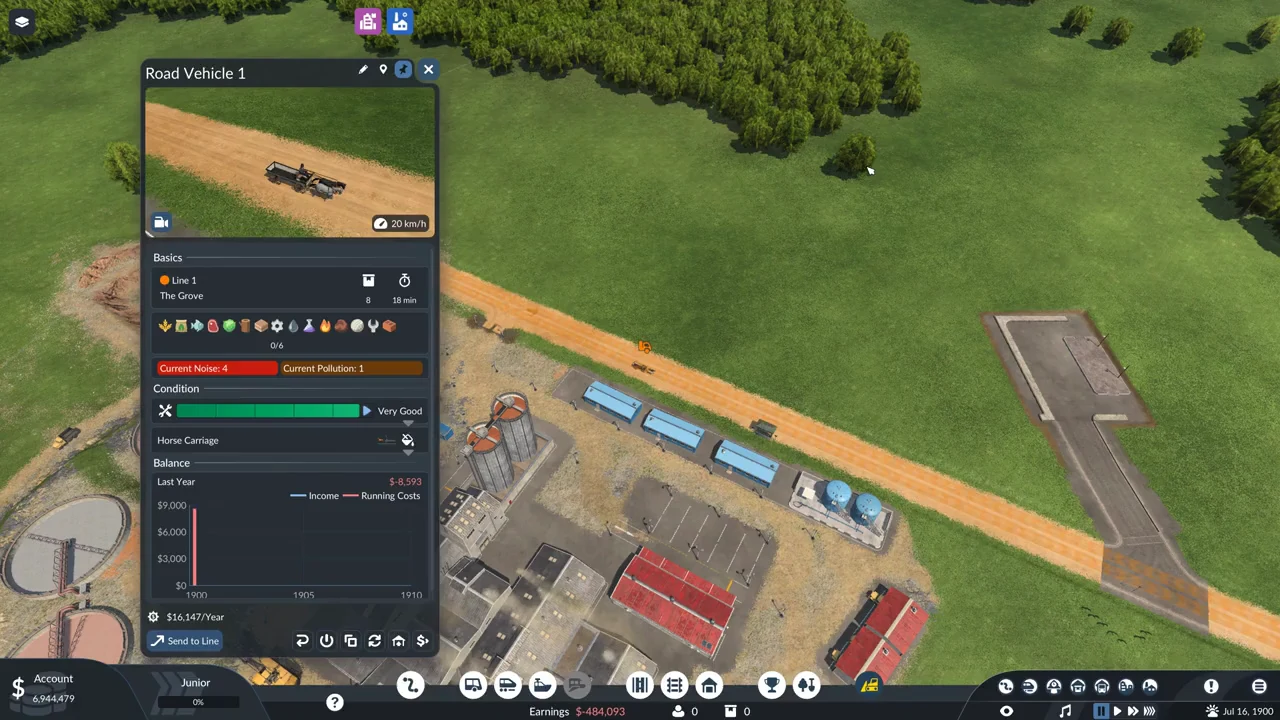
The truck follows its usual routine: it drives to the stop and comes to a halt. At normal speed, its window replaces the travel-speed readout with “Loading” for roughly four seconds, then the truck heads to its next stop. Its load remains 0/6 the whole time.
When the truck arrives, nothing appears on screen. The industry keeps all its stock, and line utilization remains at 0%; meanwhile, the balance falls because running the vehicle costs money but earns nothing. For instance, a Horse Carriage costs $16,147 a year and generates no income on a broken line.
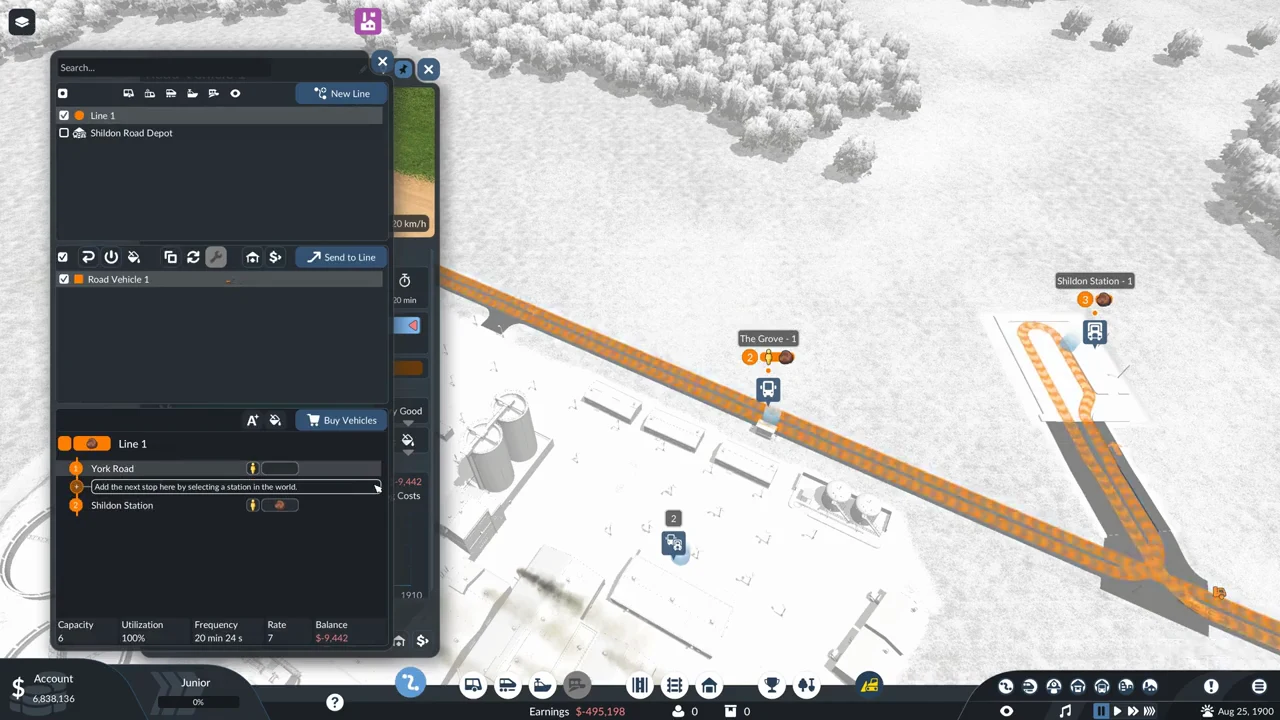
The Line Manager provides the sole alert: a red icon appears beside a line made up of Road Stops and a cargo vehicle. Its tooltip says “Some Cargo Type Configurations of This Line Are Clashing.” This indicates that none of the line’s stops can load the cargo carried by its vehicle.
Why the Road Stop refuses to load
Freight can only be unloaded at a Road Stop or a Two-Sided Road Stop. Passengers can still board and leave there; the restriction concerns cargo alone. Trucks need to visit a cargo station to pick up freight. In 1900, the available option is the Universal Cargo Station.
The game states this in three places before you ever run a vehicle:
- The Road Stop card in the build menu displays the badge “(Unload Only)” next to its icons.
- In a line’s stop settings, “Configure Stop” on a Road Stop shows the blue bar “Cargo can only be unloaded at this stop.”
- The tutorial entry on cargo specialization explains that small road stops only unload, and that loading needs a large station.
Even beside an industry, a Road Stop’s placement preview tints the industry and draws its catchment circle, making it look like the stop will serve the site. This indicates passenger access and unloading reach, not freight pickup.
How to spot the cause in the Line Manager
To open the Line Manager, click the first button on the bottom bar or press L. Choose the line to see its stops along the window’s lower edge. Every stop entry contains a pair of small boxes: one for passengers and one for cargo. If the line uses Road Stops alone, each entry has a yellow passenger icon and a blank cargo box.
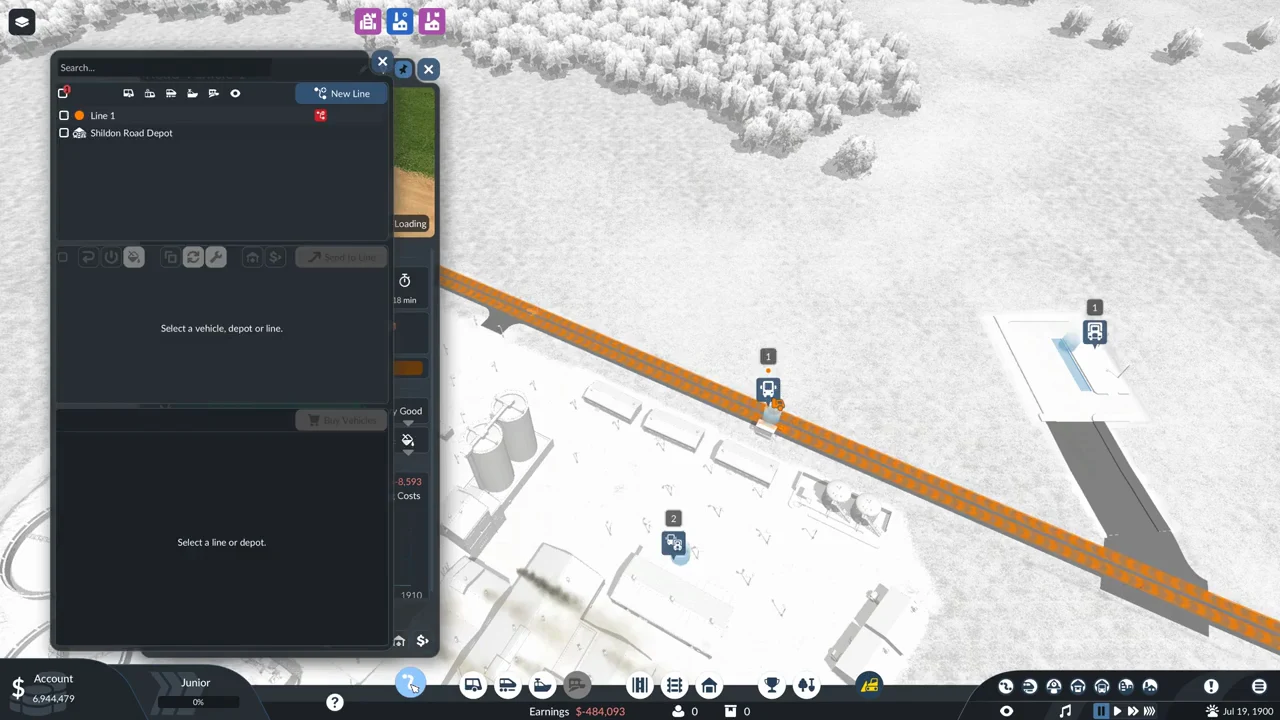
Point at the red icon on the line’s row to read the clash tooltip. Then hover a stop row, and buttons appear, including a cargo box whose tooltip is “Configure Stop”. Opening that on a Road Stop lists only “Passengers 100%” and a “+” tile, followed by the blue bar confirming that cargo can only be unloaded there. The same window on a cargo station instead lists the cargo it can pick up, such as “Clay 100%”, with no blue bar.
The fix: put a cargo station at the pickup end
A Road Stop is fine at the delivery end because it can unload cargo. For example, six units of Clay were taken from a cargo station at a clay pit and unloaded at a Road Stop beside a brickworks, where the Clay was made into Bricks. A cargo station is required only at the pickup end. If the truck carries freight in both directions, each end needs a cargo station.
The Universal Cargo Station and what it costs
The Universal Cargo Station supports extensions and specialized modules, and works for trucks as well as trams. Its appearance varies across three eras: 1900 to 1950, 1950 to 1990, and from 1990 onward; these versions look different but otherwise are the same. The listed price uses the 1900 value, with the game’s year factor increasing the cost in later years, so buying the same building later costs more.
| Piece | Price (1900) | Running cost / year | Notes |
|---|---|---|---|
| Road Stop | $30,000 | $5,000 | Unload Only |
| Universal Cargo Station (1 platform, Universal) | $66,000 | $11,000 | Noise 4, Pollution 30 |
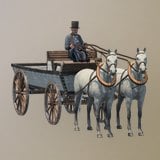 Horse Carriage Horse Carriage | $96,882 | $16,147 | Carries any cargo, 6 capacity, 20 km/h |
Liquid, Bulk, Flatbed, and Goods platforms handle their matching cargo class more quickly, but load other classes much more slowly. Universal platforms have neither a speed boost nor a penalty, making them the straightforward option while you work out a route. In the example above, Clay belongs to the Bulk class.
How to confirm it worked
Start the game and watch the truck pull onto the station platform. Its window reads “Loading – Speed: 100%”; the load row replaces the full strip of cargo icons with the type being loaded, and the amount rises through 1/6, 2/6, and onward. That count also appears above the vehicle. A blue bar beside the load indicates the average delivery time remaining: it begins at 100% and gradually decreases as the cargo travels.
A Horse Carriage loads at 1.0x speed, or about 16 seconds for each unit of Clay at normal speed. The default setting keeps the truck waiting until it is full, making a six-unit load take roughly 24 days of game time. With all six aboard, it departs for the delivery end showing 6/6.
Payment lands when the truck drives off after unloading, not while it is dropping cargo. A first run of six Clay from the pit to the brickworks paid $33,090, about $5,515 per unit. That single trip covers roughly two years of the Horse Carriage’s running cost, which is a reliable sign the line is now doing its job.
Fixes that do not work
- Building a second Road Stop, or a Two-Sided Road Stop, at the industry. Both are unload only.
- Letting the truck wait longer at the stop. It still leaves empty after a few seconds.
- Swapping the vehicle. The limit belongs to the stop, not the truck; the Horse Carriage already carries every cargo type.
- Using the “+” tile in “Configure Stop” to add cargo at a Road Stop does not change its restriction: the blue bar remains, and the stop can still only unload.
- If the cargo station is placed beside the road but no street connects to it, vehicles cannot reach the station.
One timing detail is worth knowing. If you add the cargo station to the line after the truck has already pulled away from the Road Stop, it will finish the current trip to the other end before it visits the new stop. Add the station while the truck is still sitting at the Road Stop, and it heads straight for the platform on departure.