Epic Games has taken legal action against a person who sold DMA cheat software for Fortnite, and that person is now banned from the game. The seller, who goes by “UHyper808” on X, admitted to working with the site Blurred.gg to sell cheating tools. Epic says the individual is “barred from selling cheats in the future.”
Quick answer: Epic Games sued and permanently banned UHyper808 for selling DMA cheat software through Blurred.gg. The seller issued a public apology on X and can no longer play Fortnite or sell cheats.
What Epic Games did to the Fortnite cheat seller
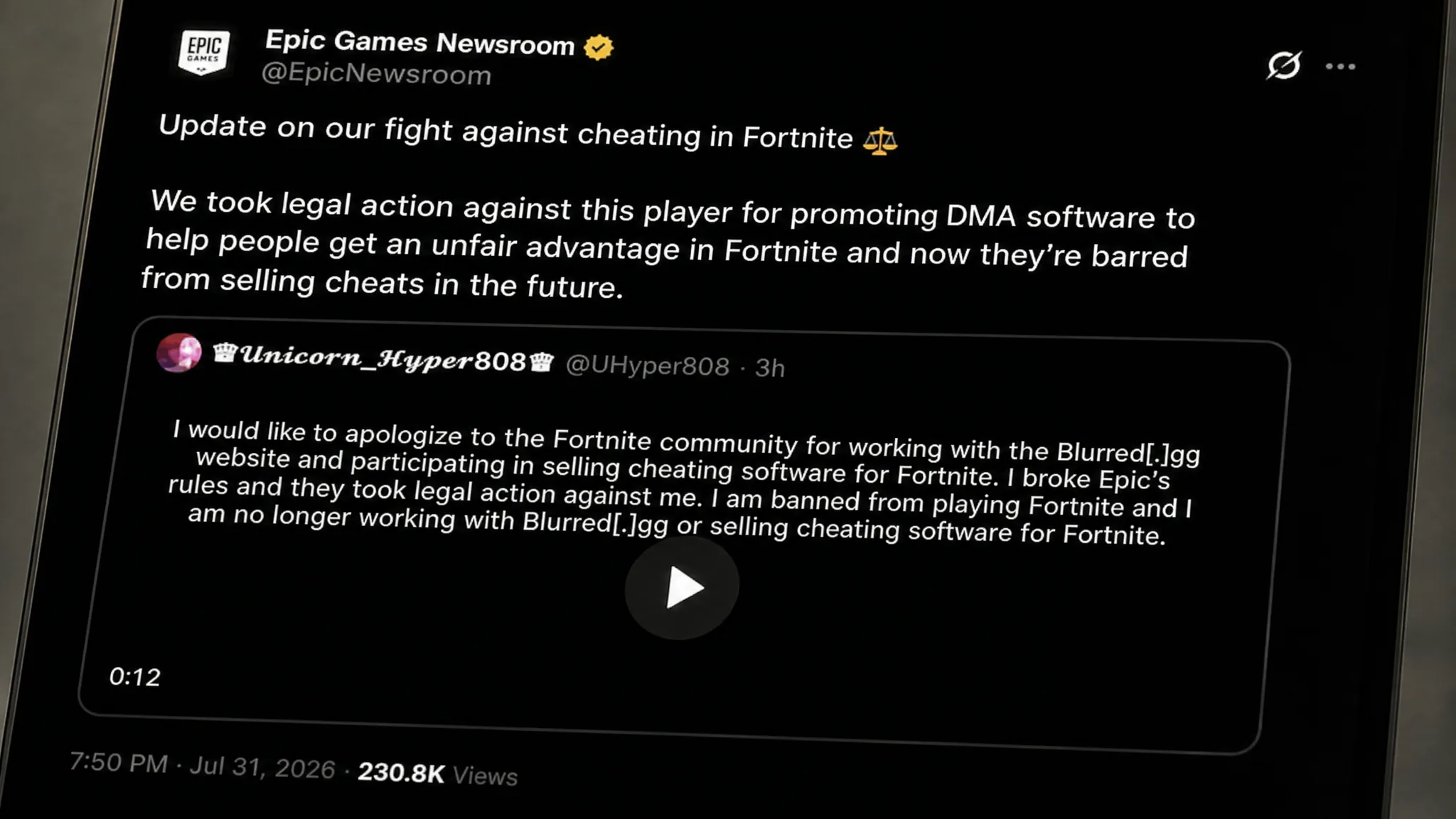
Epic confirmed the action through its official Newsroom account, stating that it targeted the seller for promoting DMA software that gave players an unfair advantage. The company’s statement was direct.
We took legal action against this player for promoting DMA software to help people get an unfair advantage in Fortnite and now they’re barred from selling cheats in the future.
The seller was tied to Blurred.gg, a site that offers DMA cheat software for Fortnite and other games. Beyond the ban from playing, the legal side of the case is still unfolding, and Epic has not detailed the full scope of what it is pursuing.
The public apology
As part of the fallout, UHyper808 posted a written apology to the Fortnite community. The statement acknowledges the partnership with Blurred.gg and the sale of cheating software.
I would like to apologize to the Fortnite community for working with the Blurred.gg website and participating in selling cheating software for Fortnite. I broke Epic’s rules and they took legal action against me. I am banned from playing Fortnite and I am no longer working with Blurred.gg or selling cheating software for Fortnite.
Forced public apologies have become a recurring feature of Epic’s enforcement. Players caught cheating or attacking others have repeatedly ended their cases by posting statements admitting fault and confirming their bans.
Why DMA cheats are treated differently
DMA cheats are harder to catch than typical software hacks, which is why Epic treats them as a serious problem. Instead of running entirely on the player’s machine, the cheat operates through a second computer connected to the gaming PC.
Once connected, that secondary PC reads the game’s memory and drives features like aimbots and wallhacks. Because the work happens off the main system, standard anti-cheat has a much harder time spotting it. That remote setup is exactly what makes DMA tools appealing to cheaters and difficult for detection systems.
Fortnite already runs two anti-cheat engines together, including kernel-level protection from Easy Anti-Cheat, and still sees cheaters slip through in modes ranging from ranked play to limited-time experiences. Player reports remain a core part of how burner accounts get permanently banned.
Epic’s wider crackdown on cheating and cheat sellers
This case fits a long pattern. Epic has repeatedly gone after people who cheat in tournaments, build and sell cheat software, resell stolen accounts, or launch DDoS attacks against streamers. Several of those cases ended in bans, settlements, or court judgments.
| Case | Outcome |
|---|---|
| BlazeFN (Brandon Despotakis), sold aimbots and loaded accounts | Australian court ruled for Epic; assets frozen and damages ordered, donated to Child’s Play |
| Tournament cheater who ignored Epic’s suit | Judge ruled in Epic’s favor, resulting in a $175,000 judgment |
| German cheat software developer and resellers | Copyright suit filed in North Carolina federal court |
| Cheat seller who also ran DDoS attacks (Mirrored and Zebsi cases) | Permanent bans and public apologies; settlements reached |
| Individual who stole and sold Epic accounts | Settlement reached with Epic |
Epic’s position is consistent across these actions. Breaking the rules leads to at least a suspension, and it can also mean legal consequences and the loss of money earned from the violation.
New PC anti-cheat requirements for Fortnite
Alongside lawsuits, Epic has tightened the technical bar for PC players. It expanded Fortnite’s PC anti-cheat requirements to all tournaments, requiring three security features to be turned on.
| Feature | What it does |
|---|---|
| Secure Boot | Helps ensure the system boots only trusted software |
| TPM | Provides a hardware-based security foundation |
| IOMMU | Controls how hardware devices access system memory, helping block cheat hardware from reading game memory |
IOMMU is the most relevant of the three for DMA cheats, since it limits how outside hardware can reach into the game’s memory. Epic notes that most PCs compatible with Windows 11, which covers roughly 95 percent of Fortnite’s PC players, likely already meet these requirements or can enable them without new hardware.
What to expect next
More security work is likely to follow. Epic continues to fix game-breaking bugs quickly, make its systems harder to reverse-engineer, and use data and machine learning to flag suspicious behavior, and it may add further checks to confirm that PC hardware and software have not been tampered with. In-game reports still play a key role, so flagging suspicious opponents remains the fastest way for players to help.