Deadlock now runs two separate matchmaking modes. A casual Standard queue sits alongside a rebuilt Ranked Mode that tracks your skill through visible Rank Points, seasons, and a fresh set of rank badges. The change is live and applies to everyone, with your existing win history counting toward the new entry requirements.
Quick answer: To queue for Ranked, you need at least 60 total wins in Standard Mode and 3 heroes that each have 15 or more Standard wins. Those heroes are the only ones you can pick in Ranked, and Street Brawl victories do not count toward any of it.
Standard Mode vs Ranked Mode
Standard is the low-stakes queue. Nothing you do there moves your rank, party size is unrestricted, and skill spread is open, so you can group with friends of any level. It also doubles as the practice space for learning new heroes, because the matchmaker factors in how little experience you have on a given character and tries to place you against players in a similar spot.
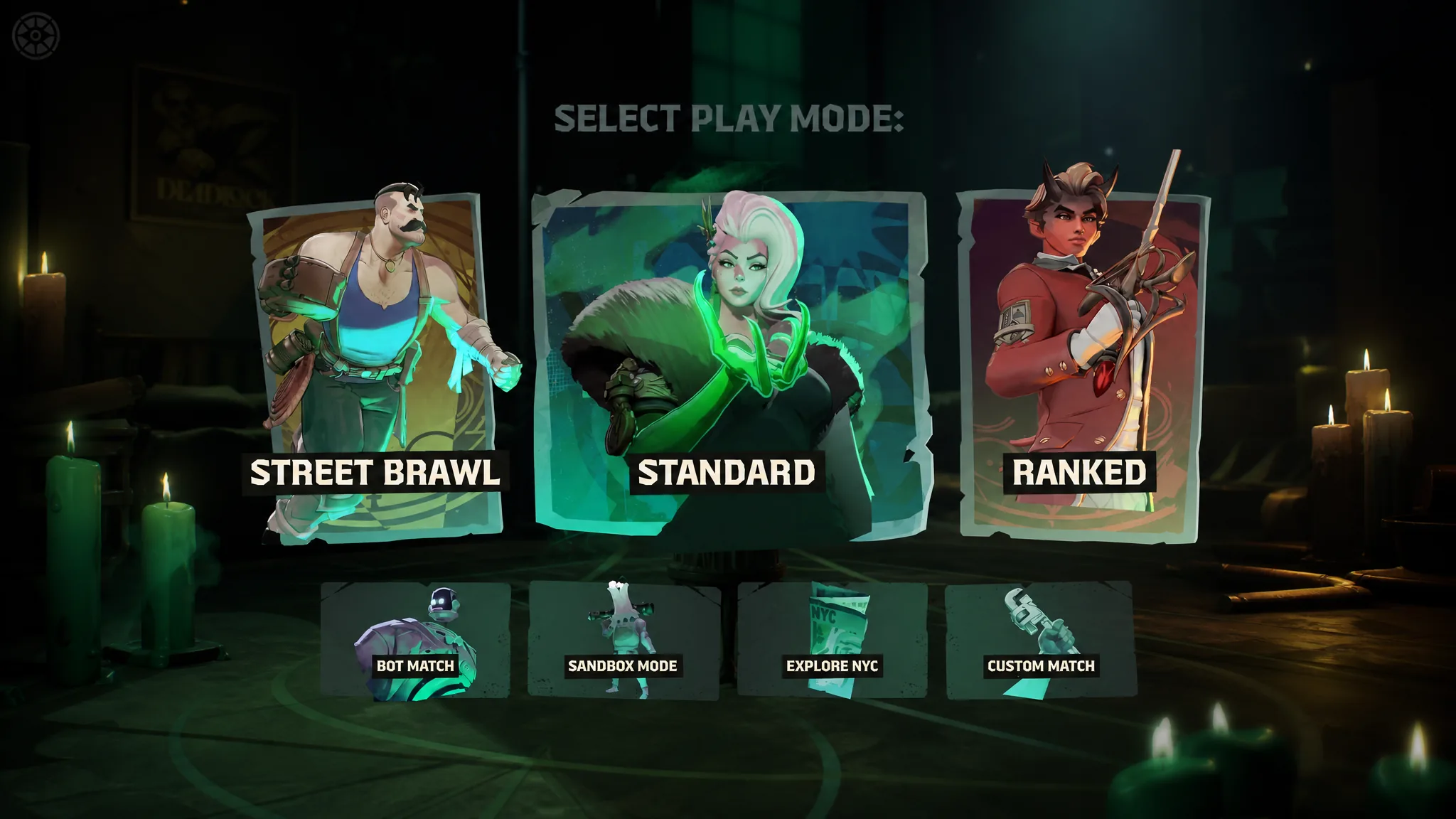
Ranked is the competitive side. It restricts who you can queue with, limits your hero pool to characters you have proven yourself on, and adjusts your standing after every game.
| Feature | Standard | Ranked |
|---|---|---|
| Affects rank | No | Yes |
| Party size | Unrestricted | Solo or duo |
| Skill spread | Unrestricted | Restricted |
| Entry requirements | None | Win-gated |
| Hero pool | Any hero | Only unlocked heroes |
| Seasonal | No | Yes |
Requirements to unlock Ranked
Ranked expects you to know the heroes you bring into it. Access is unlocked per hero rather than all at once, so a character with fewer than 15 Standard wins stays greyed out in the selection menu no matter how high your rank climbs.
| Requirement | Value |
|---|---|
| Total Standard wins to unlock Ranked | 60 |
| Standard wins per hero to make it Ranked-eligible | 15 |
| Minimum eligible heroes for a valid roster | 3 |
| Active sanctions (low priority, comms ban) | Blocked from queuing |
These totals are retroactive, so wins earned before the update carry over. If your account has any active penalty, you cannot enter the Ranked queue until it clears.
The new rank ladder
There are 11 ranks, each split into 6 subranks numbered I through VI, with VI being the highest within a rank. Players who have not finished calibration show as Obscurus.
| Tier | Rank |
|---|---|
| — | Obscurus (uncalibrated) |
| 1 | Initiate |
| 2 | Seeker |
| 3 | Acolyte |
| 4 | Sentinel |
| 5 | Mystic |
| 6 | Ritualist |
| 7 | Emissary |
| 8 | Oracle |
| 9 | Phantom |
| 10 | Ascendant |
| 11 | Eternus |
Note: A different label set (Brick, Stone, Iron, Bronze, and so on) circulated around launch day, but the in-game client uses the Initiate-to-Eternus names above.
Rank Points, promotions, and loss protection
Your standing is tracked with Rank Points, shown on a progress bar after each match. A win or loss shifts you by roughly 250 points, though the exact amount varies with what the matchmaker expected from the game and whether you are on a win streak. Every subrank promotion costs 1,000 points, except the final subrank before a new rank, which costs 2,000. Crossing from Mystic VI to Ritualist I, for example, takes 2,000 points.
Once you reach Eternus I, fixed thresholds stop applying. The population that high is small, so subranks there are re-segmented daily on a percentile basis.
Loss protection keeps a bad streak from dropping you instantly. Sitting on a boundary with 0 Rank Points gives you a buffer of losses before you demote.
| Boundary | Protected games |
|---|---|
| Full rank boundary | 5 |
| Subrank boundary | 2 |
So a player at Mystic I with 0 points must lose 5 games before dropping to Sentinel, while a subrank boundary like Mystic III at 0 points holds for 2 losses before falling to Mystic II.
Seasons and the 8-game calibration
Ranked runs in seasons. Each one opens with a calibration phase of 8 games that you must play solo, and everyone starts from a soft reset that keeps some of your prior performance to seed you into those games. You cannot exit calibration above Oracle VI, no matter how well you do.
The first season is live now and runs until October 7. When it ends, your highest rank of the season is saved permanently to your Rank History page, and you receive a commemorative item in the hideout. Future seasons are expected to run longer, with mid-season splits and hero recency requirements added later.
Party rules for duos
Outside of calibration, Ranked allows solo or duo queues only. A duo must be within one full rank of each other, such as Mystic paired with Ritualist. Eternus is the exception, where both players must be Eternus and within 3 subranks. These limits are provisional and may loosen over time.
The pre-game phase: hero swaps, lanes, and bans
Hero preferences are submitted before a match forms, letting the backend build teams from the wider queue while trying to give each player their preferred pick. When the game is created, you first see the ranks of everyone on both teams, then enter a pre-game waiting area with a 30-second window to make adjustments.
Inside that window you can swap once into any hero that has not been taken, provided it is unlocked for Ranked. This is meant to smooth out your team’s composition rather than counter-pick. You only see the enemy’s starting lineup, not their swaps, and if you both target the same hero you will get an error and need to choose another. You also lock in your starting lane here, since zipline lane swapping is disabled afterward.
Pause stays locked for the first 2 minutes after the match fully starts, so any roster or lane changes have to happen during the pre-game phase. Ranked also raises the hero ban count from 2 to 3.
Abandons and penalties
Leaving a Ranked game carries consequences that scale with timing. The 5-minute mark is the dividing line for how the match resolves.
| Scenario | Outcome |
|---|---|
| Player leaves before 5:00 | Match voided and safe-to-leave for everyone except the leaver and their party, who take the loss |
| Player leaves after 5:00 | Leaver and party take the loss; teammates are voided and safe to leave, but a win still counts if they stay and win |
| Entire team leaves | Opposing team is awarded the win |
If someone on the non-abandoning side later abandons too, they are penalized the same way and those rules apply to their team as well. Penalties begin with queue timeouts and escalate into increasing numbers of low priority games.
Leaderboards and the Ranked Hub
The requirements to appear on the leaderboards are stricter than before. The activity thresholds now sit higher, and hero boards add a lifetime win floor.
| Leaderboard | Requirement |
|---|---|
| Global | 75 games in the last 30 days |
| Hero-specific | 30 games on that hero in 30 days, plus 100 lifetime wins on it |
A new Ranked Hub sits in the hideout, added to the left of the door leading to The Atrium. A plaque shows your current rank, and a chalkboard displays your last match’s stats, your win and loss streak, and occasional doodles. Interacting with it opens a fuller breakdown of the ranks and the global leaderboards. A Heroes tab tracks how many wins you have on each character, so you can see how close one is to becoming Ranked-eligible, while a Matches tab lists past games and their post-match screens.
You will know the system is working the moment your Rank Points bar updates after a game and, once calibration is done, when a rank badge replaces the Obscurus placeholder. Expect queue times and match quality to be uneven early on, since the Ranked pool starts thin while most players are still meeting the unlock requirements.