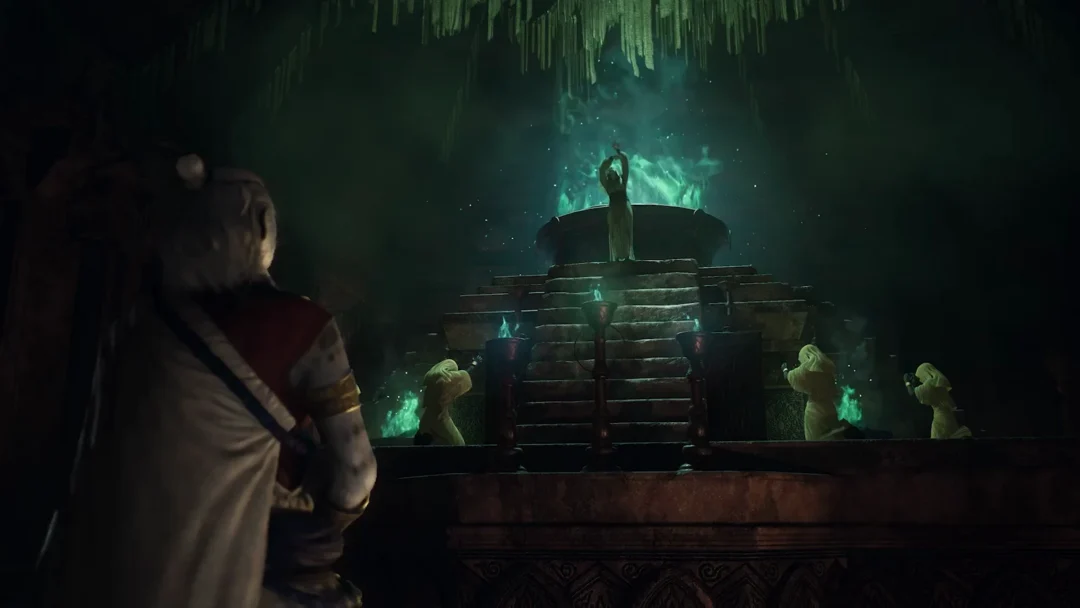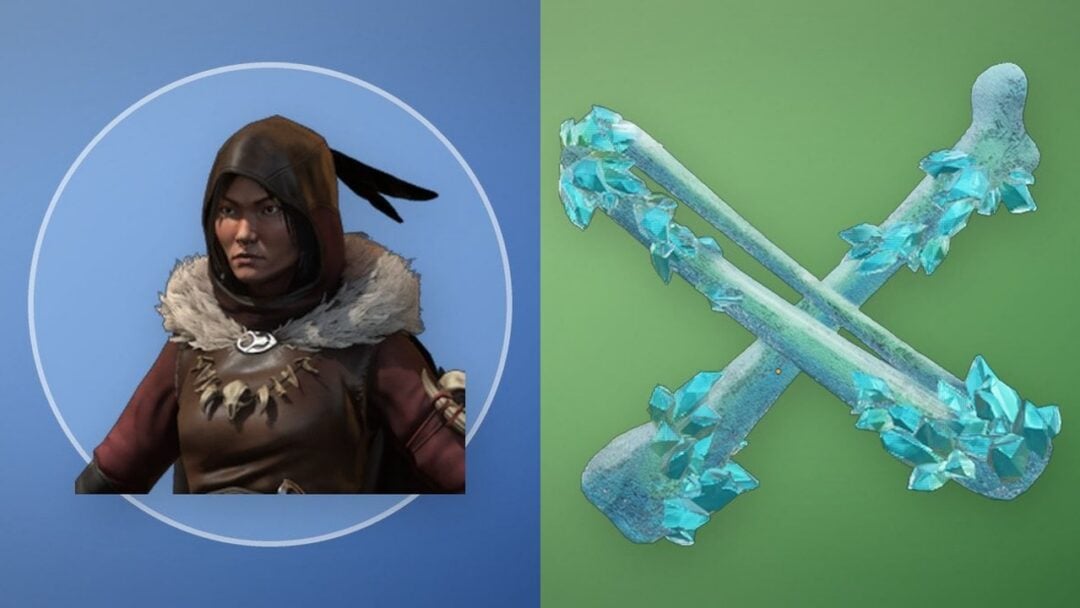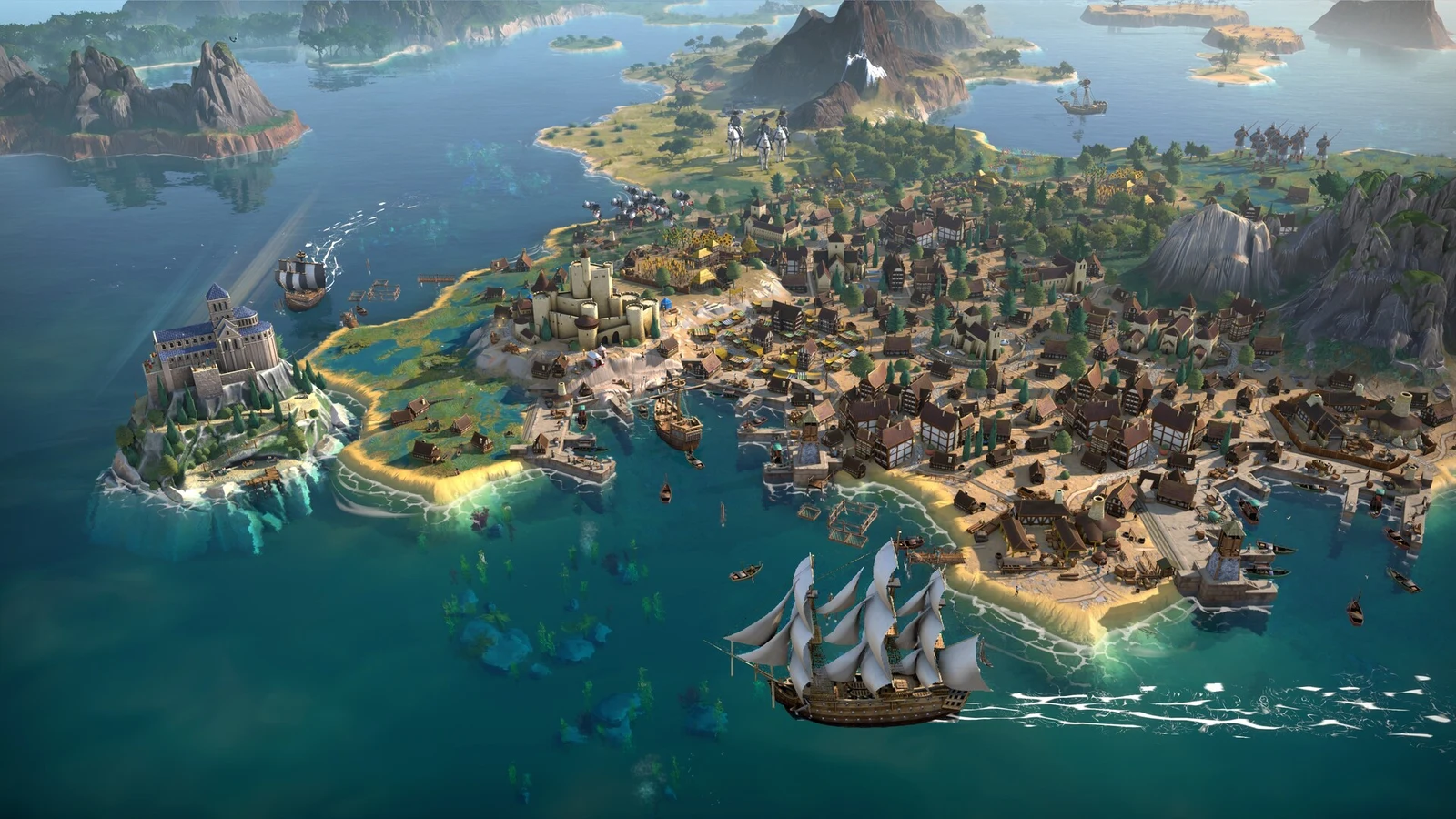
Humankind 2 is Amplitude Studios’ follow-up to its historical turn-based strategy series, and the gameplay overview lays out how the sequel reshapes the climb from a single Neolithic tribe to a Modern Age empire. It keeps the core loop of founding cities, raising armies, trading and negotiating, but rebuilds how your civilization’s identity forms and changes as you move through time. The presentation walks through more than 70 playable cultures, six historical eras, and a set of new systems built around biomes, founding myths and branching cultural growth.
Quick answer: Humankind 2 is a turn-based 4X strategy game coming to PC via Steam in 2027, spanning 10,000 years across six eras with 70+ cultures. No exact release date or time is confirmed yet.
Six eras, 10,000 years and 70+ cultures
The sequel covers 10,000 years of history divided into six distinct eras, carrying you from the earliest settlements to the Modern Age. More than 70 cultures are playable across that span, and the development team worked with over 30 international historical researchers to ground the periods, peoples and events you encounter.
You are not playing as a single avatar. This is a top-down 4X game where you directly control settlers, builders, military regiments and historical leaders as pieces on a tactical map. The footage shows that range clearly, from desert-clad tribesmen and camel riders to Hannibal Barca’s War Elephants and Arctic sled dog units.
Amplitude also names new cultures and stories reaching beyond the first game’s roster, including the Saqqaq, the Etruscans and the Scythians, aimed at a more historically varied world to play through.
First Tales set your founding myth
History Mode opens with First Tale Selection, a choice of founding myth tied to real-world lore that grants your empire its starting traits. The overview highlights two of them on an Earth map. Flood Tamer draws power from the river to feed the hungry and is tied to the Ancient Egyptians, while Wild Twins centers on a pair raised in nature with the destiny to lead, linked to early Rome.
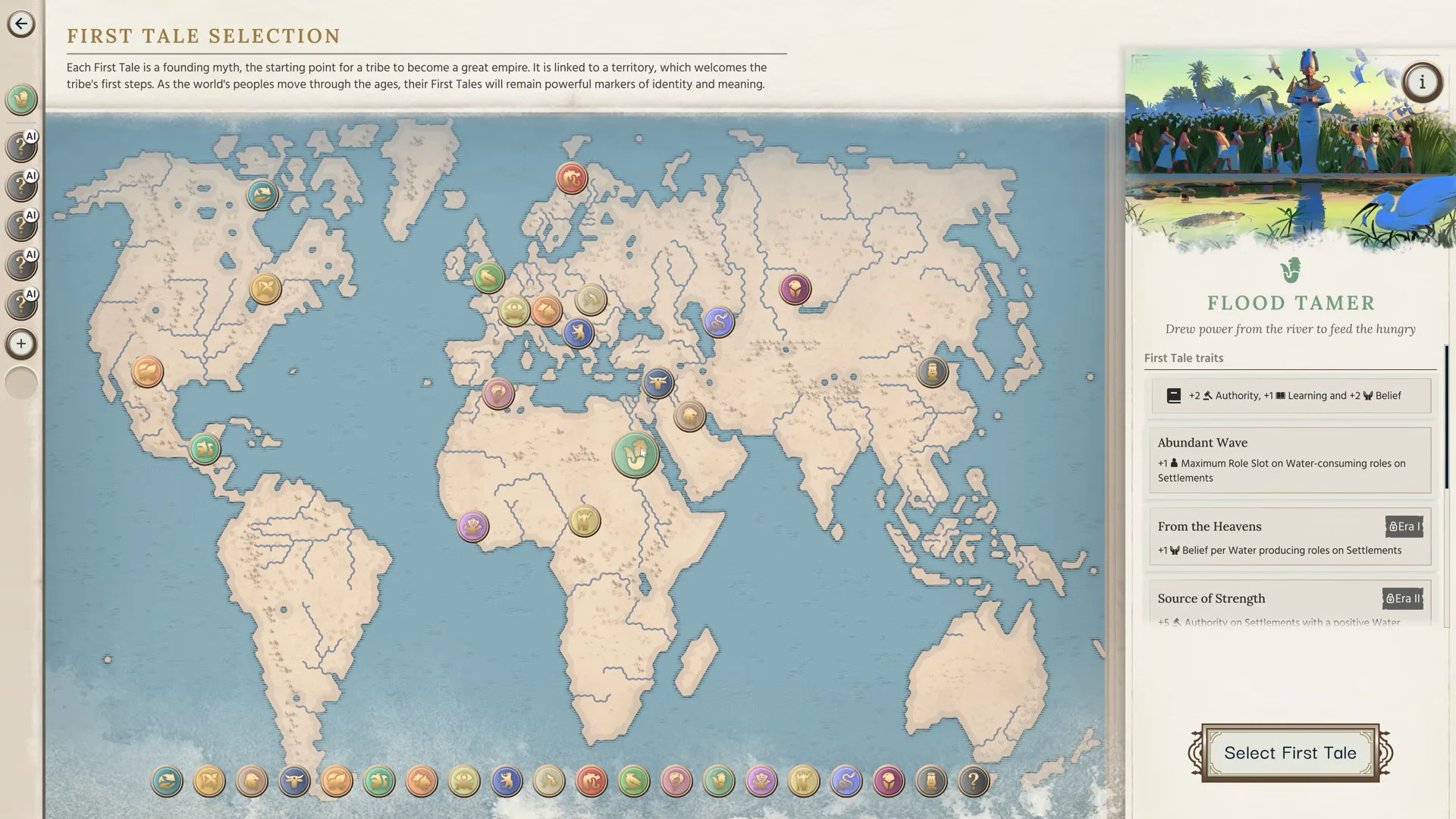
Each First Tale carries its own themed options, so the myth you pick shapes how your civilization behaves before you have placed a single city.
Biomes and Adaptation trees
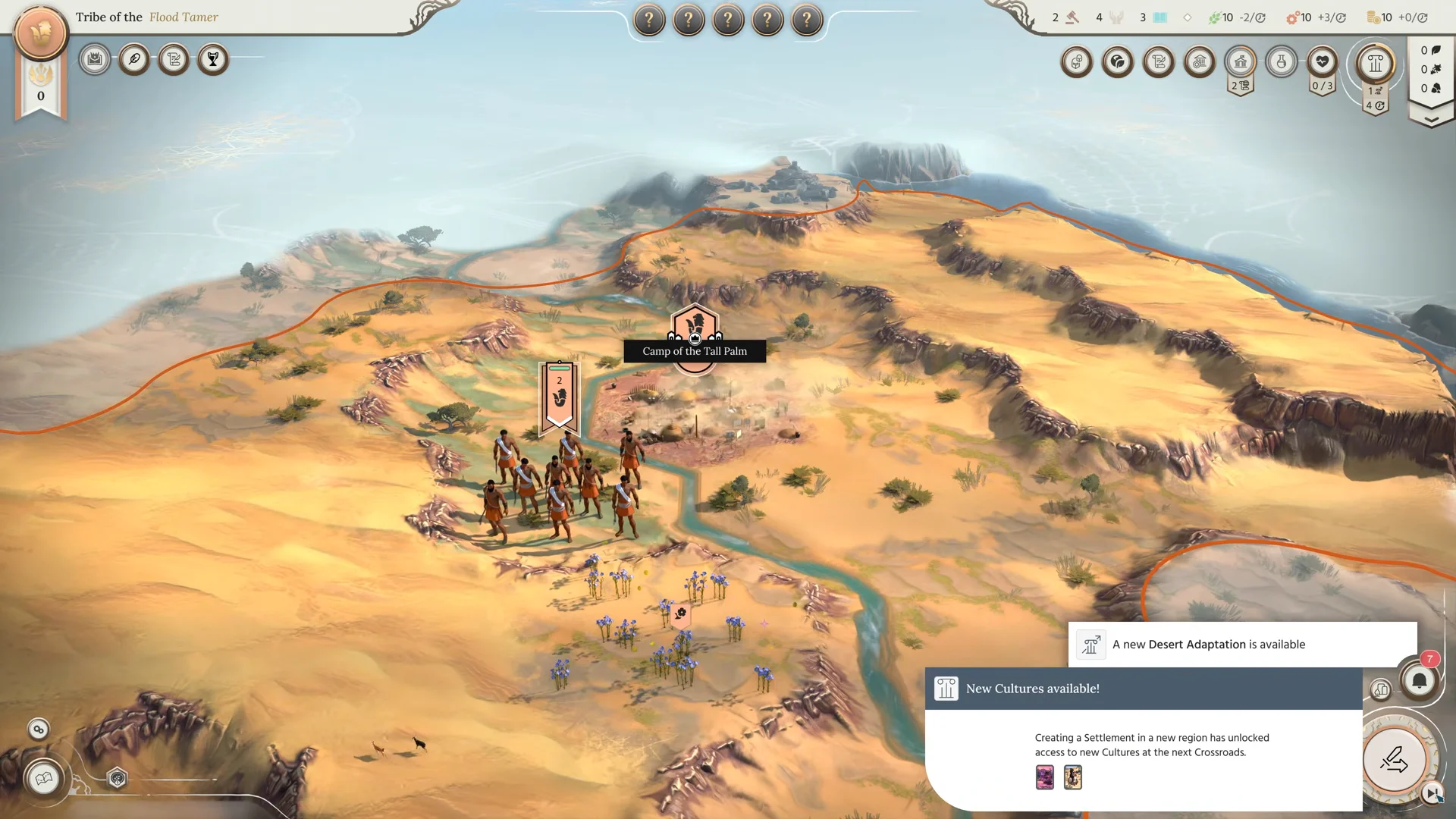
Biomes such as Desert, Forest and Polar define the environments of territories and settlements, with a separate Adaptation tree available for each. In the demo, a Flood Tamer tribe travels across desert land and establishes its first settlement, Camp of the Tall Palms, immediately gaining access to Desert Adaptation.
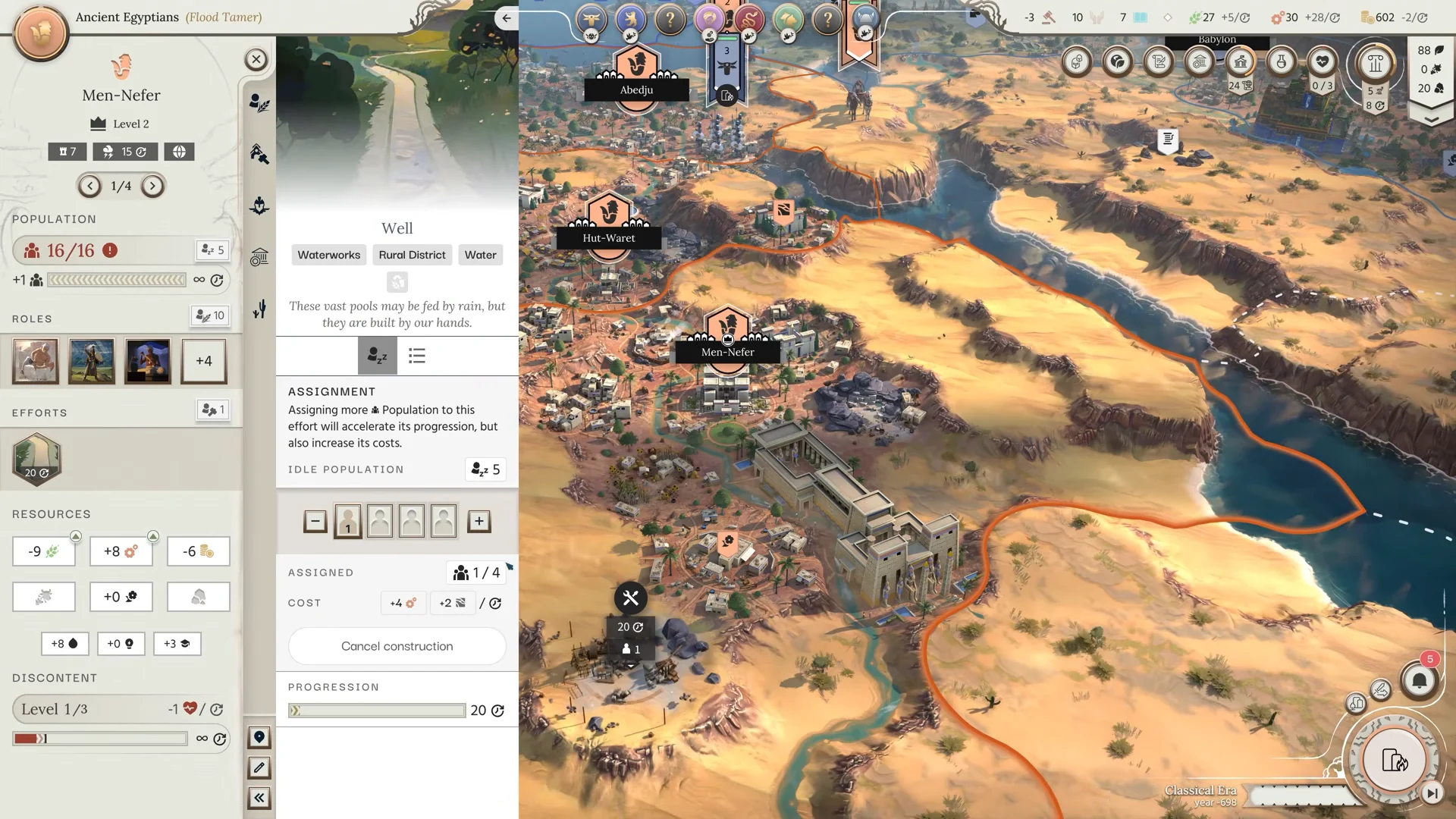
Different environments force different priorities. In arid desert regions, freshwater access is critical, so the Egyptian capital Men-Nefer builds a Well to secure water once it grows to Level 2. The construction panel there also lists options like Quarry, Temple, Library, Shrine and Lumberyard.
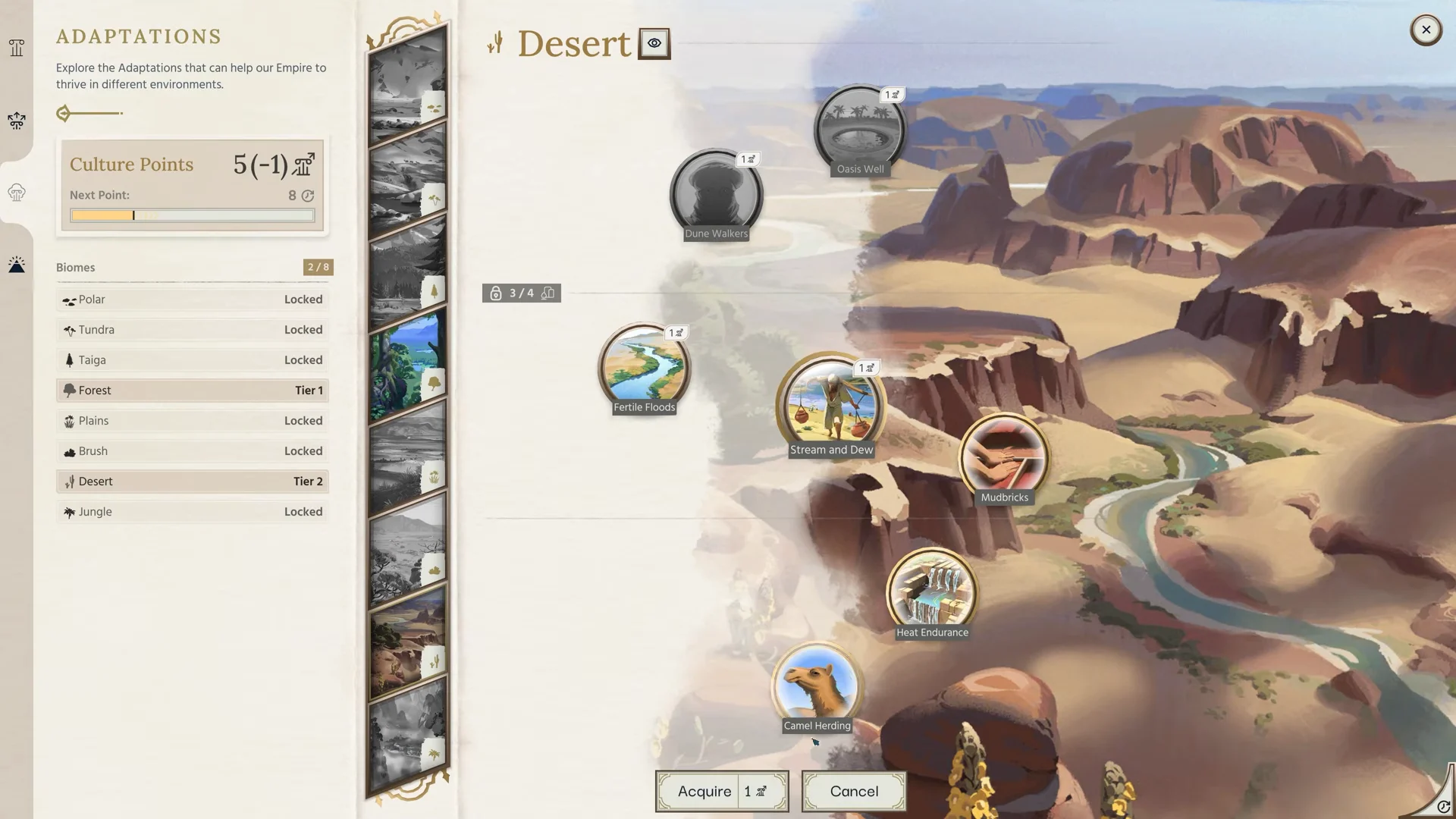
Adaptations are bought with Culture Points. Spending them in the Desert tree unlocks environmental customs suited to the terrain, and the demo shows five Culture Points available to invest through an Adaptations menu with an Acquire button.
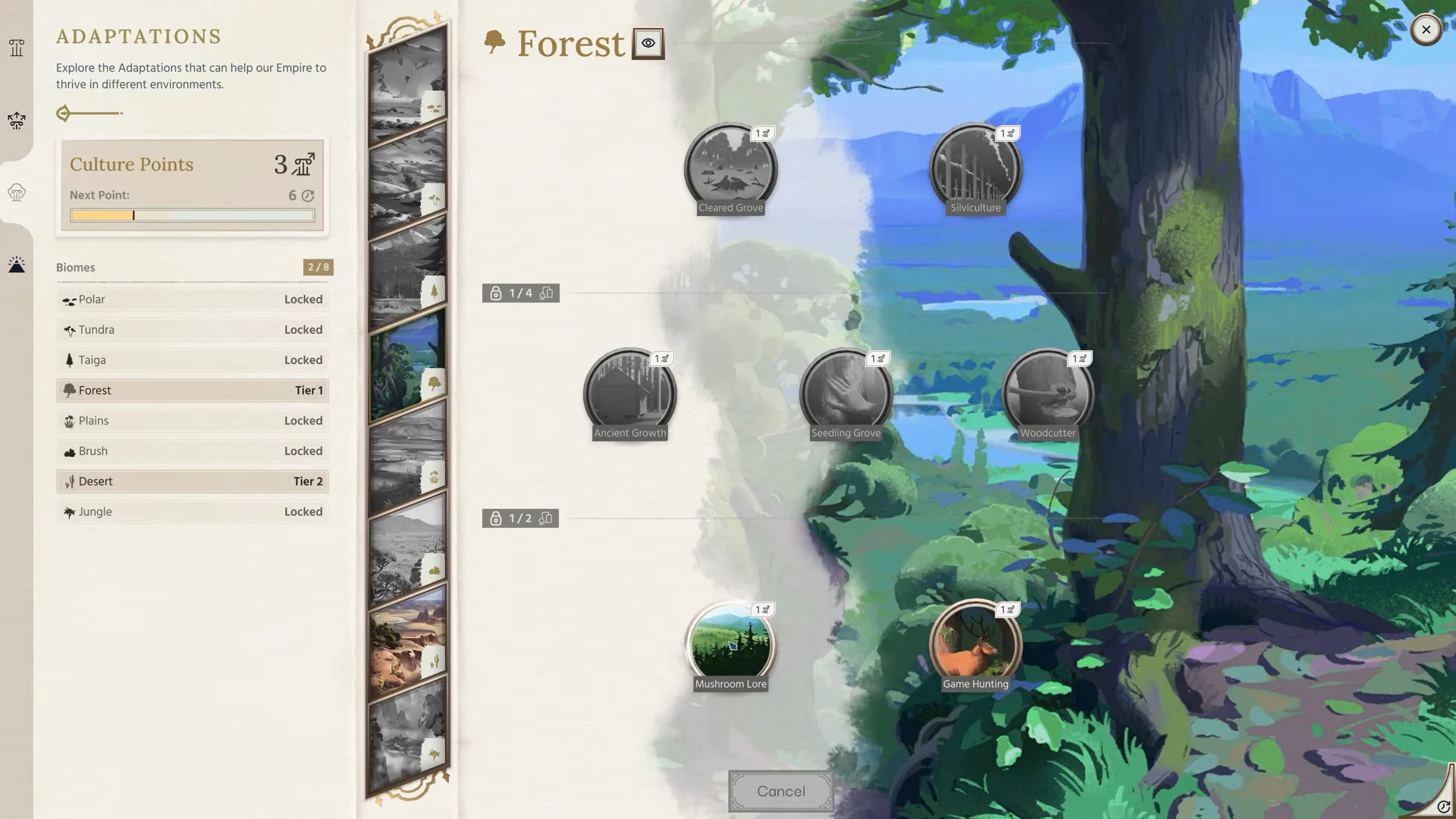
Cities specialize to match their surroundings. A second city, Zawty, sits in a forest biome and leans into high food production, with its own Forest Adaptations to invest in.
Amplitude treats climate as a force that shapes play, not merely scenery. As the ages pass, changing biomes reshape the strategic map; players must safeguard vital resources and balance immediate growth with effects that may last for generations.
Culture Evolutions rebuilt as progression trees
Culture Evolutions now use branching progression trees, rebuilt from scratch. The Ancient Egyptians’ tree has three sections—Foundations, Traditions and Legacies—and progressing through them grants exclusive customs that strengthen the civilization’s identity.
At each era transition, a Crossroads, evolving into a new culture is optional. You can keep your current culture or adopt a new one based on Common History, Shared Land or Foreign Contact. In the Classical Era demo, the Egyptian player can branch into the Parsaans, Berbers, Carthaginians or Goths, or stay as they are.
Whatever you pick, the traits and customs you earned stay permanently attached to your civilization as it changes across eras. That continuity is the point: combining influences over time builds a civilization that is unlike anyone else’s, whether you follow the historical path or deliberately diverge from it.
Diplomacy, war and acculturation
The Classical Era section turns to diplomacy, commerce and warfare. Its overview features Hannibal Barca’s War Elephants, mobilized in the Alps’ vicinity, along with Rome and Carthage. It then follows an Egyptian player directing the war with Persia through mobilized regiments.
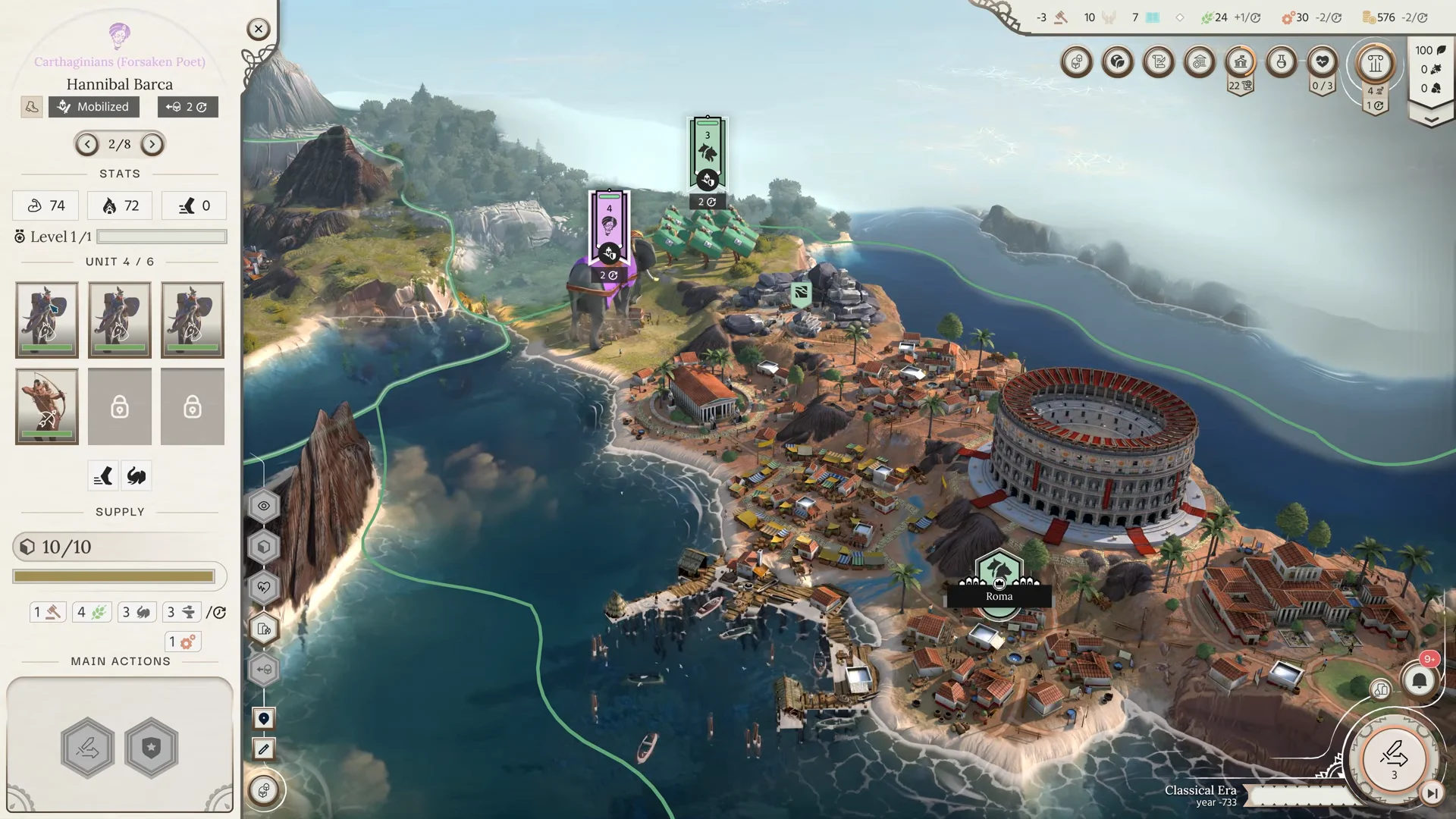
Acculturation lets you adopt the customs of other peoples through contact. An alternate scenario sends Egyptian settlers into the frozen Arctic to unlock Polar Adaptations, and meeting Greenland’s Thule culture lets you take on their tradition to gain Sled Dog units for snow mobility. The video even shows diplomacy heading off a third world war in its later, modern-day framing.
Game modes on the main menu
The main menu, styled as a study room, lists four ways to play. Each serves a different purpose, from the full historical campaign to a freeform setup and reference material.
- History Mode – the main campaign, which begins with First Tale Selection.
- Sandbox Mode – a freeform setup for custom play.
- Books of Humankind – in-game reference material.
- Prologue – an introductory starting point.
The overview itself is narrated by Game Director Benoit Humbert and Narrative Director Jeff Spock, who walk through these systems while showing an in-progress PC build.
Release window, platform and the Insiders Program
Humankind 2 is developed and published by Amplitude Studios and is set for release in 2027 on PC through Steam. A specific date and time have not been confirmed. The Steam listing carries a Rating Pending (RP) ESRB rating and tags the game as turn-based 4X strategy with city building, diplomacy and alternate history.
Ahead of launch, Amplitude is running the Humankind II Insiders Program for early testing. You can also add the game to your wishlist to be notified when it becomes available.
On PC, the minimum specification calls for Windows 10 (64-bit), a quad-core CPU such as an Intel Core i5-4430 or AMD FX-8350, 8GB of RAM, a GeForce GTX 960 or Radeon RX 5500 XT, DirectX 11 and 20GB of storage. The recommended setup moves up to Windows 11, an Intel Core i7-6700 or Ryzen 5 1500X, 12GB of RAM, a GTX 1070 or RX 5700 XT and DirectX 12, with the same 20GB storage requirement. English ships with full audio, while the other supported languages are offered with interface and subtitle localization.