
Every upgrade in Over the Hill costs Pebbles. Pebbles come mostly from one-time rewards, so a bad early purchase stays with you for a long time. Your starting vehicle can handle easy trails. Mud, deep water, steep climbs, and narrow rocky passes will stop it sooner or later. The upgrades that help most early are the ones that keep you from getting stranded, not the ones that make you faster.
Quick answer: Buy the first Tool Slot, the first Winch stage, and the first Tires stage, at 25 Pebbles each. Hold off on Engine, Suspension, Water Resistance, and Protection until a specific obstacle calls for them.
Over the Hill upgrade order for your first Pebbles
Stage 1 of every upgrade costs the same 25 Pebbles. That means your first 75 Pebbles can cover three separate weaknesses. Putting all of it into one category covers only one.
| Order | Purchase | Cost | Running total |
|---|---|---|---|
| 1 | Tool Slots, Stage 1 | 25 | 25 |
| 2 | Winch, Stage 1 | 25 | 50 |
| 3 | Tires, Stage 1 | 25 | 75 |
| 4 | Second stage of whichever keeps failing | 50 | 125 |
| 5 | Engine or Suspension, Stage 1 | 25 | 150 |
Players disagree about whether Winch or Tires should come second. A winch gets you out once you’re stuck. Better tires make getting stuck less likely to begin with. Both cost the same at Stage 1, so buying both early settles the question without much downside.
Every Over the Hill upgrade, its effect, and its cost
You buy upgrades from Crazy Günther, the Mechanic. Follow his map marker and open the upgrade menu when you get there. Stages unlock in order, so you can’t buy Stage 2 until you own Stage 1 on that same vehicle. Most categories have two stages at 25 and 50 Pebbles. Winch and Tool Slots add a third stage at 75.
| Upgrade | What it changes | Stages | Total cost |
|---|---|---|---|
| Tool Slots | Carry more tools | 3 | 150 |
| Winch | Longer winch range | 3 | 150 |
| Tires | More grip | 2 | 75 |
| Engine | More power and top speed | 2 | 75 |
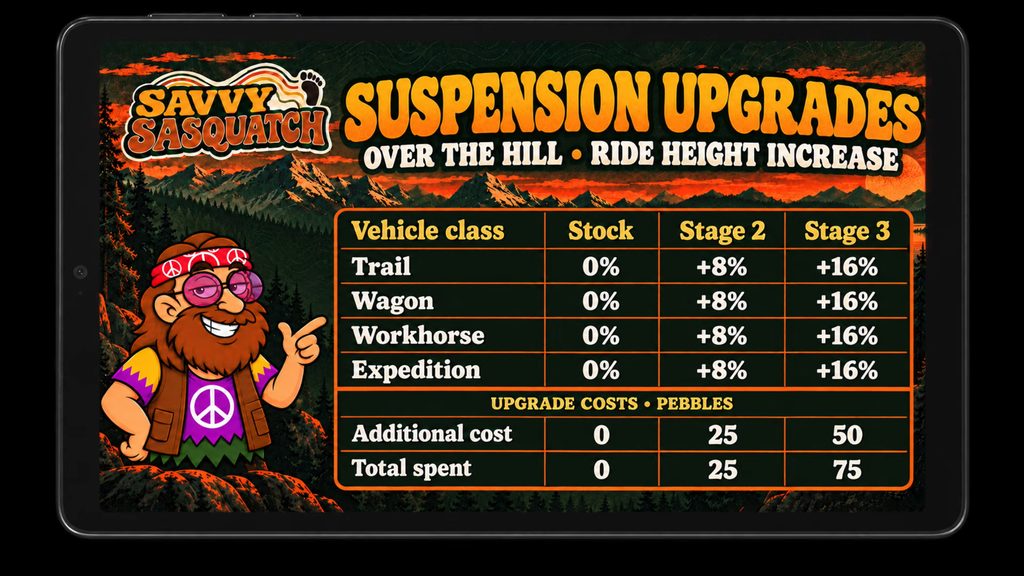
| Suspension | Higher ride height | 2 | 75 |
| Water Resistance | Engine survives water longer | 2 | 75 |
| Protection | Less damage taken | 2 | 75 |
That adds up to 16 stages per vehicle. Maxing out a single vehicle costs 675 Pebbles.
Why Tool Slots, Winch, and Tires come before power
Tool Slots come first because you start with a single slot. If the obstacle in front of you needs a tool you left behind, you have to drive back to Crazy Günther to swap your loadout. The first extra slot is the cheapest way to fix that. Three more slots are available, which brings you to four. Useful tools include the Portable Winch, the Jack, Planks, the Repair Kit, and the weather-clearing Bell.
Winch upgrades only increase range. They let you hook onto a tree from farther away, which turns some dead ends into recoveries. They don’t add pulling strength. The developers said in June that stronger winches through upgrades weren’t planned at that time. The Portable Winch can create an anchor when there’s no tree nearby. It uses up a tool slot and works once, so extra range on the built-in winch keeps paying off.
Tires add grip on mud, wet ground, rock, and steep slopes. Grip matters on nearly every trail. If your wheels spin, a bigger engine just spins them faster.
Buying Engine before Tires and Winch is the most common way to waste Pebbles early. More power doesn’t help when the tires can’t hold the ground, or when you’re stuck with nothing to pull yourself out.
Engine, Suspension, Water Resistance, and Protection: when to buy
These four aren’t bad. They fix narrower problems, so buy them when a route actually demands them.
- Engine: buy it when your tires stay planted on a climb but the vehicle runs out of power before the top.
- Suspension: buy it when you keep getting hung up on rocks and ridges because of low ground clearance.
- Water Resistance: buy it when deep fords on your route keep flooding the engine.
- Protection: buy it when repeated impacts in tight passages keep wearing your vehicle down.
Protection is usually the last of the four. Over the Hill isn’t a racing game, and slow, careful driving prevents most damage. A Repair Kit or a stop at a cabin handles what’s left.
Choosing the next upgrade by what stopped your last run
After the first three purchases, stop following a fixed list. Look at what ended your last attempt and spend on that.
| What went wrong | Upgrade to buy |
|---|---|
| Needed a tool you didn’t bring | Tool Slots |
| Stuck with no tree in reach | Winch |
| Wheels spinning or sliding | Tires |
| Grip holds, climb still fails | Engine |
| Beached on rocks or ridges | Suspension |
| Engine drowning in deep water | Water Resistance |
| Constant impact damage | Protection |
Fixing one weakness often exposes the next one. Better tires might get you halfway up a hill that the engine then can’t finish. Buy one stage, try the same obstacle again, and let the result tell you where to spend next.
Upgrades are per vehicle, so pick one to invest in
Upgrades don’t carry over between vehicles. Over the Hill has 21 vehicles, and maxing out all of them would cost 14,175 Pebbles. One-time rewards like crates, cabins, viewpoints, Challenge Trails, Item Recoveries, and wildlife photos add up to 3,240 Pebbles in total. Repeatable sources, including meteorites, can keep your balance growing after that, but spreading early Pebbles across several cars leaves each of them underpowered for harder maps.
Choose the vehicle that suits how you drive and put your Tool Slots, Winch, and Tires stages into it first. Once that vehicle can reliably get itself out of trouble, you can start spending on engine power, clearance, or a second car.