ReStory: How to Fix the Eight Toughest Devices (Assembly Orders)
The exact reassembly sequence and screw counts for the hardest repairs, from the Nony PMP to the Nony PlayMachine.
The exact reassembly sequence and screw counts for the hardest repairs, from the Nony PMP to the Nony PlayMachine.
by Sehaj Padda
Every repair in ReStory: Chill Electronics Repairs runs on the same loop. You accept a job, take the device apart by removing screws and panels, swap the faulty part, then rebuild everything in the reverse order. The parts list shown in-game is written in assembly order, so it doubles as your disassembly map when you take a device apart. The tricky part is the reassembly, which gets harder as devices gain more screws and more parts.
Quick answer: Rebuild each device in the exact numbered order below, and drive in the listed screws at each step. When the final part is placed with no missing or dirty components flagged, the repair completes and the job is ready to hand back or ship.
If you lose track mid-rebuild, open the in-game notebook to check what is broken, missing, or still dirty, and press the Space Bar for a hint. Some parts also need cleaning before they go back in, and the notebook highlights those too.
How repairs complete in ReStory
Most devices need their own license before their repair jobs unlock. Starter devices come unlocked from the beginning and need no license. Once you have the license, you can also buy new parts directly for that device instead of harvesting them from spare units.
To source spare parts, buy listed devices through your PC, then disassemble them and store the parts in your inventory for later repairs. That gives you a stock of replacements without waiting on new-part orders.
Note: A repair is done when the last part in the assembly order is seated and nothing is still flagged as broken, missing, or dirty. If it will not finish, the usual cause is a skipped clean step or a part placed out of order.
Nony PMP (Sony PSP) assembly order
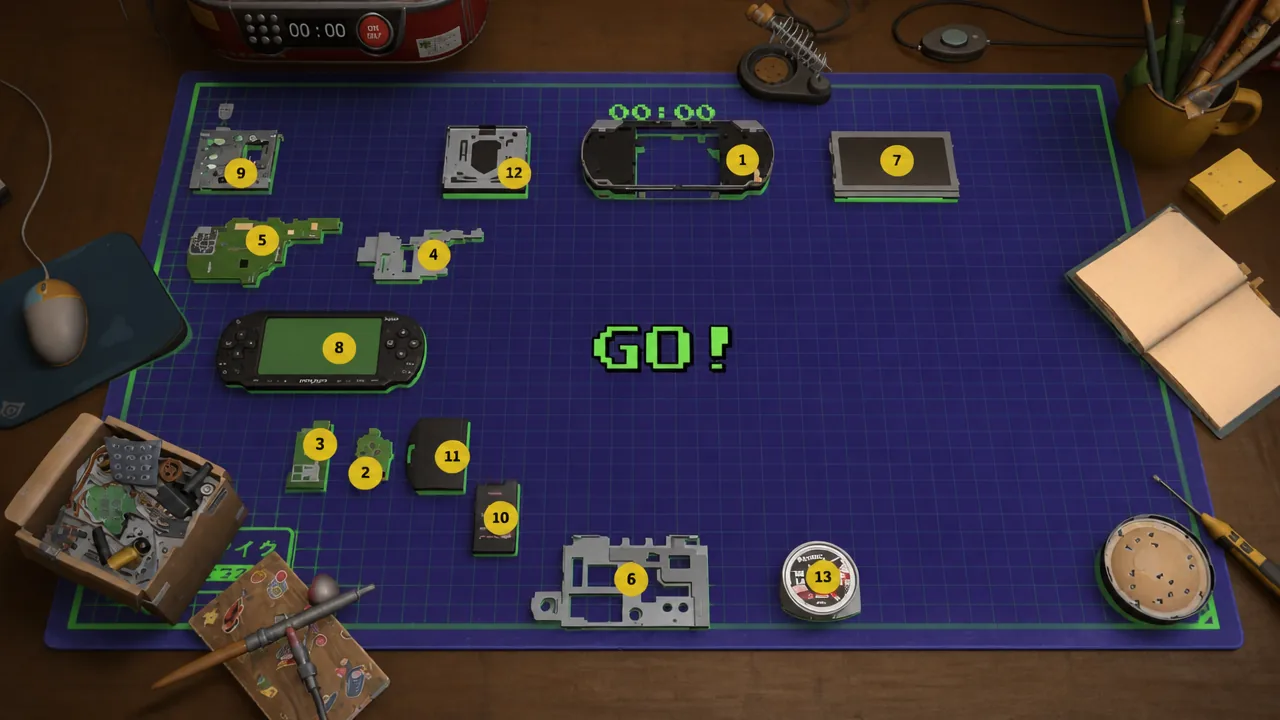
The Nony PMP is ReStory’s take on the PlayStation Portable 1000. It has 18 screws across 13 parts. Most of those screws sit around the display and front panel, so line those parts up carefully during the rebuild.
The green “GO!” prompt starts the timed teardown.
Detail
Info
Sell Price
¥ 23,400
Parts Price
¥ 35,100
License Cost
¥ 40,000
Total Screws
18
Total Parts
13
Order
Part
Screws
1
Frame
—
2
Wi-Fi Board
—
3
Metal Frame
2
4
Motherboard
—
5
Display Frame
5
6
Control Board
—
7
Display
2
8
Front Panel
4
9
Disc Drive
4
10
Disc Drive Lid
1
11
Disc
—
12
Battery
—
13
Battery Lid
—
Atari Lynx assembly order
The Lynx carries only 12 screws but a high 23-part count, which makes it look worse than it is. Once you follow the order, it comes together smoothly.
Detail
Info
Sell Price
¥ 45,000
Total Screws
12
Total Parts
23
Order
Part
Screws
1
Circuit Board
—
2
Lightbulb
—
3
Lightbulb Housing
2
4
Display Seal
—
5
Display
4
6
Cartridge Slot
2
7
Action Buttons (2x)
—
8
Menu Buttons
—
9
Power Button
—
10
Directional Buttons
—
11
Battery Compartment
—
12
Speaker
—
13
Front Casing
—
14
Cartridge Cover
—
15
Back Panel
4
16
Battery (6x)
—
17
Battery Compartment Cover
—
Game Duck (Game Boy) assembly order
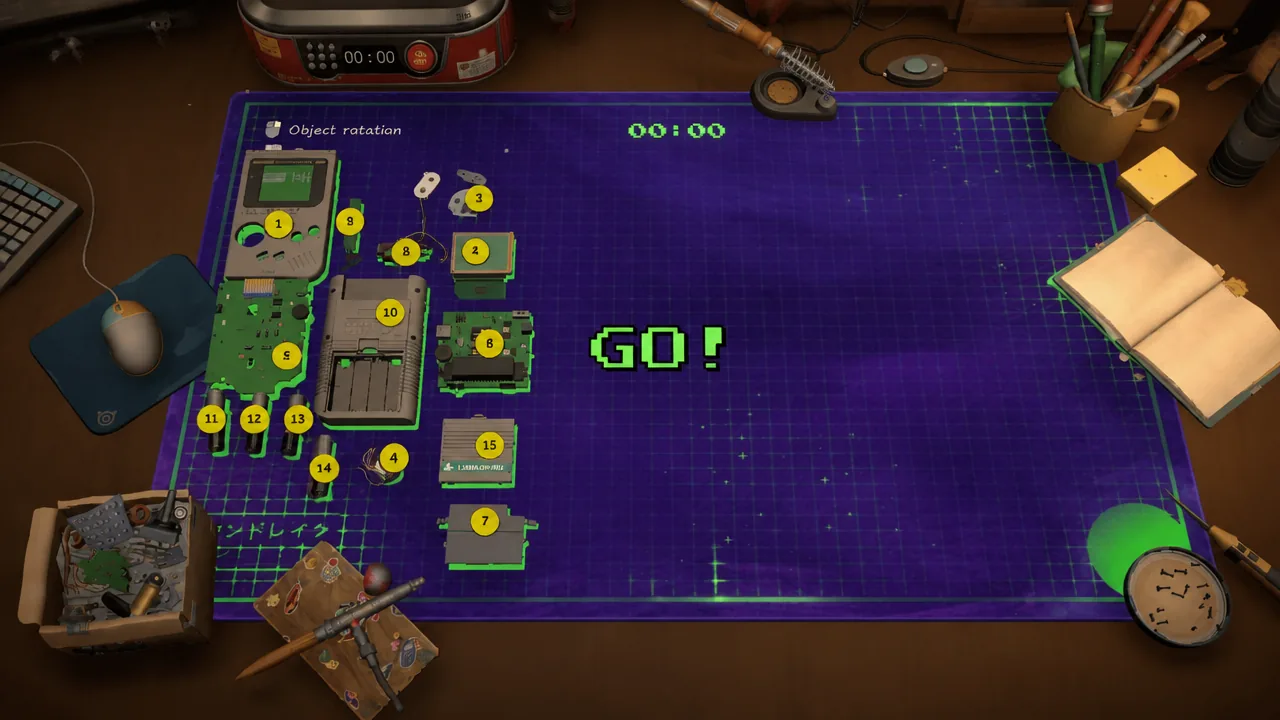
The Game Duck stands in for the original Nintendo Game Boy. It uses 16 screws across 15 parts, and its ¥ 191,000 license makes it one of the priciest unlocks in the game.
The object rotation challenge lines up numbered components on the workbench.
Detail
Info
License Cost
¥ 191,000
Total Screws
16
Total Parts
15
Order
Part
Screws
1
Front Panel
—
2
Buttons
—
3
Speaker
—
4
Screen
—
5
Control Board
4
6
Motherboard
2
7
Frame
2
8
Sound Card
2
9
Circuit Board
—
10
Back Panel
6
11
Battery (4x)
—
12
Battery Cover
—
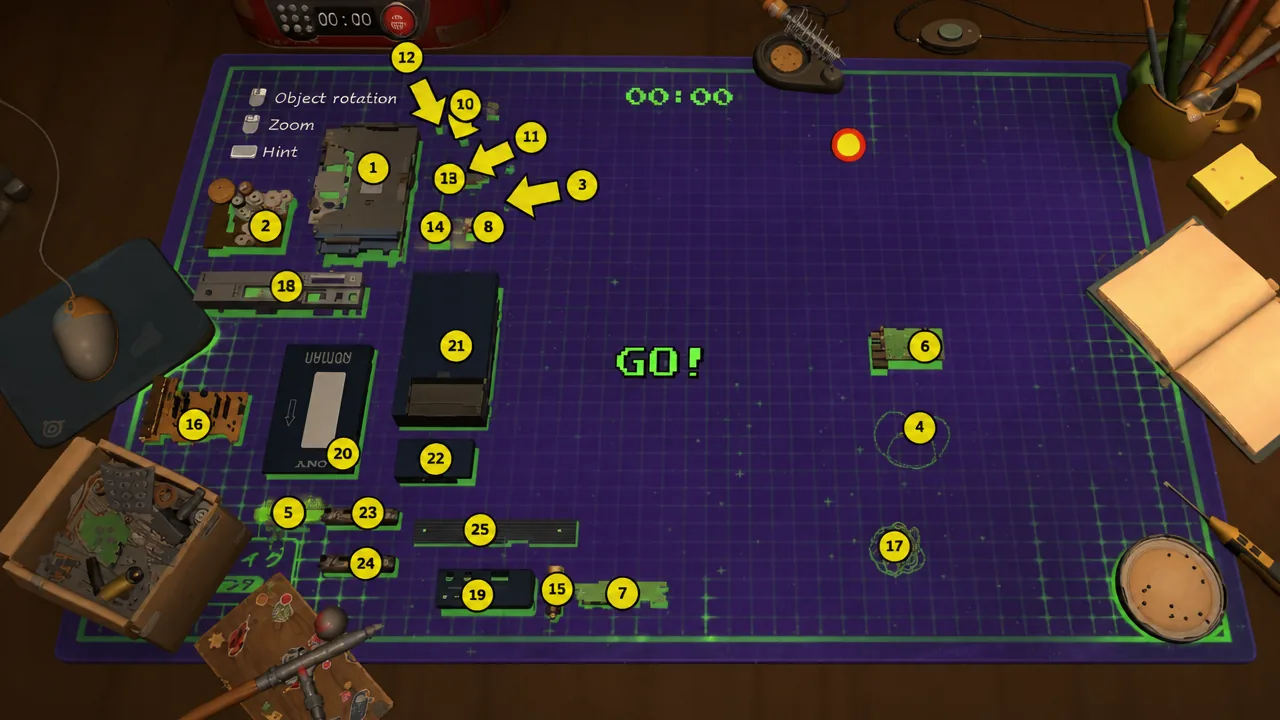
Nony Goman (Sony Walkman) assembly order
The Nony Goman is a music player based on the Sony Walkman, not a console. With 25 parts and 14 screws, it has one of the highest part counts of any device, so work slowly and check off each piece in the notebook as you go.
The assembly timer starts at 00:00 as the numbered board loads.
Detail
Info
Sell Price
¥ 36,000
Parts Price
¥ 105,000
License Cost
¥ 46,000
Total Screws
14
Total Parts
25
Order
Part
Screws
1
Casing
—
2
Drive Unit
2
3
Drive Belts
—
4
Drive Frame
1
5
Mainboard
2
6
Control Board
—
7
Motor
—
8
Wires
—
9
Tape Head
2
10
Microphone
—
11
Open Button
—
12
Rewind Button (2x)
—
13
Play Button
—
14
Volume Control
—
15
Right Panel
—
16
Cassette Compartment
—
17
Back Panel
3
18
AA Batteries (2x)
—
19
Battery Cover
—
20
Sound Card
2
21
Hotline Button
—
22
Top Panel
—
23
Side Panel
2
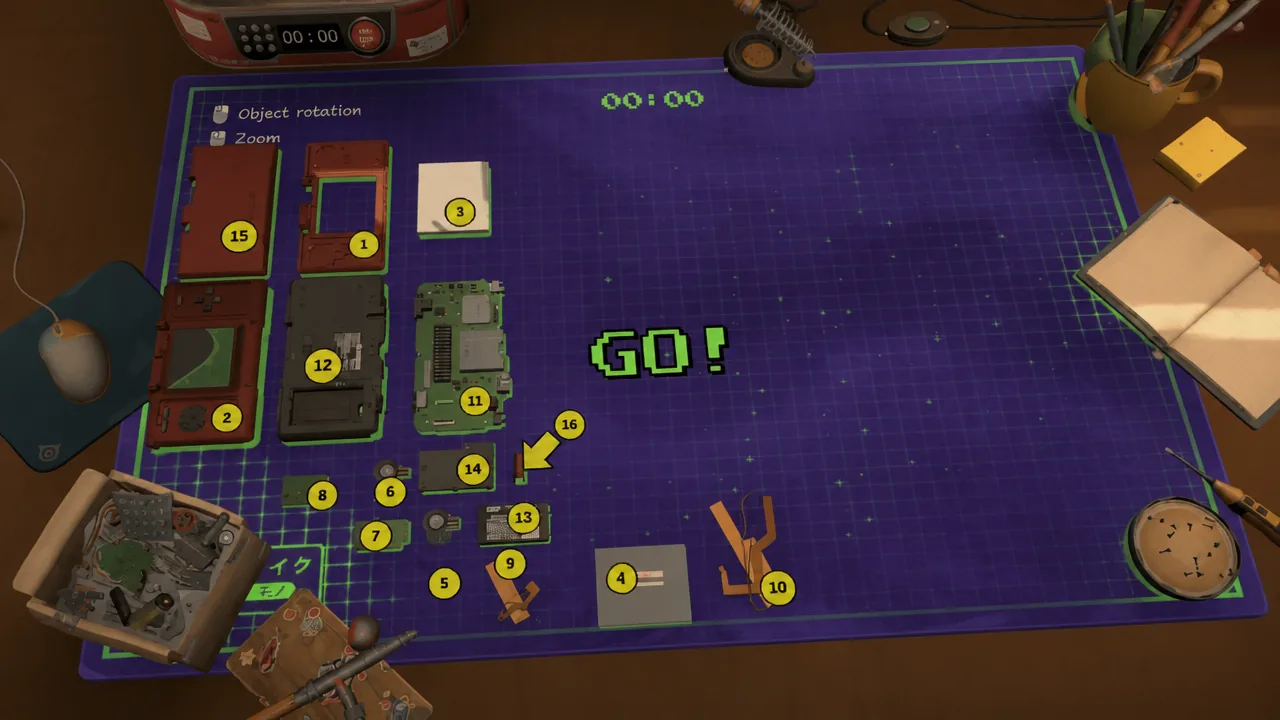
Patento BS (Nintendo DS) assembly order
The Patento BS mirrors the Nintendo DS. It has 16 screws across 15 parts, with the two display panels and the hinge making the top-half rebuild the fiddly section.
An arrow highlights component 16 for placement during assembly.
Detail
Info
Sell Price
¥ 32,000
Parts Price
¥ 48,000
License Cost
¥ 61,000
Total Screws
16
Total Parts
15
Order
Part
Screws
1
Upper Display Panel
—
2
Lower Display Panel
—
3
Lower Display
—
4
Mainboard
3
5
Bottom Wire
—
6
Back Panel
6
7
Battery
—
8
Battery Cover
1
9
Upper Display
—
10
Speaker (2x)
—
11
Right Audio Board
1
12
Left Audio Board
1
13
Top Wire
—
14
Hinge
—
15
Upper Panel
4
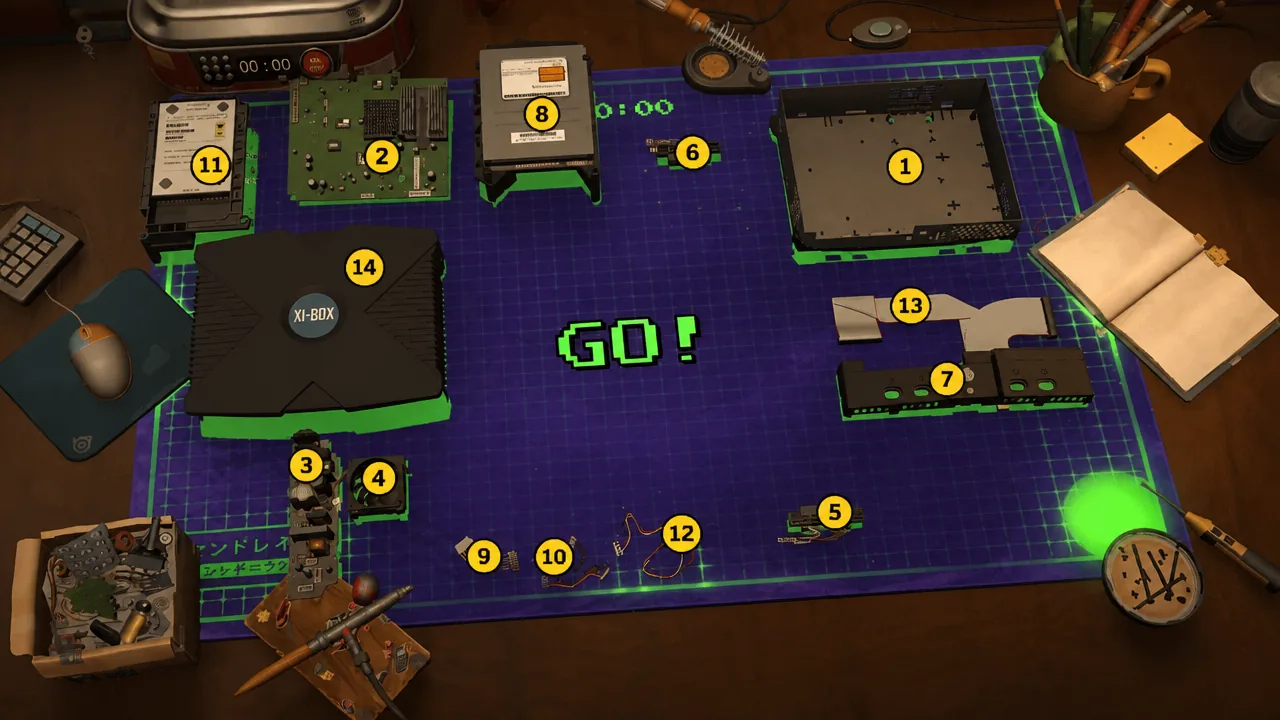
XI-Box (Xbox) assembly order
The XI-Box is ReStory’s version of the original Xbox, with 19 screws across 14 parts. It has a known trap: two separate parts share the name “Front Panel.” Use the visual preview in the parts menu to tell them apart rather than trusting the label, since installing the wrong one will block the rebuild.
The numbered hardware layout fills the workbench before the build begins.
Detail
Info
Parts Price
¥ 90,000
License Cost
¥ 110,000
Total Screws
19
Total Parts
14
Order
Part
Screws
1
Back Panel
—
2
Motherboard
6
3
Right Ports
2
4
Left Ports
2
5
Fan
—
6
Power Unit
2
7
Motherboard Cable
—
8
DVD
1
9
DVD Cable
—
10
Front Panel (1st)
—
11
Hard Drive
2
12
Hard Drive Cable
—
13
Ribbon Cable
—
14
Front Panel (2nd)
4
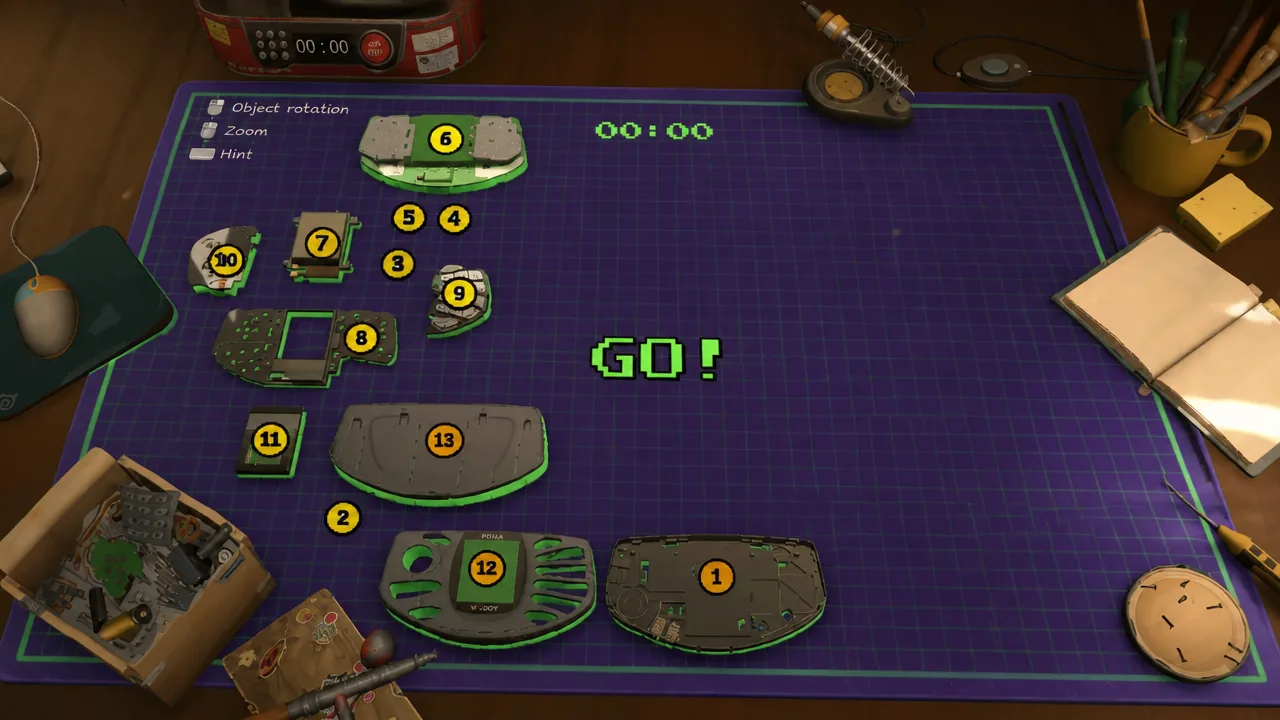
Pokia Njoy (Nokia N-Gage) assembly order
The Pokia Njoy is based on the Nokia N-Gage, with its odd cell-phone form factor and 13 parts. All 8 of its screws sit on the UV Shield, so once that single part is off, the rest of the teardown is quick.
The rotation board arranges numbered components for the timed assembly.
Detail
Info
License Cost
¥ 32,000
Total Screws
8
Total Parts
13
Order
Part
Screws
1
Casing
—
2
Vibration Motor
—
3
Microphone
—
4
Tweeter
—
5
Speaker
—
6
Circuit Board
—
7
Display
—
8
UV Shield
8
9
Right Keyboard
—
10
Left Keyboard
—
11
Front Panel
—
12
Battery
—
13
Back Panel
—
Nony PlayMachine (Sony PlayStation) assembly order
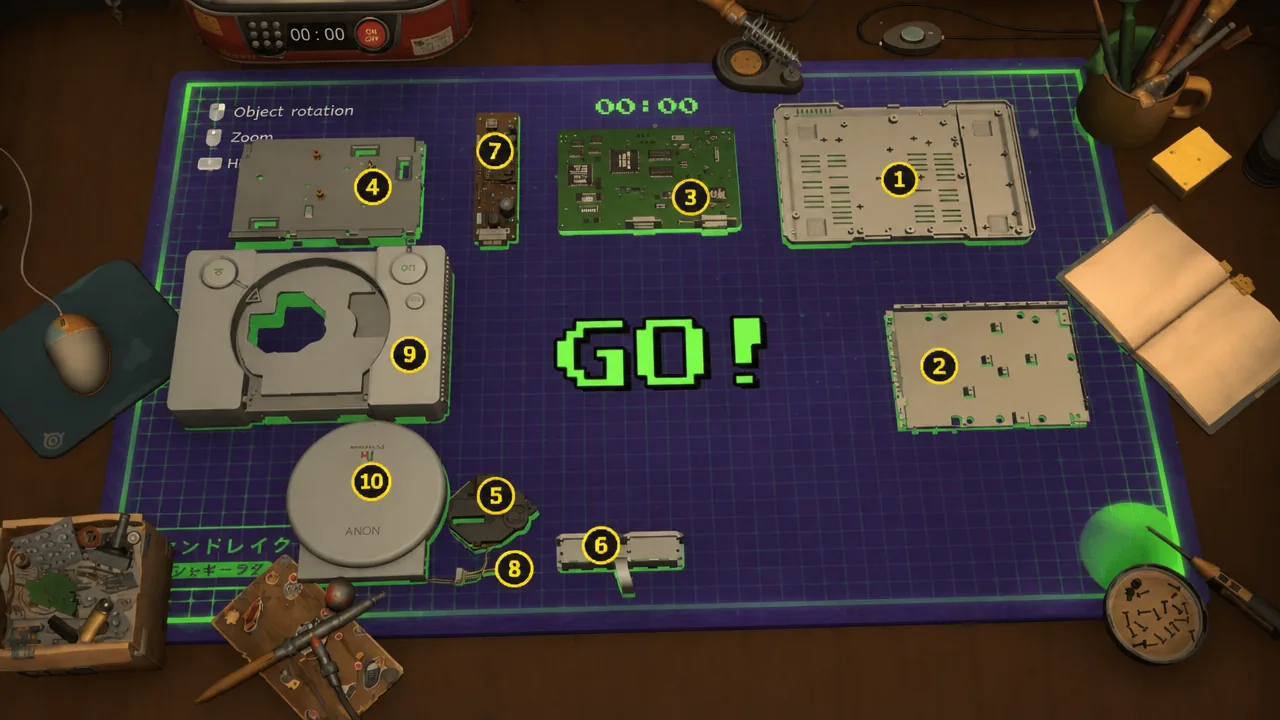
The Nony PlayMachine is built on the original PlayStation. It packs 20 screws into only 10 parts, so the screw count per part runs high. It is also one of the more profitable devices to fix, with a ¥ 54,000 sell price against ¥ 36,081 in parts.
Numbered console components surround the green “GO!” prompt.
Detail
Info
Sell Price
¥ 54,000
Parts Price
¥ 36,081
License Cost
¥ 71,000
Total Screws
20
Total Parts
10
Order
Part
Screws
1
Back Panel
—
2
Bottom Frame
—
3
Motherboard
5
4
Frame
3
5
Memory Slots
2
6
Power Card
2
7
Cable
—
8
Disc Drive
—
9
Front Panel
6
10
Disc Drive Cover
2
Which devices pay off best
If you are chasing profit, the Nony PlayMachine has one of the strongest sell-to-parts ratios, at ¥ 54,000 sold versus ¥ 36,081 in parts. The Atari Lynx is another solid earner at a ¥ 45,000 sell price, as long as you are comfortable managing its 23-part rebuild. Keep the notebook open and the Space Bar hint ready, and even the biggest devices come apart and back together cleanly.