Trinity Support rewards hit-based builds that spread damage across two or more elements, but only if you keep resonance flowing into all three meters at once. The gem still stings from its 3.15 nerf, yet it remains one of the strongest damage multipliers available to elemental attackers and casters. The trick is simple once you see it: you never need all three damage types on the skill itself, only two that trade places for the highest roll.
Quick answer: Link Trinity to a hit skill that deals two elemental damage types with overlapping damage ranges (Lightning and Cold is ideal). Attack or cast at least twice every two seconds so the winning element keeps flipping, and all three resonance meters will fill to 50/50/50 for the full 30% More Elemental Damage plus 16% penetration.
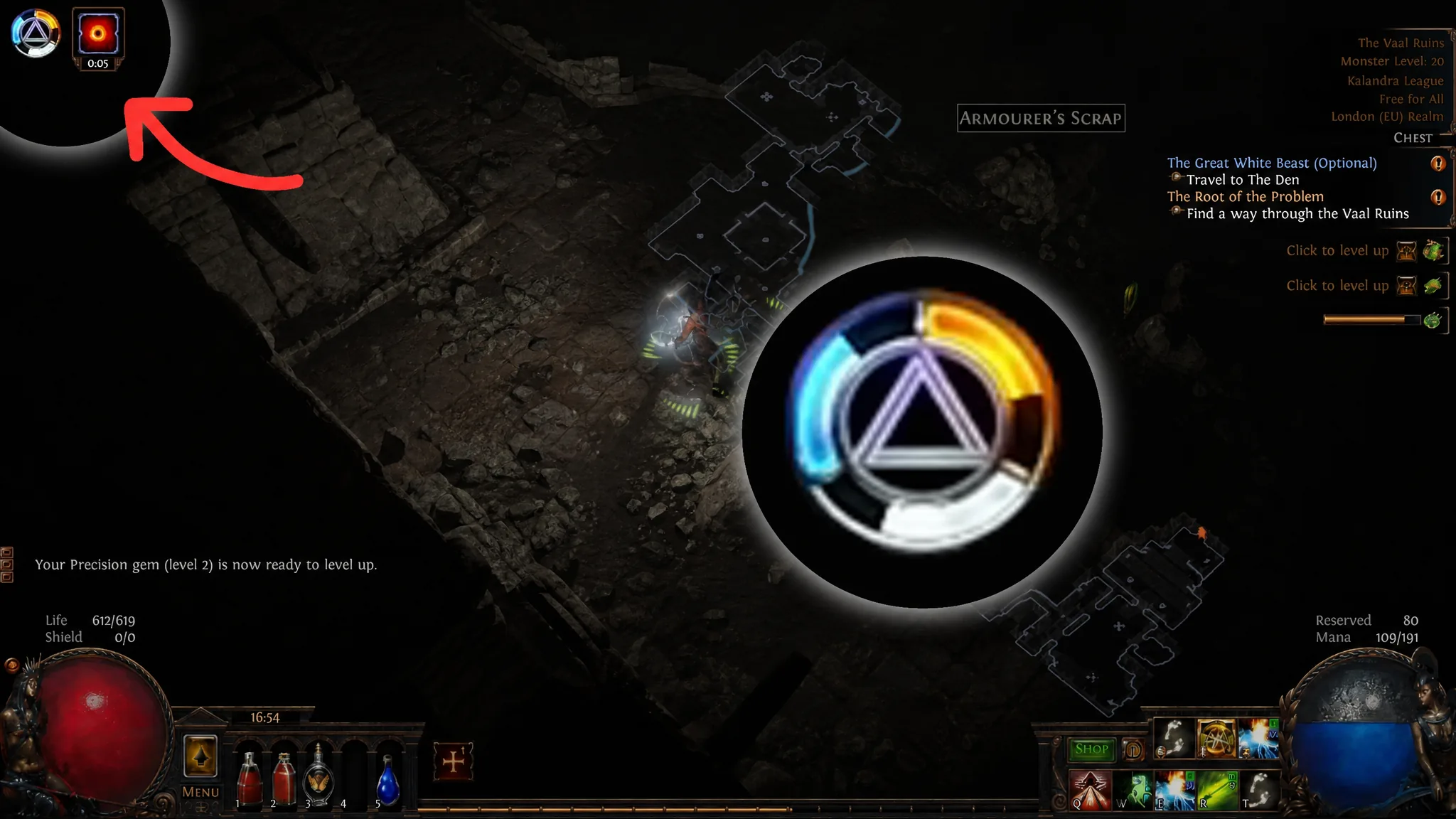
How Trinity resonance builds and decays
Once Trinity is linked to a skill, a three-part circle appears in the top-left corner of the screen where your buffs sit. The blue slice tracks Lightning, the orange slice tracks Fire, and the white slice tracks Cold. Each element holds a maximum of 50 Resonance.
Every time a supported hit deals more of one element than the other two, you gain 25 Resonance per second of the other two elements over 2 seconds. Physical and Chaos damage are ignored entirely. So a hit whose highest type is Cold feeds Fire and Lightning, a hit topped by Lightning feeds Fire and Cold, and so on. Whichever element you are not currently gaining bleeds off at 5 Resonance per second, which is why standing still on a single element type causes the other meters to drain.
The payoff scales off your lowest meter, not your highest. Supported skills deal 3% More Elemental Damage per 5 of the lowest Resonance, capping at 30% More when all three sit at 50. Separately, once every meter is at least 25, supported skills gain up to 16% Elemental Resistance penetration based on gem level. That dual scaling, a “more” multiplier stacked with penetration, is what makes Trinity worth the socket.
The two-element rule and damage-range overlap
You only need two elemental damage types to keep all three meters full. The reason is the decay math: as long as one type is always winning the highest slot and it keeps switching between two options, both of those elements pass resonance to the third, and the pair themselves stay fed because whichever loses the roll still receives resonance from the other.
The condition that makes this reliable is overlapping damage ranges. Open the skill tooltip and check the added elemental damage lines. If the two elements have similar average (mean) values, each cast has a real chance of either one rolling highest, so the winner alternates naturally and the gauges refill before decay eats them.
If one element always out-rolls the other, Trinity stalls. For example, a skill dealing 8 to 1,000 Lightning next to a fixed 1,200 to 1,500 Cold will always favor Cold, so Lightning never wins and its partner resonance never builds. Pull the two ranges close, say 350 to 650 Cold against an average near 500 Lightning, and the highest type flips hit to hit, keeping you parked at 50/50/50. Lightning is the easiest anchor here because it has the widest roll variance of any element, giving it plenty of natural overlap with a steadier partner.
Lightning paired with Cold is the cleanest combo. If you build around Fire as one of your two elements, favor the Scorch ailment over Ignite so your damage handling stays consistent with the resonance loop.
Skills and items that sustain Trinity automatically
The most hands-off way to feed Trinity is a prismatic skill. Wild Strike and Elemental Hit convert their damage to a random element on every hit and never pick the same element twice in a row. As long as you attack at least twice within two seconds, the element rotates and every meter stays topped up without any tuning.
If your skill deals a single element, conversion gear turns it into a two-element hit. Unique rings and weapons do most of the heavy lifting here.
| Item / Skill | Effect | Use it for |
|---|---|---|
| Wild Strike | Converts all damage to a random element each hit | Physical-weapon melee, effortless sustain |
| Elemental Hit | Deals only the chosen element, rotating each hit | Attack builds wanting automatic rotation |
| Pyre (ring) | Converts 40% of Cold Damage to Fire | Cold skills needing a second element |
| Call of the Brotherhood (ring) | Converts 40% of Lightning Damage to Cold | Lightning skills needing a second element |
| Voidforge / Fulcrum / The Stormwall | Adds or converts damage to extra elements | Melee builds shaping their spread |
| Elemental Aura (e.g. Wrath) | Adds flat elemental damage to your hits | Balancing a lagging element type |
Auras are the quiet advantage. If one element runs far ahead of the others, layering in an aura such as Wrath adds flat Lightning to help a Cold- or Fire-heavy build reach the overlap it needs. Rare martial weapons with added elemental damage, or those converting a percentage of Physical, can achieve the same balance without spending a unique slot.
Skill types that break Trinity
Trinity only works with hit skills you use yourself. If a meter refuses to build no matter how you tune your damage, the skill is probably one Trinity cannot support. It ignores the following.
- Triggered skills, such as anything on Cast when Damage Taken or Cast on Critical Strike
- Instant skills like Vortex or Frostblink
- Orb skills, including Orb of Storms and Tornado
- Brands and skills with a reservation
- Skills used by totems, traps, mines, or minions
As a rule, if it is a hit-based skill you cast or attack with directly, Trinity applies. For the cleanest sustain, pick a skill that deals pure elemental damage with no Physical or Chaos component diluting the roll.
How to confirm Trinity is sustained
Watch the tripartite circle while you fight. When Trinity is fully sustained, all three slices stay filled and none visibly drains between hits. At 50/50/50 you are getting the full 30% More Elemental Damage, and once every slice holds at least 25 you also have the 16% penetration active. If one slice keeps sliding toward empty during combat, that element is losing the highest-damage roll every hit, so tighten the overlap between your two damage types or add a conversion item from the table above.
Coming from Path of Exile 2, the loop runs in reverse, but the version in Path of Exile is the more forgiving of the two. Two well-matched elements and a steady attack rhythm are all it takes to keep the meters pinned and both damage layers online.