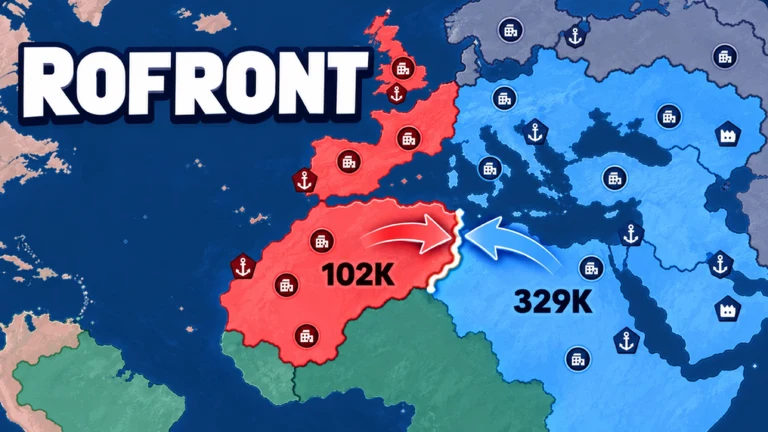
RoFront is a real-time strategy game on Roblox that turns a world map into a single, continuous land grab. You start as one nation sitting on a single tile, then push your borders outward by claiming empty ground, attacking neutral tribes, and eventually swallowing rival player nations. It borrows its map and core loop from Open Front, and everything happens live on a shared server rather than in turns.
Quick answer: RoFront is a top-down conquest game where you expand one nation across a world map, build an economy, and win a match by controlling 80% of the world.
The win condition: 80% world control
Each match ends when one nation holds 80% of the global map. That single number shapes everything else. A server can host up to 88 player nations plus hundreds of smaller tribes, so reaching that threshold means absorbing most of the players around you, not just defending a corner of the map. There is no points table or timer to wait out. You either push your share of territory toward 80% or you get eliminated along the way.
Elimination is immediate and final for that match. If your capital and territory are taken, the screen reads “ELIMINATED – YOUR NATION HAS FALLEN,” names the nation that conquered you, and drops you back to the lobby to play again.
Choosing a spawn and expanding early
Every match opens on a “CHOOSE YOUR STARTING LOCATION” map where you pick an unclaimed tile to drop your capital. Highland and mountain tiles are common early picks. Once “THE WAR BEGINS” appears, expansion is driven by clicking adjacent unclaimed land. Each claim spends a small number of troops to extend your border by a ring of tiles, and the circle of your territory widens with every click.
Neutral tribes sit between the player nations and make up the earliest targets. Groups like Cinderfell, Valeward, Pinewatchers, and Skykin can be attacked directly from the map, with a prompt appearing when a tribe borders your land. Taking these smaller, weaker neighbors early adds territory quickly without draining the troop reserves you would need against a full nation.
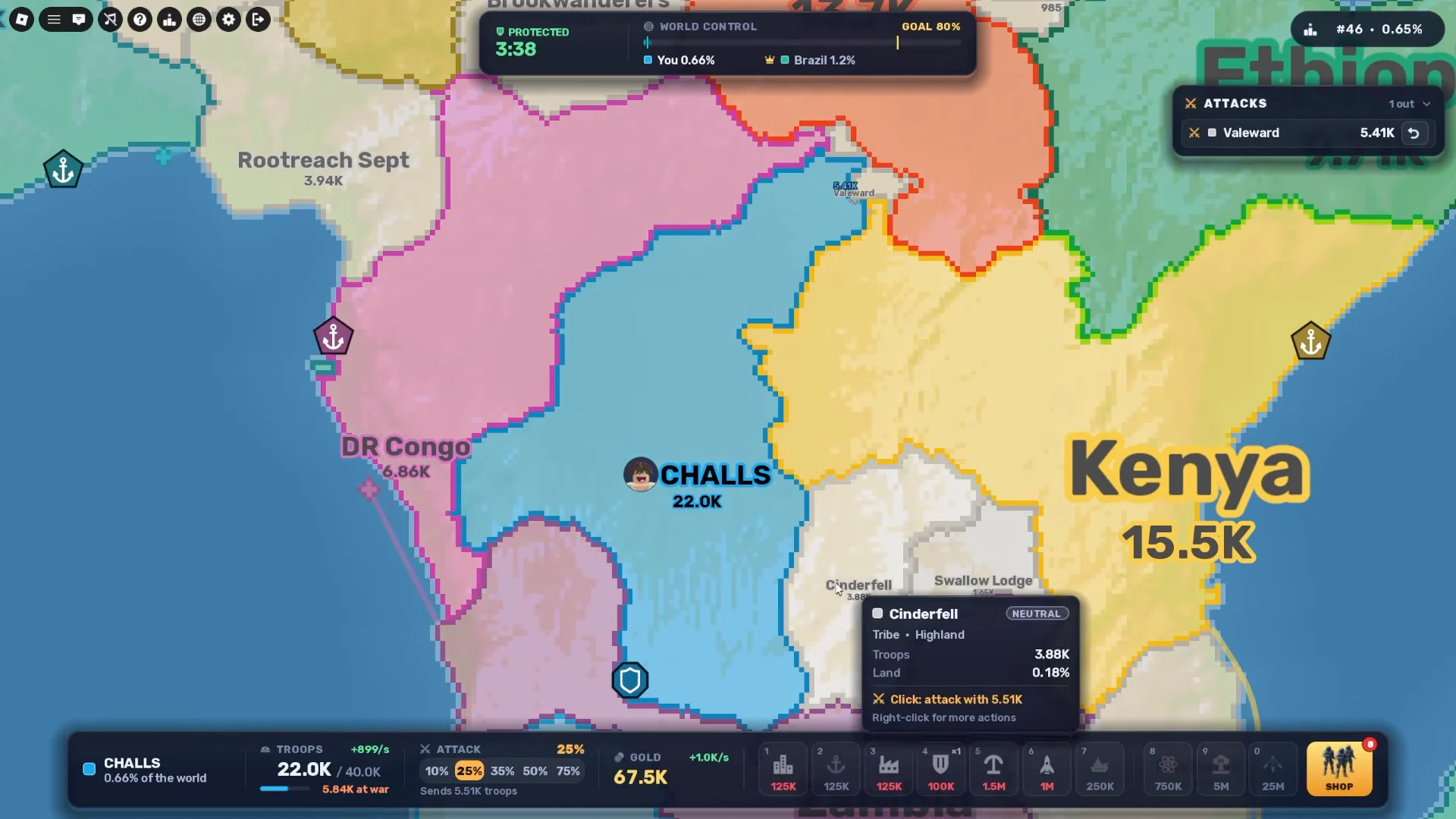
Your own stats banner tracks the terrain you command, labeled as Commander across Highland, Mountains, and Plains. Different tile types feed into the land you are holding, and the capital itself is marked on the map by your Roblox avatar face icon rather than a walking character. This is a 2D map game, not a game you move through on foot.
The economy: factories and cities
Gold is the resource behind every building and upgrade, and it comes from infrastructure you place on your own land. Factories act as road hubs that spawn delivery trucks, and those trucks pay out gold each time they complete a route across friendly territory. The more connected your road network, the more passive income rolls in. A first Factory costs 125K gold and scales up through higher tiers.
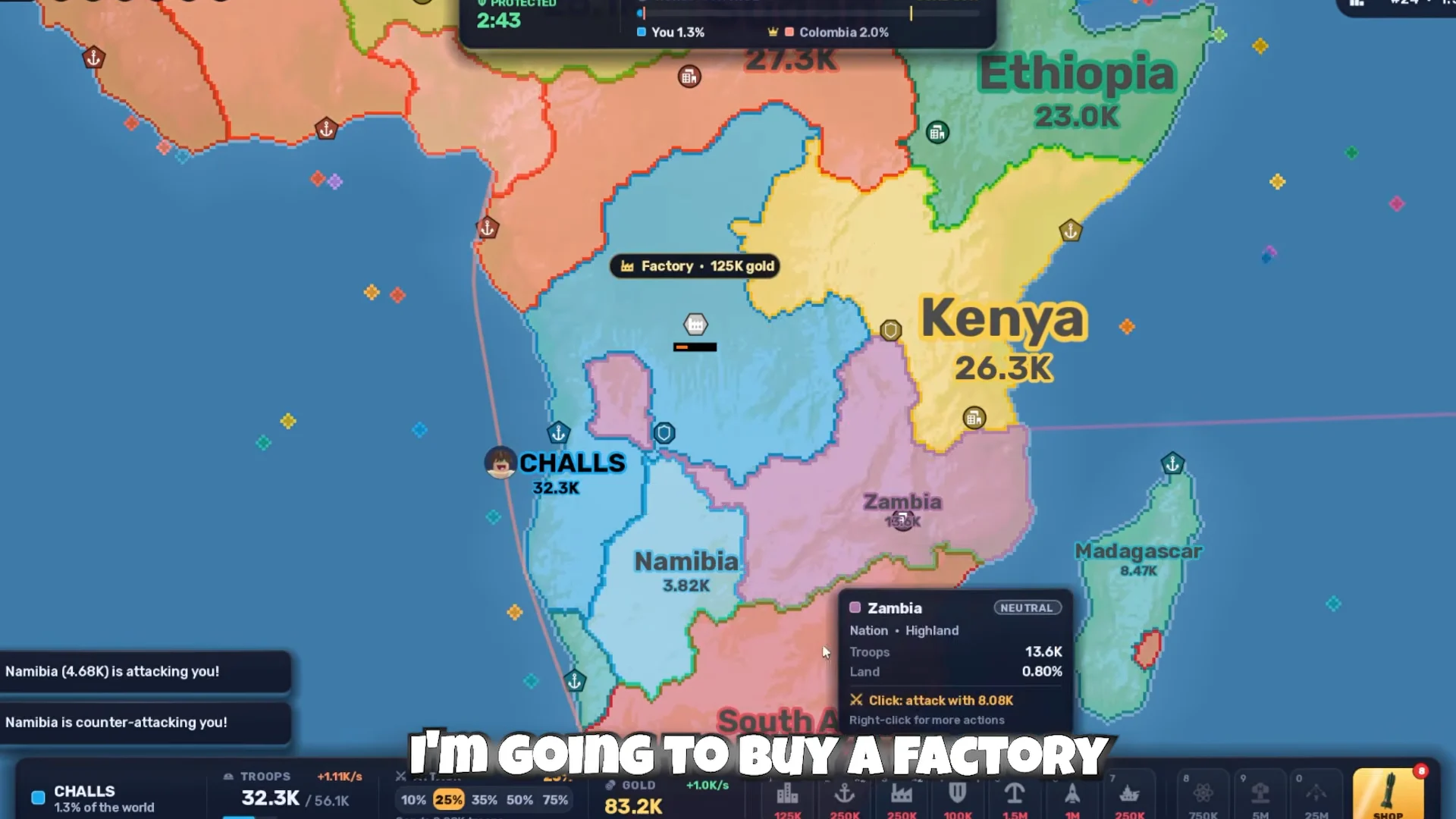
Cities raise your troop cap, which sets how large your army can grow, and they also tie into the same road network as factories. Both structures upgrade through three tiers, so a single well-defended inland city or factory can be pushed to Level 2 or Level 3 instead of spreading many weak buildings across exposed borders. Here is how the main structures and their costs line up.
| Structure | Cost | Effect |
|---|---|---|
| Factory | 125K–1M gold | Road hub; trucks pay gold along routes |
| City | 125K–1M gold | Raises troop cap; joins road network |
| Defense Post | 50K–250K gold | Slows attacks within 30 tiles |
| Warship | 250K–500K gold | Patrols seas; sinks transports |
| Port | 1M gold | Sends trade ships; builds warships |
| Missile Silo | 1M gold | Required to launch nukes |
Defense posts and how they slow attackers
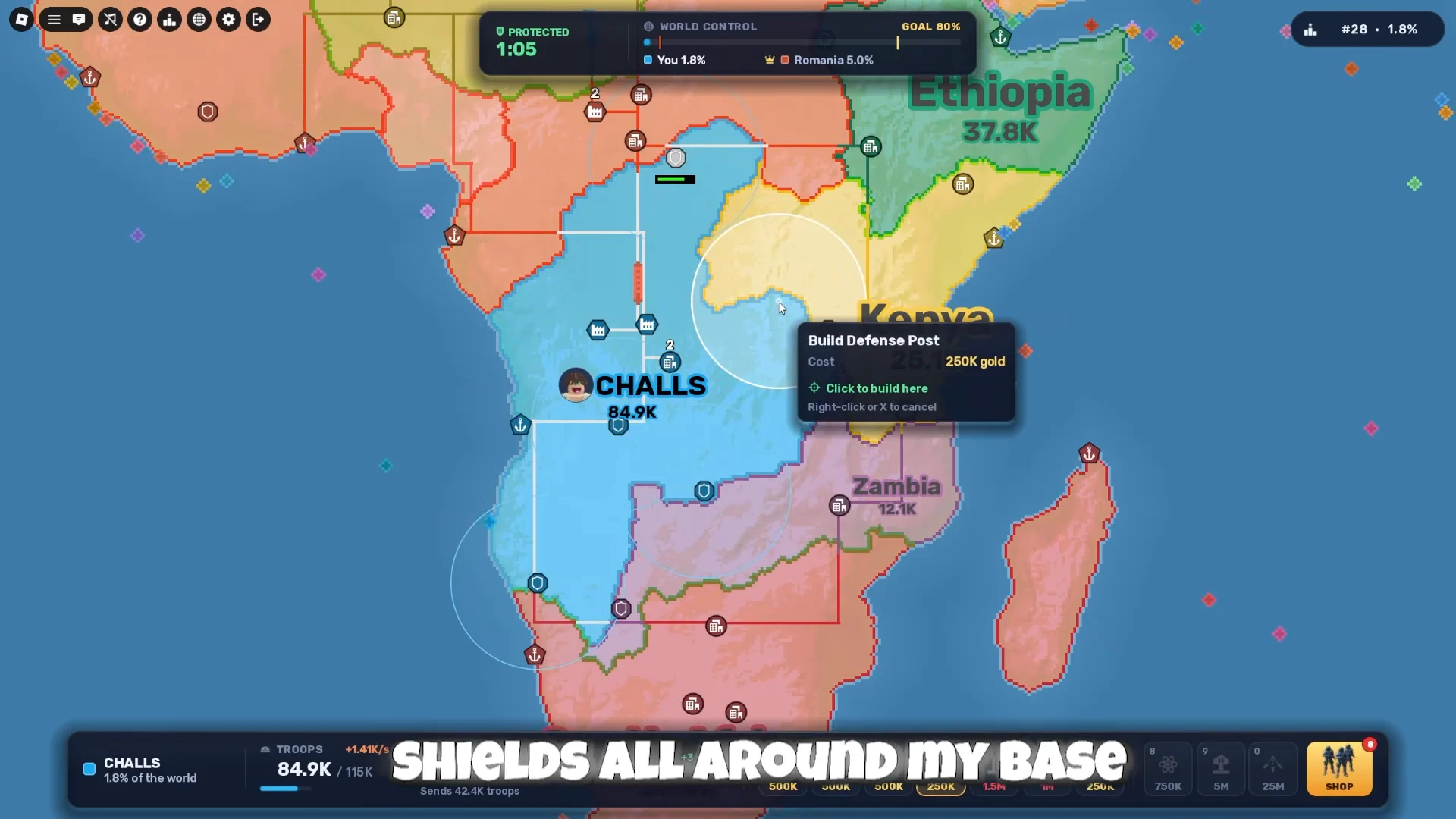
Defense Posts are the main tool for holding a border. Any enemy attack against land within 30 tiles of a post costs the attacker 5x the troops and 3x the time, which turns a thin frontier into a serious obstacle. Posts range from 50K gold at the lowest tier up to 250K for the strongest, and several placed along a threatened edge can blunt or outright deflect a counter-attack.
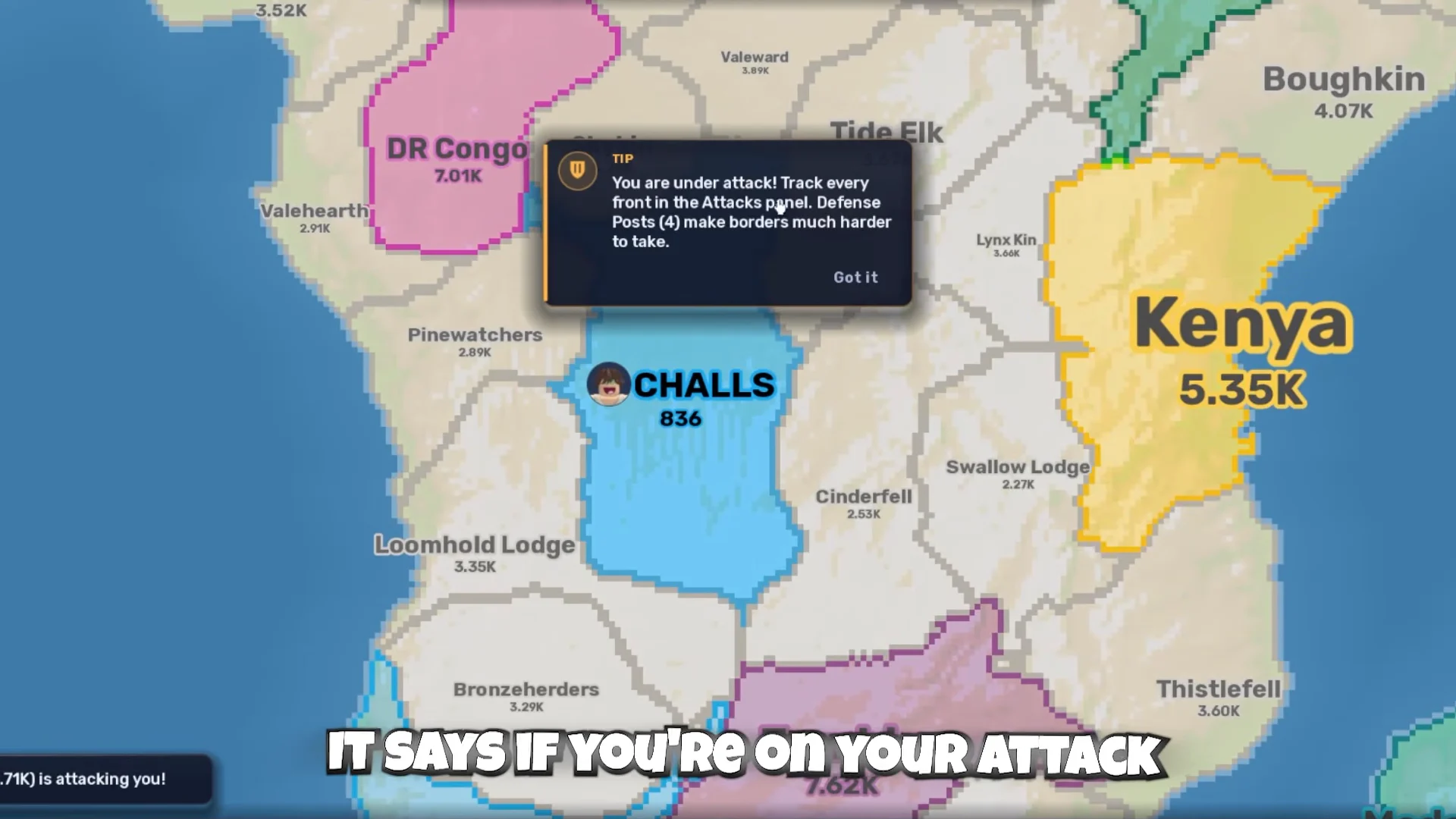
The game actively warns you when a border is in danger. A notification card reading “TIP: You are under attack!” flags an incoming assault, and the attacks panel lists each front so you can see where pressure is building before committing troops or stone.
Placing posts is done straight from the build menu onto your own tiles, and the map shows shield icons marking where each one sits along the frontier.
Troop deployment controls
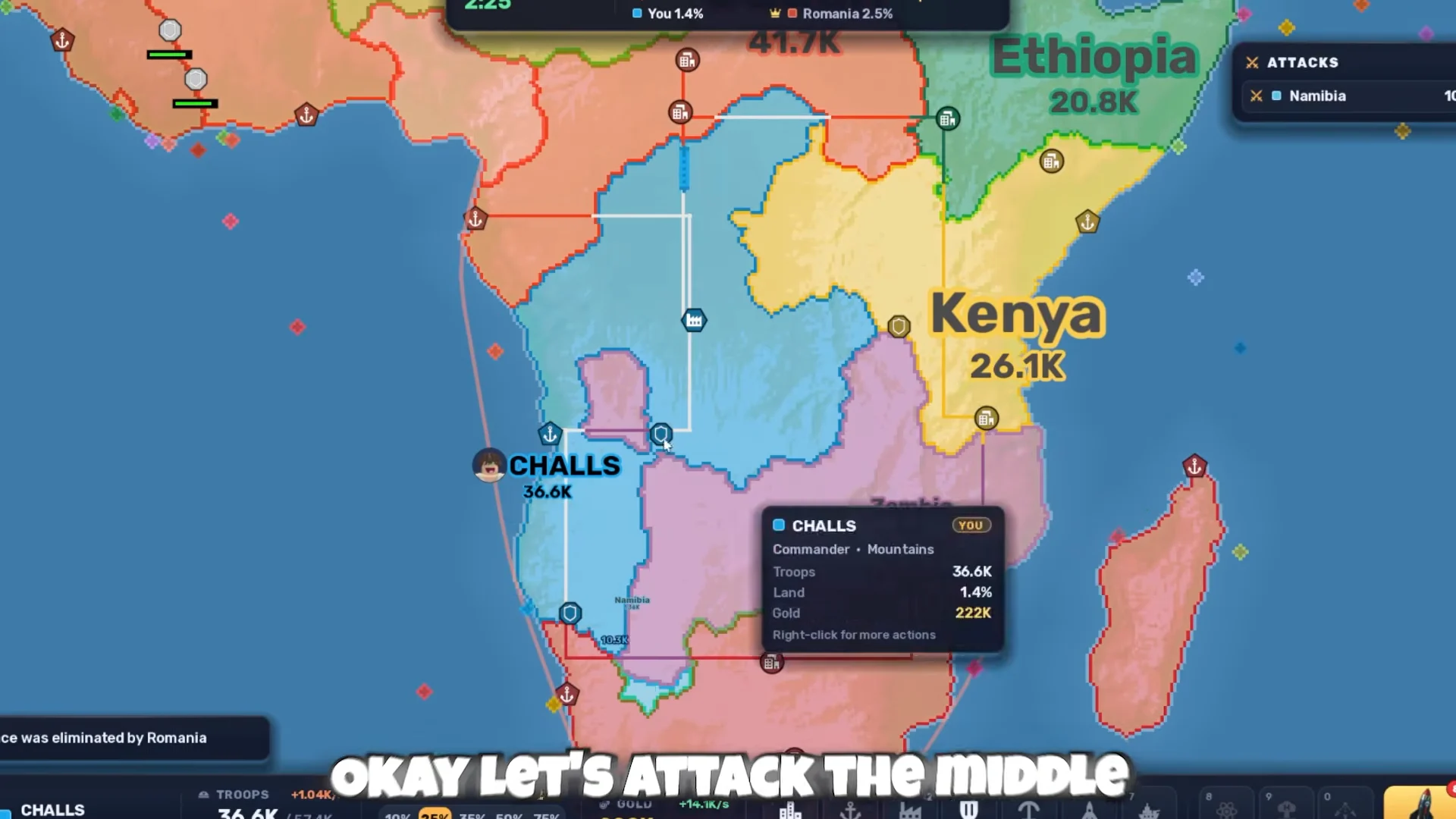
Attacks do not use your whole army by default. A panel along the bottom of the screen sets how much of your current strength to commit, with options of 10%, 25%, 35%, 50%, and 75%. Smaller percentages let you nibble at weak tribes while keeping reserves at home, and larger commitments are meant for fortified nations that need overwhelming force.
A heavily defended nation like Sudan can absorb a 75% assault and still inflict heavy losses, so troop management is as much about recovering and rebuilding as it is about the initial push. Troops regenerate against your cap over time, which is where extra cities pay off.
Going to sea: ports, warships, and invasions
Reaching a coastline changes the game. Once your border touches the sea, a prompt appears (“You reached the sea.”) that lets you send troop transports across open water to land on distant or neighboring coasts. That is how a landlocked African empire can jump to targets like Namibia, or later stage an amphibious landing into Chad, without a direct land route.
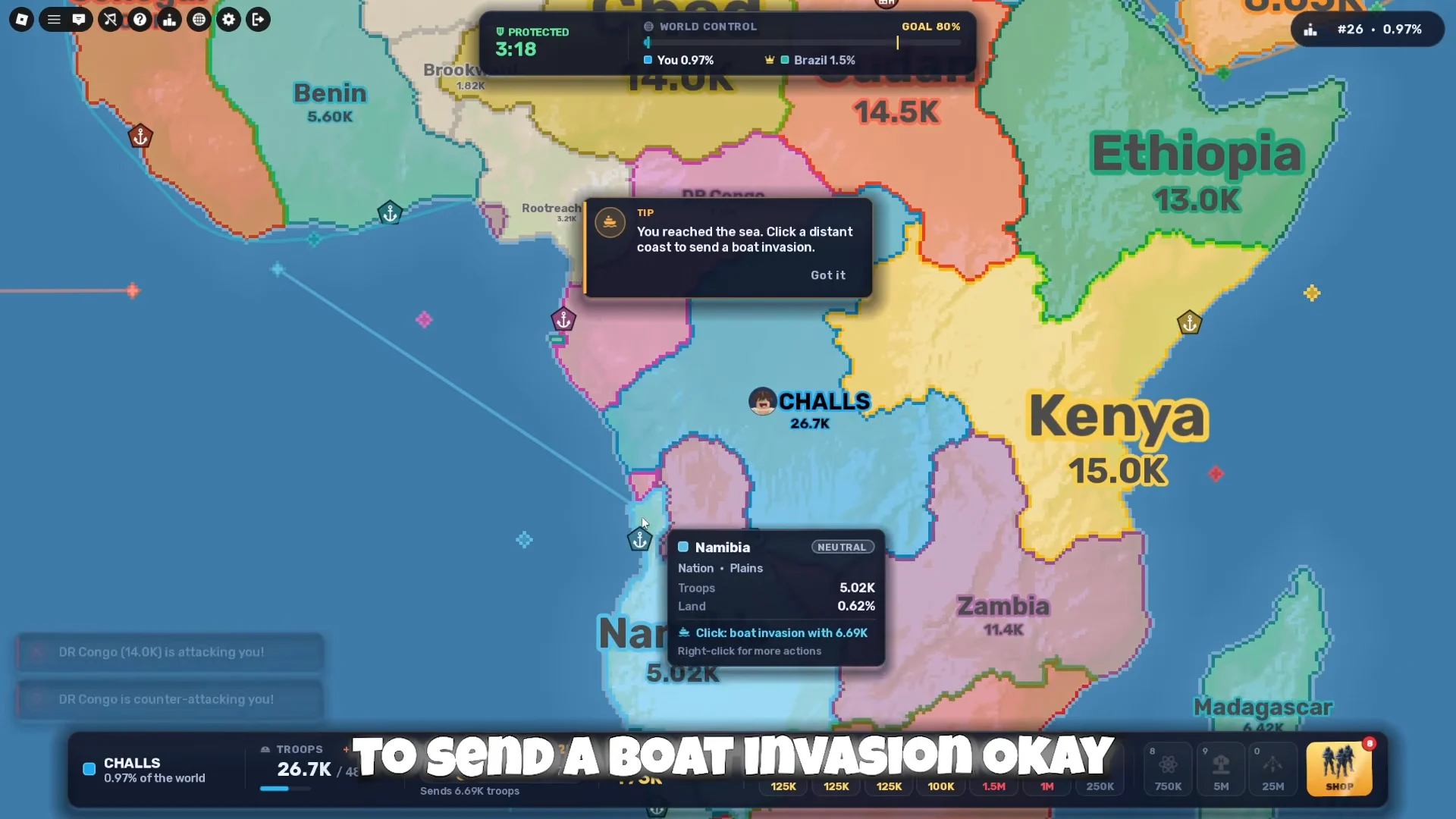
Warships patrol wherever you send them. They sink enemy transports first, then enemy warships, capture trade ships, and shell enemy coasts, and they heal when sitting over your own land. A Warship costs 250K gold at its base tier. Ports, at 1M gold, sit on coastal land and do double duty by sending out trade ships for gold and building warships of their own.
Missile silos and alliances
At the top end of the tech, a Missile Silo costs 1M gold and is required before you can launch nuclear weapons. It is a late-game purchase, sitting alongside the Arsenal of warheads and support strikes the game offers, including options such as a Mega Nuke, Scattershot, Artillery, Air Strike, and Railgun.
Diplomacy runs parallel to all of this. Neighboring sovereign nations can send alliance requests, and accepting one protects a shared border from that partner’s aggression. Securing a flank with an alliance, then throwing full strength at a different front, is a common way to avoid being attacked from two sides at once while you expand.
An alliance only holds for as long as both nations keep it, so it covers one border rather than the whole map. The rest still needs defense posts and troops.
Where to play and current status
RoFront [World PvP] is made by Torrey Pines and runs on servers of up to 30 players, with matches filling out to 88 player nations and hundreds of tribes. It released on September 27, 2026, has been updated since, and currently sits around a 77% satisfaction rating with more than 7 million visits. You can open it from its Roblox game page, which also offers a Play Solo mode with Relaxed, Standard, and Brutal difficulty settings for practice away from live opponents.
Taken together, the loop is straightforward to describe and hard to master. Expand into cheap land early, convert that territory into gold through factories and cities, wall off your borders with defense posts, and only then reach for the sea and the silo. The 80% target is the finish line that keeps every one of those systems pointed in the same direction.