The June 2026 update for Windows 11, shipped as KB5094126 (Build 26200.8655 on 25H2 and 26100.8655 on 24H2), is the biggest release of the year. It also has a rough side. After installing it, some PCs refuse to boot and drop into a black screen or BitLocker recovery, OneDrive stops opening from File Explorer, certain business apps lose Word integration, and a handful of machines see slow logins and services that never start.
Quick answer: If your PC won’t boot after KB5094126 (a 0xc0430001 black screen or a BitLocker recovery loop, mostly on HP hardware), enter BIOS, turn off Secure Boot, boot to Windows, let the update finish, then re-enable Secure Boot. Have your BitLocker recovery key ready before you start.
KB5094126 boot failures: 0xc0430001 BSOD and BitLocker recovery
The most serious problem hits at startup. After KB5094126 installs, affected machines either show a Black Screen of Death with error 0xc0430001 or get pushed into BitLocker recovery, sometimes in a loop that doesn’t clear even after you type the recovery key. The common thread is HP hardware, though some Dell models are also reported.
Devices that have run into the boot failure include the following:
| Vendor | Models affected |
|---|---|
| HP | EliteBook 840 G10, ProBook 460 G11 / 460 G11, Engage One Pro 15.6 G2 AiO POS, ZBook |
| Dell | Precision, Precision 7530 |
Owning one of these models doesn’t guarantee a failure. The crash depends on how the firmware and the EFI/System partition are set up, so two identical-looking machines can behave differently.
Why KB5094126 breaks startup on some PCs
KB5094126 turns on the Secure Boot certificate update for most supported PCs, and that process touches Secure Boot files, certificates, Boot Manager, and EFI contents. On systems with a small EFI partition, often the older 100MB layout instead of a newer 500MB to 1GB one, Windows can’t write the files it needs. When that write fails, Secure Boot blocks Windows from loading, which produces the 0xc0430001 black screen. If BitLocker is on, you land in recovery instead.
HP machines are more exposed because HP stores firmware recovery files under the EFI partition, in paths like EFIHPDEVFW, which eats into the limited space. So the real bottleneck is usually a small or crowded EFI partition combined with an outdated BIOS, not the SSD or the Windows install itself. If you can boot, open Event Viewer and you’ll likely see TPM-WMI errors, including one that reads “The secure boot update failed to update Boot Manager (2023) due to the error: insufficient disk space.”
A separate boot loop showing DPC_WATCHDOG_VIOLATION has also been reported, where removing the update lets the PC start normally again.
Fix a PC that won’t boot after KB5094126
Disabling Secure Boot is the workaround that has reliably brought affected machines back. Do not skip the backup step, because you may be prompted for your BitLocker key during the process.
You’ll know it worked when the machine boots straight to the sign-in screen without dropping into recovery or the black screen. Also update your BIOS/UEFI to the latest version, since a mismatch between firmware and the Windows Secure Boot update is the likely trigger. If the steps above don’t hold, leave Secure Boot off until HP or Microsoft addresses it.
Tip: After you’re back on the desktop, check free space on the EFI partition. Some PCs with a tight EFI partition keep failing until it’s resized, so giving it room can prevent a repeat. You can grab the standalone package from the Microsoft Update Catalog if you need to reinstall the patch manually.
Boot from install media: missing boot.stl and error 0xc0430001
If you’re deploying images and using the accompanying dynamic updates (KB5094149, KB5095971, and KB5094156), the same 0xc0430001 error can appear when a PC boots from a USB installer or ISO. The cause there is a missing boot.stl file on the installation media. Secure Boot uses this file to verify the boot files are trusted, and it must match the same Windows version and architecture.
The cleanest fix is to run the Update WinPE script, which refreshes the image and handles the required files automatically. Alternatively, copy boot.stl from the WindowsBootEFI folder of a working Windows device into the matching folder on your media before redeploying.
KB5094126 breaks OneDrive in File Explorer
On some PCs, OneDrive stops opening from File Explorer after the update. Click OneDrive in the left pane, the tray icon, or an existing shortcut, and nothing happens. The same behavior shows up for Dropbox and iCloud Drive, though less widely than OneDrive.
Your files aren’t lost. If you navigate manually to C:Usersusername and open the cloud folders there, they load fine. It’s only the File Explorer sidebar and tray shortcuts, the routes most people use, that fail. The problem appears to break Explorer’s cloud storage shell integration, and it shows up most on systems with UAC disabled and a local admin account.
The reliable fix is to turn User Account Control back on. Administrators tracing this in their environments found that the combination of disabled UAC plus a local admin account is what breaks OneDrive in Explorer, and re-enabling UAC restores it even with KB5094126 still installed. Switching to a Microsoft account alongside UAC also helps. You’ll know it’s resolved when clicking OneDrive in the sidebar or tray opens the folder normally again. Updating OneDrive on its own has not shown a clear fix.
Word integration broken in business apps
KB5094126 also breaks Microsoft Word integration in some line-of-business software. Word itself still opens documents normally. The failures hit apps that embed Word, automate it, or open Word documents inside their own document or workpaper system. Dental and accounting tools are the most affected categories.
Programs reported with this problem include:
- Dentrix
- Softdent
- CCH ProSystem fx Engagement
- CCH ProSystem fx Workpaper Manager
- Older Eaglesoft / SmartDoc
- Neurology software that uses Word
Slow logins, app launch delays, and service start timeouts
A different set of machines runs fine at boot but feels sluggish afterward. Background services fail to autostart, the Event Log records timeouts like “A timeout was reached (45000 milliseconds) while waiting for the [service] service to connect,” and the first login after a reboot lands on a black screen where the desktop and taskbar take tens of seconds to appear. The first UAC prompt and the Settings app also stall on the first open, then behave normally afterward. UWP and modern-platform apps are hit hardest, while standalone Win32 programs usually open instantly.
This traces back to the new Low Latency Profile that ships in KB5094126, which briefly spikes the CPU to speed up app launches and shell experiences such as the Start menu, Search, and Action Center. On some setups it has the opposite effect at startup. Turning the feature off has restored normal boot and login times, cutting one reported case back from roughly three minutes to about 30 seconds.
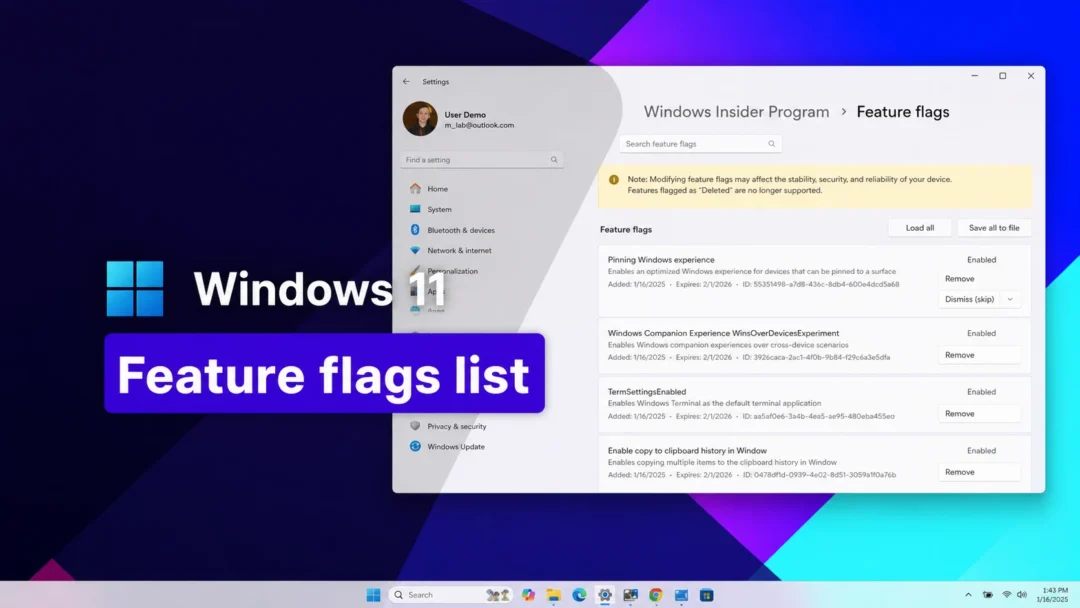
The Low Latency Profile is controlled by feature flag 58989092. Disabling it removes the startup delay. After applying the change and rebooting, services should autostart on their own again and the desktop should load without the long black-screen wait.
Should you uninstall KB5094126?
KB5094126 is a security update that patches up to 200 flaws, including critical and zero-day bugs, so removing it leaves your PC exposed. Treat uninstalling as a temporary measure if a workaround above doesn’t apply to your situation. For the boot failures, disabling Secure Boot, updating the BIOS, and freeing up the EFI partition is the safer path because it lets you keep the security fixes. For the OneDrive issue, re-enabling UAC fixes it without touching the update at all. You can review the full change list on the official KB5094126 support page before deciding. Microsoft has not formally acknowledged these problems yet, so keep an eye on Windows Update for a follow-up fix.